
Recirculating Cooling Water: 1.7% Make-Up, Losses in Pumps and Water

founder and CEO of Cold Energy (NCT)
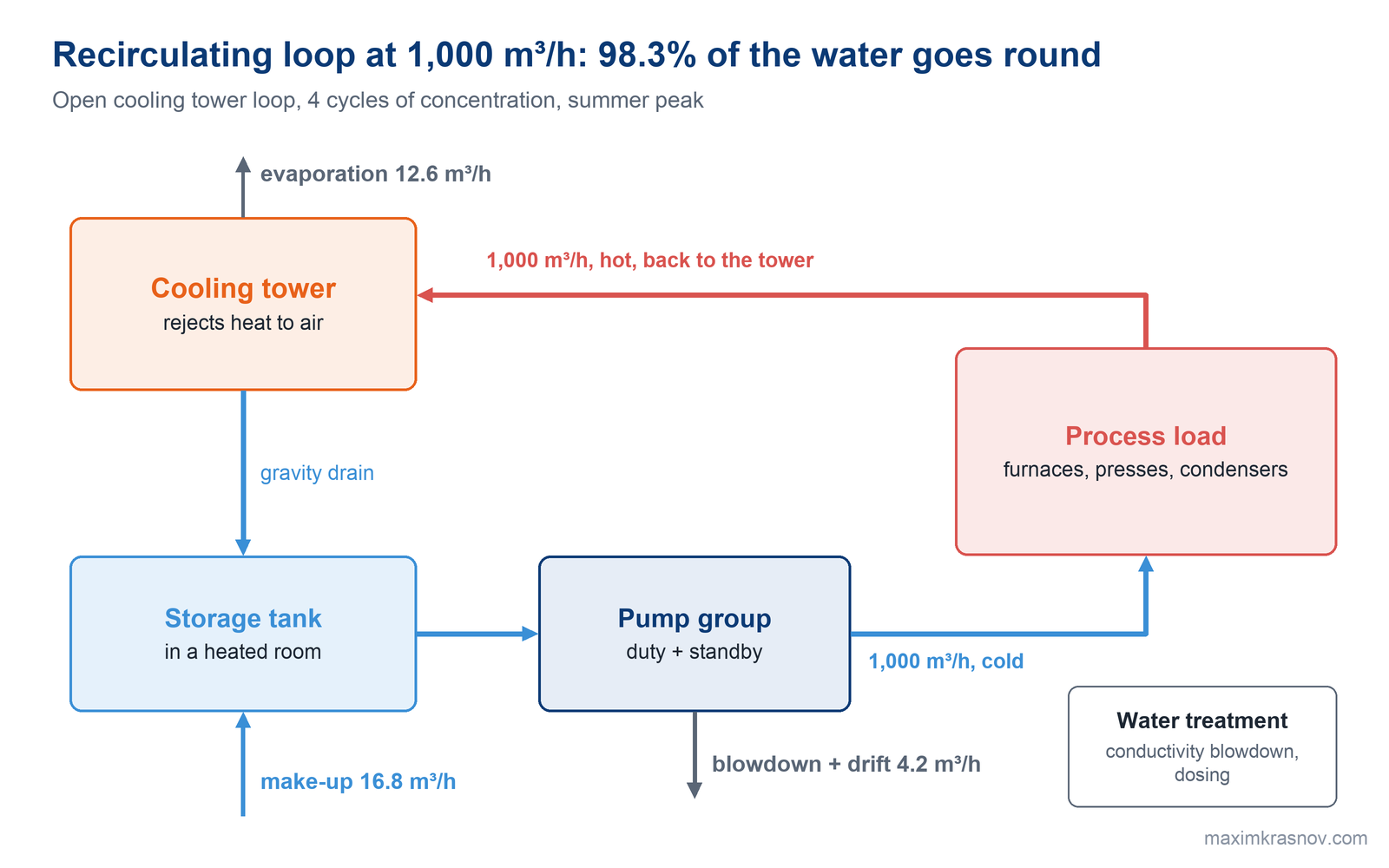
A recirculating cooling water system is one where the cooling water goes round in a loop: it picks up heat from the equipment, rejects it in a cooling tower or dry cooler and comes back. On a 1,000 m³/h loop the plant buys in about 16.8 m³/h, or 1.7% of the flow, to cover evaporation and blowdown. Such a system loses money not on water but on pumps, dirt in the loop and design mistakes.
This article is for the owner and the chief engineer of a plant where recirculating water cools furnaces, presses, chiller condensers, reactors or test benches. The numbers come from our calculations and sites; money is at RUB 10 per kWh. More on cooling costs is in the energy efficiency section.
Why is recirculating cooling water better than once-through cooling?
A recirculating system draws roughly 115 times less water from the source. A once-through system takes water, passes it through a heat exchanger and discharges it: on a 1,000 m³/h loop running 8,000 hours, that is 8 million m³ a year. A recirculating loop with a cooling tower at four cycles of concentration sends the water round and, on a real load profile, takes about 69 thousand m³ of make-up a year.
An open loop cannot run without make-up: the cooling tower cools by evaporation, and part of the water leaves as vapour. Evaporation cannot be reduced; only blowdown can. How to calculate each stream I covered in how much water a cooling tower uses.
If there is no water on site, the loop is made dry, on a dry cooler: it needs no make-up, so there is nothing to pay for a water connection or water use. How to choose between the two is in cooling tower or dry cooler.
What does a recirculating cooling water system consist of?
A recirculating cooling water system is the unit that rejects heat (a cooling tower, a dry cooler or a chiller) plus the hydraulic package around it. It is not the cooling tower that moves water round the loop but the package: pumps, tanks, make-up, filters, water treatment. Every loop has five jobs: move the water and hold its volume, pressure, cleanliness and chemistry.
| Component | What it does | Where it sits |
|---|---|---|
| Pump group | Delivers design flow and head, holds standby | Between the tank or basin and the load; in a closed loop, on the return ahead of the machine |
| Storage tank | Holds reserve water for load surges and make-up interruptions, takes the water from the pipes at shutdown | Next to the cooling tower or instead of its basin, often in a heated room |
| Buffer tank | Adds volume so the machine does not start too often | On the return ahead of the chiller |
| Expansion vessel | Takes up volume growth on heating and holds closed-loop pressure | On the pump suction, at the lowest-pressure point |
| Make-up | Replaces evaporation and blowdown, or small leaks | Open loop: into the tank through an air gap; closed loop: into the expansion vessel line |
| Filtration | Catches suspended solids, scale, debris | Ahead of the pump or heat exchanger, on a side stream, on the make-up |
| Water treatment | Keeps the water free of scale, corrosion and biofouling | Control, dosing and blowdown panel |
| Controls | Switches in standby, holds differential pressure, runs make-up and blowdown | Pump group panel and water treatment controller |
Mistakes in this package look like machine faults: the chiller trips on the flow switch, the cooling tower scales up, glycol turns into a weak solution after one season. The package is designed together with the machine, not after it: tank volume, pump head and the water treatment scope depend on which unit is installed and in which loop.
Open or closed loop: which to choose?
An open loop is a cooling tower loop where the water is in contact with air; a closed loop carries water or glycol under pressure with no air contact: a chiller loop, a dry cooler loop or the coil of a closed-circuit cooling tower. The choice drives make-up, water treatment and pump head.
| In the package | Open cooling tower loop | Closed loop |
|---|---|---|
| Make-up | Continuous, cubic metres per hour: evaporation plus blowdown | Close to zero; rising make-up means a leak |
| Pump head | Loop resistance plus lifting water to the fill | Loop resistance only |
| Water treatment | Conductivity-controlled blowdown, inhibitor and biocide dosing | Treated make-up, inhibitor, glycol monitoring |
| Where trouble comes from | Scale, airborne solids, biology, corrosion | Oxygen with every top-up, galvanic couples, glycol ageing |
| Freeze protection | Water in a heated tank, basin heating, draining | Glycol at the right concentration |
Most plants run both loops at once. A typical example is a water-cooled chiller: the evaporator sits in the closed chilled water loop, the condenser in the open cooling tower loop. Each loop has its own pump group, its own tanks and its own water treatment. A closed loop must not be topped up from the open loop: concentrated salts and biology will go with it.
We recently finished such a system at a powder metallurgy plant: 4.6 MW of cooling with water at +7/+12 °C. In summer a Thermax absorption chiller runs, and three NCT cooling towers with centrifugal fans cool its water from +32 to +25 °C. In winter the machine stands idle, two cooling towers cool water from +12 to +7 °C and pass the cooling to production through heat exchangers. The package included an NCT pump group, design, supply and commissioning by us.
How much electricity do the pumps use, and where is the overspend?
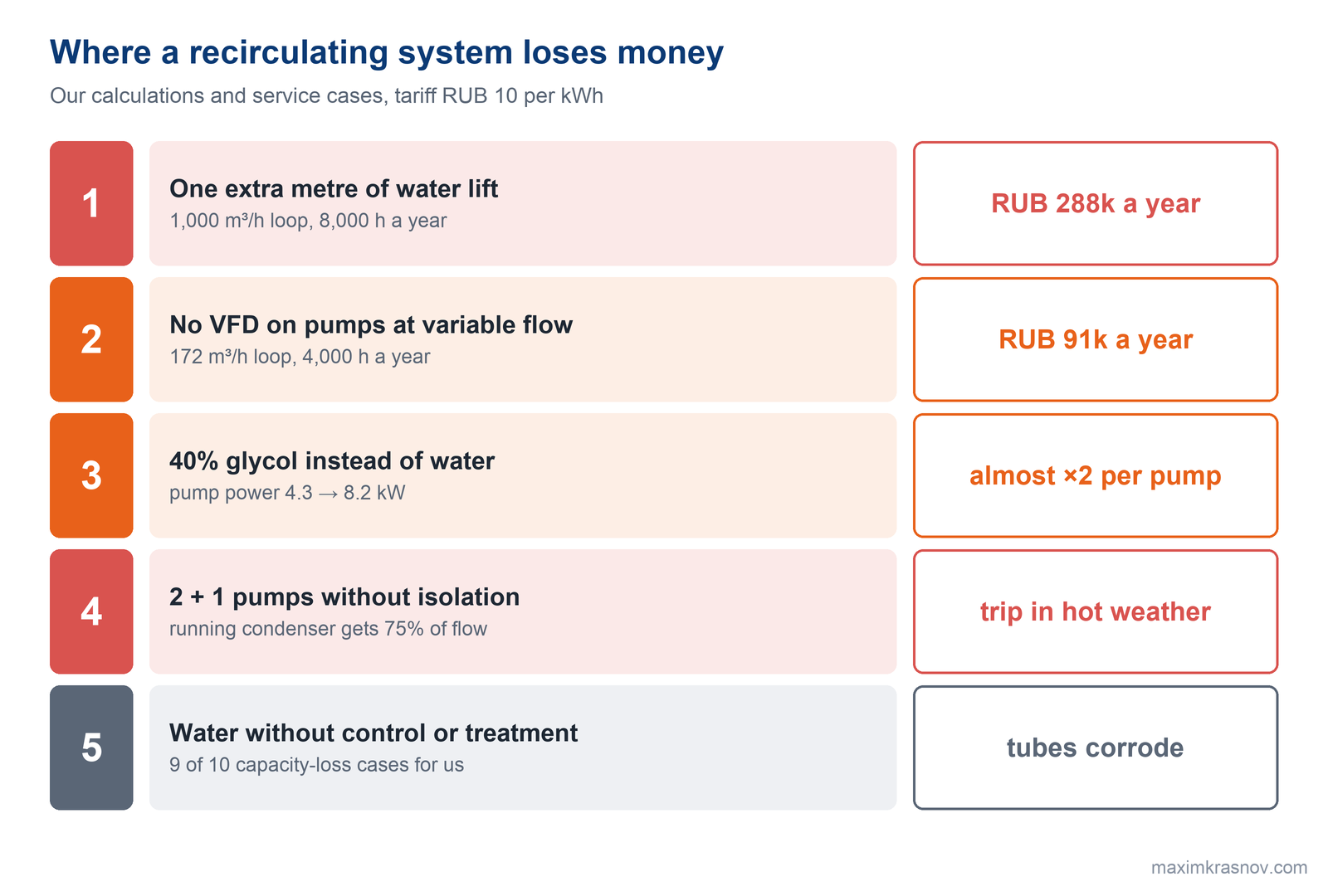
The biggest overspend is on extra water lift, pumps without variable frequency drives (VFDs) on variable flow, and glycol without re-sizing the pumps. Pumps run every hour the plant runs, so each extra metre of head is paid for all year round.
1. A tank set lower than it needs to be. In an open loop the pump lifts water from the tank water level to the cooling tower fill. On a 1,000 m³/h loop each metre of elevation difference costs about 3.6 kW. At 8,000 operating hours that is about RUB 288 thousand a year for a single metre. Set the tank as high as gravity drainage from the cooling tower basin allows.
2. A pump without a VFD where the flow varies. A VFD saves only if the flow in the loop is variable, and only with a differential pressure sensor at the most remote load. On a 172 m³/h secondary loop at 4,000 hours a year, pumps without a VFD use 30,700 kWh; with a VFD and the sensor at the pump group, 27,100 kWh; with the sensor on the remote branch, 21,600 kWh. That is 30% less and about RUB 91 thousand a year on one loop. On a process site with an almost constant load the drive pays back worse: run the numbers on your own load profile.
3. Glycol without re-sizing pumps and machines. Switching a chilled water loop to 40% propylene glycol raises the flow by 8%, the loop resistance by a factor of 1.78, and the pump's hydraulic power from 4.3 to 8.2 kW, almost double. Machine cooling capacity drops from 458 to 412 kW.
The fourth overspend is a pump oversized on head "for margin": a throttled valve kills the excess head, but the electricity has already been spent on it. The other electricity measures are collected in how to cut industrial cooling costs.
Why does the water in the loop matter more than the equipment itself?
Because water is what most often robs a unit of its capacity: at our sites, in nine cases out of ten the cause is water quality, not the manufacturer and not the installers. A heat exchanger is killed not by load or frost but by what flows inside it.
Our most expensive lesson was an absorption chiller at a shopping centre: a year after start-up its stainless steel tubes had rotted through, although the steel grade was correct. Acid the customer had used to flush their own heat exchanger got into the loop, the water was drained for the winter against the instructions, and in the remaining droplets the acid concentrated until it ate through the tube.
Four problems work in an open loop, and they feed each other: deposits shield the metal from the inhibitor, pitting corrosion runs underneath them, corrosion products feed bacteria, and biofilm holds scale in place. That is why water treatment is a set: scale inhibitor, dispersant, corrosion inhibitor and biocide, plus automatic conductivity-controlled blowdown.
Chemicals are selected only from a laboratory water analysis, not from a catalogue. The minimum is twelve parameters: pH, total hardness, calcium, magnesium, alkalinity, conductivity, total dissolved solids, chlorides, sulphates, iron, silica and suspended solids. The sample must be no older than a month. Silica must be reported with its form stated: converting Si to SiO₂ means multiplying by 2.14, and getting the form wrong distorts the allowable cycles of concentration by a factor of two. The working range in practice is 3 to 6 cycles.
A closed loop cannot be "filled and forgotten" either. It still gets make-up, through seals and air vents, and every litre brings oxygen. The sign of a leak is daily make-up above the water reserve in the expansion vessel; in our design example that is 20 litres a day, and it is the alarm setpoint on the water meter.
How do you keep cooling when a pump fails?
You need a full-flow standby pump with automatic changeover: then the failure of one pump does not take cooling away from the plant. The standard NCT pump group is built this way: a duty and a standby pump, each for full flow, switching over on a fault. Installed capacity is 200% of what is needed.
A "two duty plus one standby" arrangement is cheaper on pumps, but it has a trap. At night one chiller and one pump run, while the valve on the idle machine's condenser stays open. The pump splits the water between two condensers, the running one gets 75% of rated flow, condensing pressure rises, and on the first hot day the machine trips. The cure is a motorised isolation valve on each condenser, or a "pump per machine" arrangement.
Automatic standby changeover must happen before the chiller's flow switch trips. The standby pump is rotated by running hours so it does not seize. More on multi-machine arrangements is in chilled water plant design schemes.
Factory-built pump station or assembly on site?
In most cases a factory-built pump station, assembled and tested on a common skid, is more reliable. Assembling separate pumps, pipes and valves on site is justified in two cases, given below the table.
| Criterion | NCT factory-built station | Assembly on site |
|---|---|---|
| Pipework resistance | Included in pump selection | The designer calculates it, easy to forget |
| Pressure testing | At the factory: 0.675 MPa for at least 30 minutes | On site, leaks are found during commissioning |
| Lead time | Manufacturing from 4 weeks, arrives as a ready module | Procurement, welding and painting on site |
| Housing | An insulated container is possible for operation at −60 °C | Needs a pump room or a canopy |
| Responsibility | One manufacturer for hydraulics and controls | A boundary between pump supplier, installer and commissioning team |
On-site assembly is justified in a retrofit with healthy pumps, or when the module will not fit through the openings. In all other cases a factory station removes the two most common start-up problems: underestimated pipework resistance and leaks found during filling.
We design and install ourselves, so one company is responsible for the result, and spare parts and repairs are here, not 10 to 12 weeks away in Europe or China. NCT pump groups are made for flows from 16 to 1,560 m³/h and heads from 10 to 100 m. Tanks can be sectional too: at the chiller plant of a banana storage warehouse in St. Petersburg we assembled the tank right inside the room, where a fully welded one could not have been brought in without taking the building apart.
Which codes govern recirculating cooling water design in Russia?
There is currently no Russian code in force for the thermal design of a cooling tower or the water balance of a recirculating loop. A section on recirculating cooling systems existed in SNiP 2.04.02-84 (former Soviet water supply code), but it was not carried over into the current SP 31.13330.2021 (Russian water supply code for external networks and facilities). There are no numerical limits for recirculating water quality either: SP 340.1325800.2017 (Russian code for cooling tower water supply systems), clause 5.1.6, only lists the parameters to monitor.
In practice, climate data are taken from SP 131.13330 (Russian building climatology code), and the water regime from the water analysis and the equipment manufacturers' limits. Under SanPiN 3.3686-21 (Russian sanitary rules on infectious disease prevention), chapter XLII, cooling towers and evaporative condensers require periodic testing of the water for Legionella.
Key takeaways
1. A 1,000 m³/h recirculating system buys in about 1.7% of its water; once-through cooling at the same flow would take roughly 115 times more over a year.
2. Each metre of extra water lift on a 1,000 m³/h loop costs about RUB 288 thousand a year at 8,000 hours and RUB 10 per kWh.
3. A VFD with a differential pressure sensor on the remote branch cuts pump energy by about 30%, but only where the flow is variable.
4. In nine cases out of ten, capacity loss at our sites is linked to water; chemicals are selected from a twelve-parameter analysis, not from a catalogue.
5. A "2 + 1" pump arrangement without isolating the idle condenser leaves the running machine 75% of its flow and trips it in hot weather.
FAQ
Our water comes from a well and is hard. Can we do without water treatment?
No. On hard well water, untreated cooling towers have failed for us within a year: salts clogged the fill, damaged the pumps, and deposits on the louvres took away up to 20% of capacity. Order a laboratory report before the tender, and put the chemistry into the service contract from the start.
Total dissolved solids in the make-up water exceed the manufacturer's limit. Can chemicals fix it?
They cannot: only membranes reduce dissolved solids, and acid will just trade one exceedance for another. In a case we worked through, the solution was make-up from reverse osmosis blended with about 10% softened water, because pure permeate is aggressive to copper tubes. Plus a corrosion inhibitor, a biocide and weekly water checks with a log.
The design calls for a 15 m head pump, but the supplier offers 20 m. Is that overspending?
Not necessarily. We had a case where the smallest available model gave 20 m, and the resistance of the pump group itself was added to the network losses; it is often forgotten. Fix the duty point in writing and attach the data sheets to the contract.
Sources
-
SP 31.13330.2021 "Water supply. External networks and facilities" and SNiP 2.04.02-84 (section 11, historical): Russian codes for recirculating water supply.
-
SP 340.1325800.2017, clause 5.1.6: list of water parameters for cooling towers.
-
SanPiN 3.3686-21, chapter XLII: Legionella control in systems with cooling towers.
-
GOST R 59024-2020: Russian standard for water sampling.
-
SP 131.13330 "Building climatology": design outdoor air parameters.
-
Cold Energy experience and calculations: engineering guide to NCT pump stations and water treatment (2026), reference list of NCT pump groups, service case reviews.
Need a cooling solution for your site? Get a consultation
Watch: pump stations (in Russian)
 NCT recirculating water pump station review