
Cooling Tower vs Dry Cooler: Which to Choose for Equipment Cooling

founder and CEO of Cold Energy (NCT)
A cooling tower cools water to the wet-bulb temperature, a dry cooler only to the dry bulb. On a hot day in central Russia the gap between them is 7–10 °C: at +30 °C outdoors an open cooling tower gives 26–28 °C water, an economically sized dry cooler 36–41 °C. On the other hand, a dry cooler needs no water, no blowdown and no water treatment, and in winter it is the best unit for free cooling.
The choice comes down to one question: how close to the outdoor air temperature the fluid has to be cooled. I put the rule from our design guide this way: the closer the required temperature is to the wet bulb, the more expensive the unit. Below is what this looks like in numbers, for water, electricity and winter.
What is the difference between a dry cooler and a cooling tower?
A dry cooler (dry fluid cooler) is a finned heat exchanger with fans. The fluid, almost always a glycol solution, flows through tubes, air blows over the fins, and heat leaves only by heating the air. There is no water outside: no make-up, no blowdown, no aerosol.
A cooling tower cools by evaporating water. In an open tower, process water runs down the fill in contact with air. In a closed tower, the fluid flows inside a coil, and the outside of the coil is sprayed with its own water from the basin. Evaporating a kilogram of water takes about 2.4 MJ of heat, so a cooling tower handles the same load with a smaller unit and less air. How to choose between an open and a closed tower is covered in how to choose an industrial cooling tower.
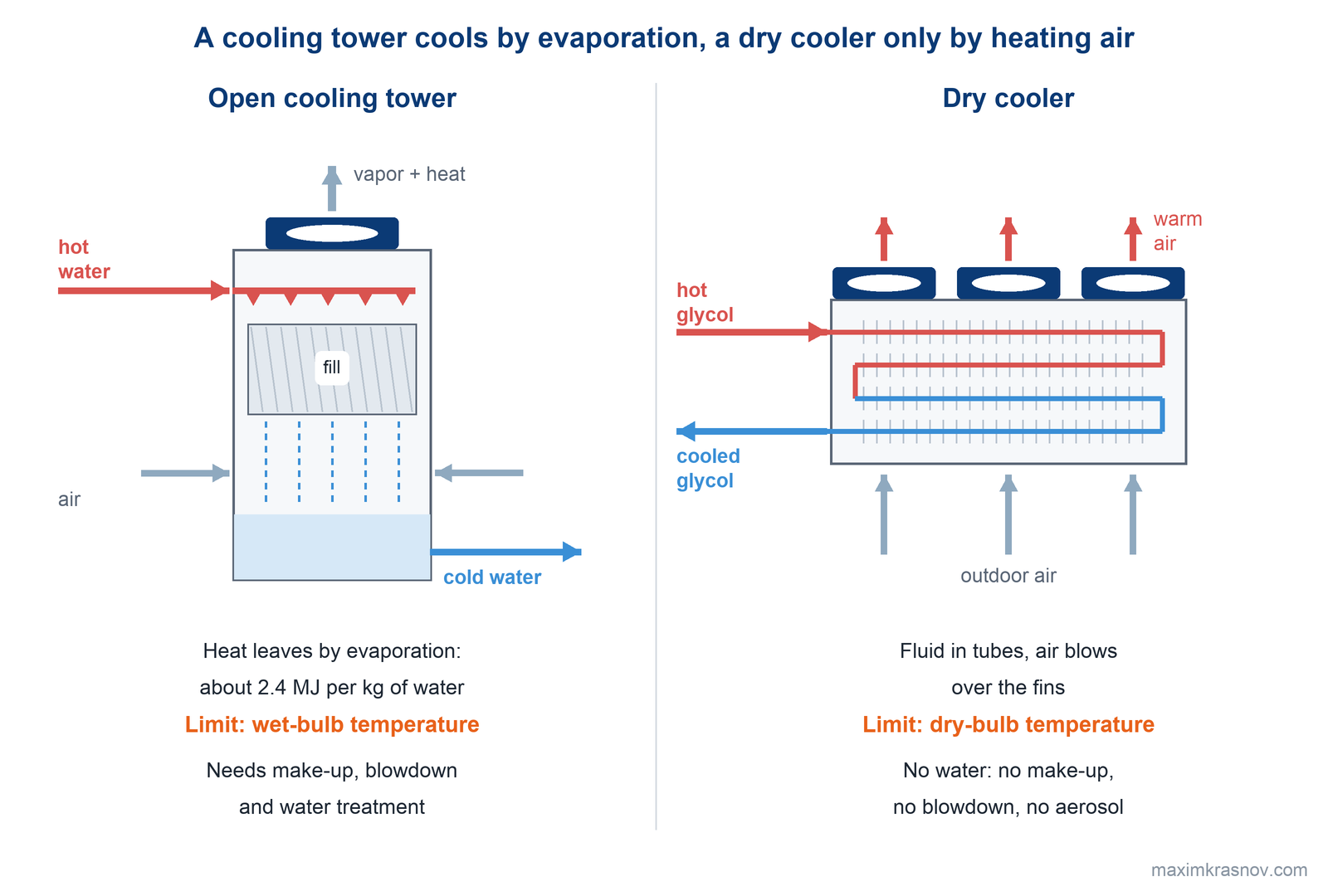
Between them sits the adiabatic dry cooler: the same dry unit, which in hot weather sprays water in front of the heat exchanger. The inlet air gets colder, while the fluid inside still never touches the atmosphere.
What temperature will a dry cooler and a cooling tower deliver in summer?
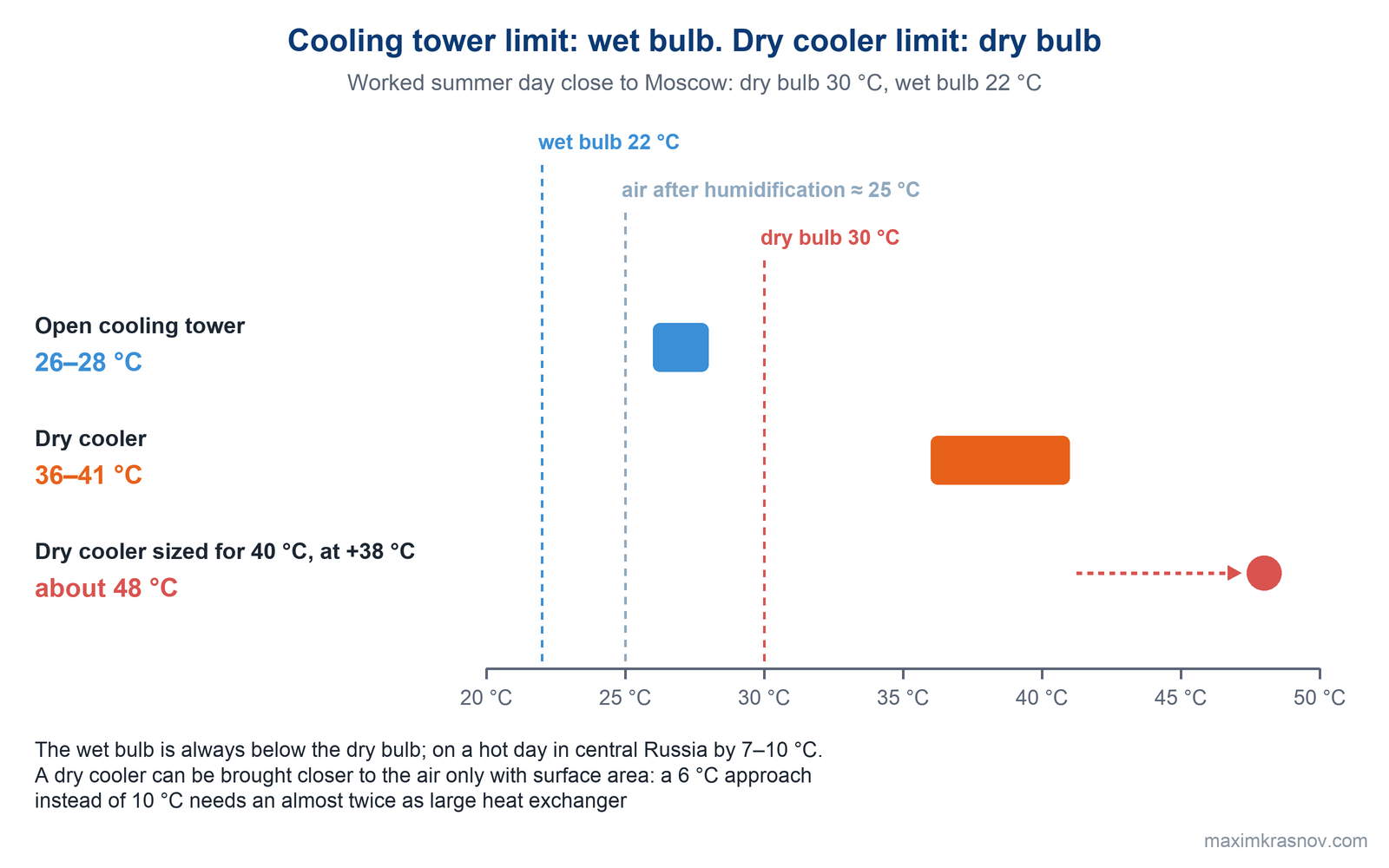
A dry cooler's limit is the dry bulb plus the approach; a cooling tower's limit is the wet bulb plus the approach. The wet bulb is always below the dry bulb, on a hot day in central Russia by 7–10 °C.
One summer day, worked figures close to Moscow: dry bulb 30 °C, wet bulb 22 °C.
| Unit | Temperature it works from | Leaving temperature |
|---|---|---|
| Dry cooler | Dry bulb 30 °C | 36–41 °C at an economical size |
| Adiabatic dry cooler | Air after humidification, about 25 °C | Colder than the dry bulb by the amount of pre-cooling |
| Closed cooling tower | Wet bulb 22 °C | Close to open, depends on selection |
| Open cooling tower | Wet bulb 22 °C | 26–28 °C |
A dry cooler can be brought closer to the air only with surface area. On glycol 45 → 40 °C, cutting the approach from 10 to 6 °C needs an almost twice as large heat exchanger, and to 4 °C almost four times as large. Per the NCT catalog, a dry cooler is used when the fluid only needs to be cooled to 3–5 °C or more above the outdoor temperature.
In heat above the design point, a dry cooler warms up with the air. A unit sized for 40 °C at +30 °C will deliver glycol at about 48 °C when it is +38 °C outside. So for a process that must never stop, the design temperature is set by the process engineer, and it is often the site's absolute maximum: for Moscow 38 °C against 26 °C under the "B" parameters of SP 131.13330 (Russian building climatology code).
How much water do a cooling tower and a dry cooler use?
A dry cooler uses no water at all. A 1,300 kW evaporative cooling tower evaporates up to 2.0 m³/h and runs on water for thousands of hours a year, plus blowdown that keeps salts in the loop under control.
The adiabatic dry cooler is the middle option. For the same 1,300 kW in Moscow it uses about 1.2 m³/h, and only in hot hours. In Moscow the dry bulb exceeds 28 °C for about 88 hours a year, so such a unit uses no more than 106 m³ of water per year.
A detailed calculation of a cooling tower's evaporation, blowdown and make-up is in how much water a cooling tower uses.
How much electricity does each option use?
A dry cooler uses more fan power than a cooling tower of the same capacity: without evaporation, more air has to be pushed through a large surface. A 1,300 kW dry cooler with an 8 °C air temperature rise needs about 500 thousand m³/h of air.
The main difference is not in the fans but in the compressor, if a chiller sits behind the unit. Every degree of condensing temperature adds 1.8–4.0% to compressor power. At +30 °C outdoors a dry cooler sends 40 °C glycol to the condenser, an open tower 28 °C water. Twelve degrees of difference at a rule of thumb of 3% per degree is about a third of compressor power in a hot hour.
Our chiller catalog gives the same conclusion. A machine with an air-cooled condenser, which is also dry heat rejection, rejects 1.30 kW of heat outside per kilowatt of cooling; a machine on cooling tower water, 1.16. So its compressors take 0.16 kW per kilowatt of cooling against 0.30, almost half.
Glycol adds its own line. The solution flow for the same heat is 11% higher than for water, and the pump, at the upper estimate, is twice as powerful: in the worked example of a 1,300 kW dry cooler that is 33.9 kW against 16.6 kW on water. A variable-frequency drive on the dry cooler's fans pays off: at an assumed 24 kW of installed power and year-round operation it saves about 70 thousand kWh per year, RUB 0.7 million at RUB 10 per kWh.
How do climate and winter affect the choice?
In winter a glycol dry cooler works better than a cooling tower: it does not ice up and gives cooling without a compressor, that is, free cooling. With a 7/12 °C chilled water regime and a combined approach of the dry cooler and heat exchanger of 7 °C, partial free cooling starts below +5 °C and full free cooling below 0 °C. With a 12/18 °C regime, below +11 and +5 °C.
Glycol concentration is chosen by the winter minimum, not "fifty percent just in case". 40% ethylene glycol freezes at about −23 °C, while in Moscow the coldest five-day period is −26 °C and the absolute minimum −43 °C. If the dry cooler may stand without load in winter, the concentration is set higher or a drain is provided.
Our dry coolers run in Yakutia, the Arkhangelsk region, on Novaya Zemlya and on a drilling platform off Sakhalin: places where water outdoors cannot survive the winter. A closed cooling tower with a finned coil covers the same scenario differently: it runs wet in summer and, per the catalog, from 0 °C goes into dry mode and behaves like a dry cooler.
Which is easier and cheaper to maintain?
A dry cooler is easier to maintain; a cooling tower needs a water treatment service. A cooling tower requires blowdown, chemical dosing, Legionella monitoring under SanPiN 3.3686-21 (Russian sanitary rules) and passivation of new galvanizing. For a dry cooler the main task is glycol concentration.
A glycol loop may be topped up only with solution. A 10 m³ loop at 40% drops to 33.3% after 2 m³ of water is added, and freeze protection moves up by several degrees. Concentration is checked with a refractometer, and a top-up log is kept.
In capital cost, an open cooling tower is the most affordable heat rejection unit; a closed tower is more expensive, since you pay extra for a clean loop. A dry cooler for the same load takes more space, because it needs surface area and a lot of air. Only a selection for your duty gives an exact cost comparison.
When does it pay to install a cooling tower and a dry cooler together?
A combination is needed when a dry unit covers winter and the shoulder seasons but cannot hold the temperature in hot weather. There are four typical solutions.
1. Dry cooler plus a trim chiller. The dry cooler comes first along the fluid path; the chiller covers the rest in summer. For most of the year the chiller is off or runs at a low stage. We used the same principle at the Tver Foundry, but with a cooling tower: an open tower cools the furnace water, and a chiller with a remote air-cooled condenser trims it further when it is above +25 °C outside.
2. Adiabatic dry cooler for peak trimming. The dry heat exchanger is sized not for +30 °C but for +26 °C, and comes out about a third smaller in area. Above +26 °C humidification switches on. This is not done for continuous processes: cut the water, and in hot weather the unit cannot hold its setpoint.
3. Hybrid closed cooling tower. Wet in summer, dry in winter. It fits when summer requires the temperature of an evaporative unit but water is scarce.
4. Liquid cooling for servers. Cooling for chips can be taken from the weather: a closed cooling tower in winter, an adiabatic dry cooler in summer. How this works in a data center is covered in liquid cooling a data center without a chiller.
Cooling tower vs dry cooler: comparison
| Criterion | Open cooling tower | Closed cooling tower | Dry cooler | Adiabatic dry cooler |
|---|---|---|---|---|
| Cooling limit | Wet bulb | Wet bulb | Dry bulb | Between dry and wet in hot weather |
| Water in July at +30 °C | 26–28 °C | Close to open | 36–41 °C | In between |
| Make-up water | Evaporation + blowdown | Spray water only | Not needed | Only in hot hours |
| Water treatment | Mandatory | Mandatory for spray water | Not needed | Needed for humidification water |
| Electricity | Low | Medium + spray pump | High | Lower than a dry cooler in hot weather |
| Winter | Anti-icing measures | Glycol or dry mode | Best of all, free cooling | Runs dry |
| Footprint | Smallest | Small | Large | Large |
| Aerosol | Yes | Yes | No | Possible when spraying |
| Typical site | Metals, machine building, food plants | Pharma, electronics, chillers, absorption chillers | Sites without water, hot fluids, data centers | Sites without water and with hot summers |
Key takeaways
1. If the process needs fluid in summer no warmer than the wet bulb plus a few degrees, a dry cooler will not reach that point with any amount of extra surface. That is a cooling tower's job.
2. If the fluid can be kept 5–10 °C above the air temperature, there is no make-up water, or the loop must stay clean, a dry cooler is simpler and cheaper to maintain.
3. A chiller with a dry cooler on its condenser uses noticeably more electricity in a hot hour than with a cooling tower: every degree of condensing temperature costs 1.8–4.0% of compressor power.
4. Winter is the dry cooler's strong side: on glycol it gives free cooling below +5 °C with a 7/12 °C regime.
FAQ
What temperature will a dry cooler deliver in hot weather?
An economically sized dry cooler delivers fluid 5.6–11 °C warmer than the outdoor air; at +30 °C that is 36–41 °C. Getting closer to the air takes a much larger heat exchanger. The exact figure comes from a selection for your flow, fluid and climate.
Can a dry cooler run on water instead of glycol?
Practically no. If circulation stops or power fails in frost, a water-filled heat exchanger freezes within hours. Water is allowed only with automatic drainage, backup power for the pump and heating, and the designer has to justify that decision.
Can a dry cooler serve an absorption chiller?
Only with a Thermax selection for warmer water and reduced capacity. An absorption chiller is rated for 29.4 °C cooling water at the inlet, and a dry cooler will not deliver such water in hot weather. For an absorption chiller I advise a closed cooling tower: no outdoor dirt gets into the loop.
From what capacity are industrial dry coolers made?
NCT type DC dry coolers start from 300 kW, in horizontal, vertical and V-shaped versions. System capacity is increased by adding modules to a running installation.
Sources
-
ASHRAE Handbook — HVAC Systems and Equipment, chapter 40 "Cooling Towers"; ASHRAE Climatic Design Conditions 2021.
-
Cooling Best Practices, "Evaluating Process Cooling Supply Temperatures": approach of an economical dry cooler 5.6–11 °C.
-
SP 131.13330 (Russian building climatology code).
-
SanPiN 3.3686-21, chapter XLII "Prevention of Legionnaires' disease".
-
NCT catalogs and technical-commercial proposals, 2026: DC dry coolers, adiabatic version, cooling towers.
-
Experience and calculations of Cold Energy.
More on cooling towers in the Cooling towers section.
Need a cooling solution for your site? Get a consultation