
Plant Short of Grid Power? How to Free It Up on Cooling

founder and CEO of Cold Energy (NCT)
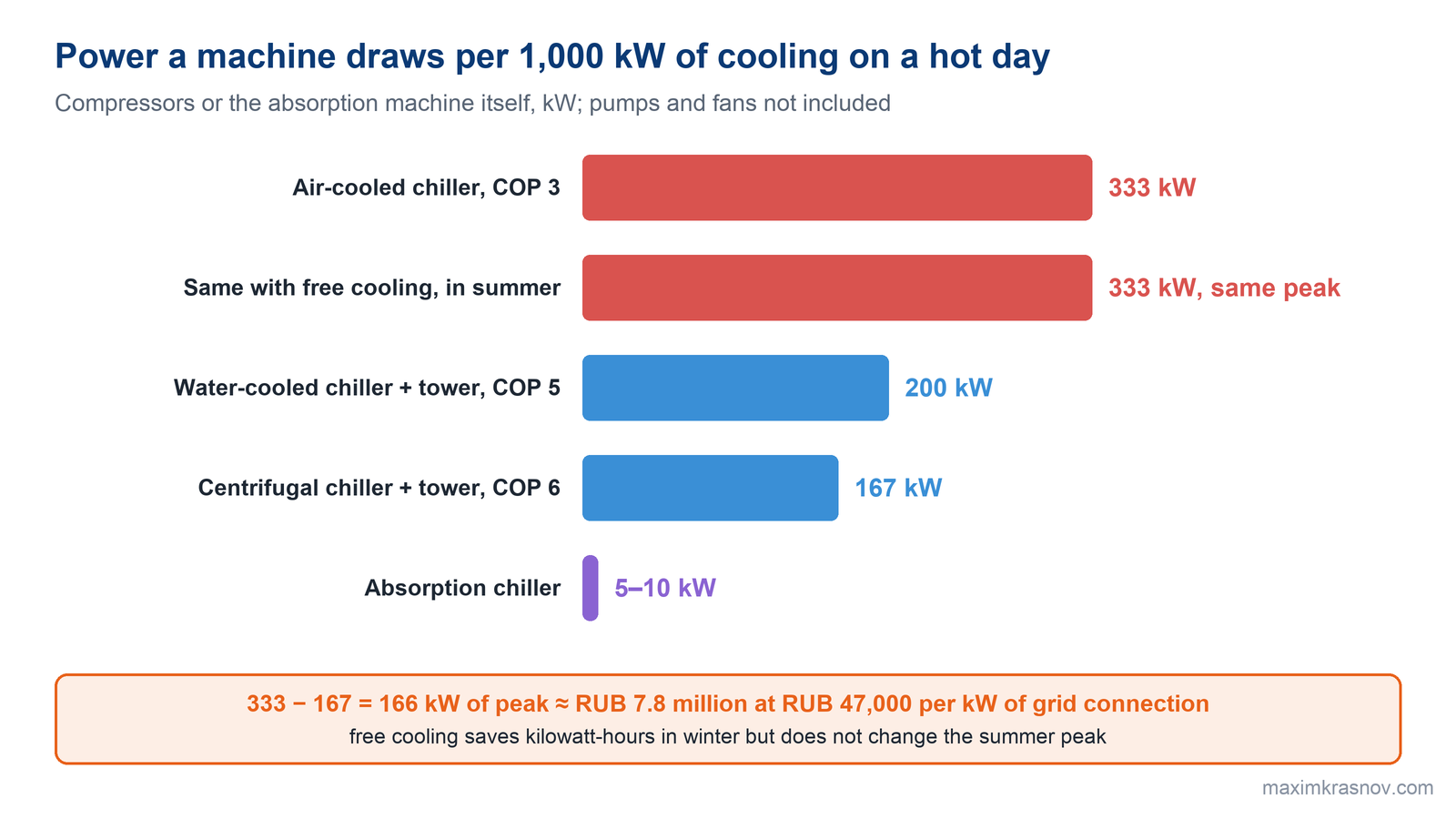
When a plant runs short of electric capacity, the chiller plant is the first place to look. Per 1,000 kW of cooling, an air-cooled chiller draws about 333 kW for its compressors, a centrifugal chiller on a cooling tower 167 kW, an absorption chiller 5–10 kW. With grid connection at about RUB 47,000 per kilowatt, the difference between these designs is worth millions of rubles before the first start-up.
This article is for plant directors and chief power engineers whose utility has refused capacity for a new line or issued technical conditions (the utility's connection permit) for less than they need. The cooling design is decided once, at the project stage, before the grid connection is paid for. More on the topic in Energy efficiency.
How much electric power does a chiller plant draw?
A chiller plant's electric demand is set almost entirely by how it rejects heat. Per 1,000 kW of cooling, the compressors of an air-cooled chiller with a coefficient of performance (COP, kilowatts of cooling per kilowatt of electricity) of 3 draw 333 kW, a water-cooled chiller with COP 5 draws 200 kW, a centrifugal chiller on a cooling tower with COP 6 draws 167 kW. Pumps and fans come on top.
The design engineer is often the last to hear about the power limit. An example from our internal design guide: with 250 kW permitted, a 1,000 kW water-cooled chiller barely fits, because the pumps and cooling tower fans add to the compressors, and an air-cooled one does not fit at all. If the technical conditions do not give enough power, the debate about machine type is over before it starts.
The opposite mistake is overstating the request. A chiller with 350 kW of cooling draws about 110 kW of electricity, yet in questionnaires these kilowatts are sometimes added together, and the requested supply ends up three times too high. Before you ask the utility for capacity, check that the calculation uses kilowatts of electricity, not kilowatts of cooling.
What does a kilowatt of grid connection cost?
Grid connection (hooking up to the utility network, paying for every kilowatt of connected capacity) costs about RUB 47,000 per kilowatt, and in some regions up to RUB 100,000. You pay for the peak: the power the plant draws in the hottest hour, not the annual average.
On one megawatt of cooling, an air-cooled packaged chiller and a centrifugal chiller on a cooling tower differ in peak by 333 − 167 = 166 kW. At RUB 47,000 that is about RUB 7.8 million, once, up front. At a data center with 5,000 kW of cooling, a gas-fired absorption chiller cuts the chiller plant's peak from 1,667 to 230 kW: 1,437 kW freed up, or RUB 67 million of grid connection fees.
This line is often left out of the budget because it is taken as a given. A conversation with the client of a 5 MW data center: I ask whether they realize they could have bought one and a half megawatts less electricity. "That's hundreds of millions." "Why didn't you do it?" "Well, we've already bought it." That is why the cooling design is chosen before the grid connection is paid for, not after.
Why doesn't free cooling free up grid capacity?
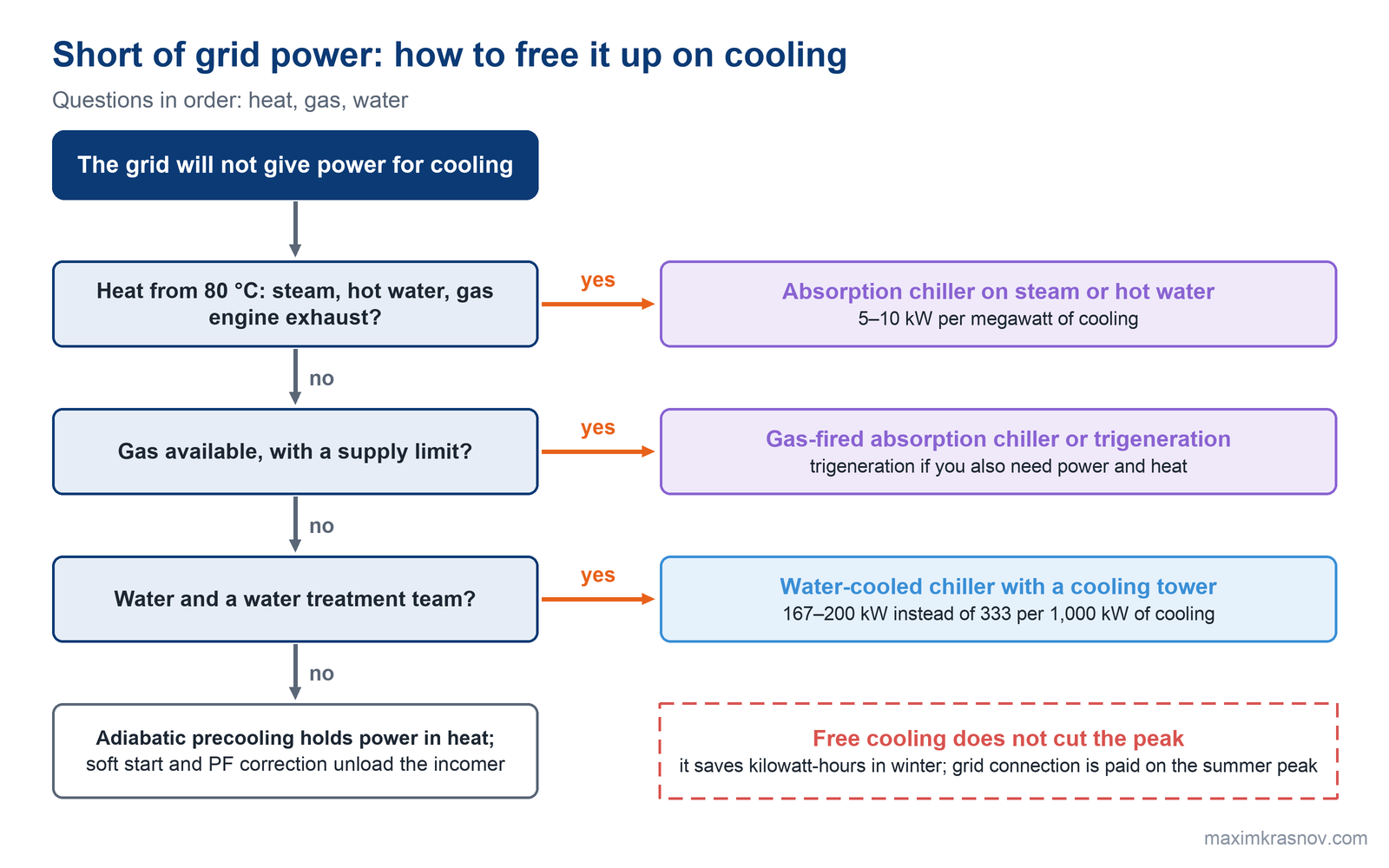
Free cooling (cooling with outdoor air without running the compressor) saves kilowatt-hours but does not lower peak demand. The peak falls in summer heat, when free cooling is off and the compressors carry the full load, and connected capacity is sized on exactly that peak.
At a 5,000 kW data center, packaged chillers with free cooling use 1.8 times less electricity than a design without it, yet the peak stays at 1,667 kW, the same as a conventional chiller plant. Free cooling makes sense where there is load in winter, and it pays back on the electricity bill, not on capacity; details in the article on chiller free cooling.
How much capacity does a water-cooled design with a cooling tower free up?
A water-cooled design with a cooling tower cuts compressor peak by 1.7 to 2 times compared with an air-cooled chiller: 167–200 kW instead of 333 kW per 1,000 kW of cooling. An evaporative cooling tower works off the wet-bulb temperature, so a water-cooled chiller condenses at about 35 °C, while an air-cooled one at +30 °C outdoors condenses at 46 °C.
At a 5,000 kW data center, a centrifugal chiller with a wet cooling tower holds the system peak at 1,015–1,130 kW including towers and pumps, against 1,667 kW for a conventional design. The price is water: about 10 m³/h at this site, plus water treatment and a team to run it.
Most Russian clients do not know that electricity can be traded for water, and sometimes this trade-off decides whether a site gets connected to the grid at all. The first question I advise asking the design engineer: what is in short supply, kilowatts or cubic meters? In Moscow and St. Petersburg it is almost always kilowatts. How to price the trade-off is covered in Water vs electricity.
If a cooling tower is not an option, adiabatic precooling remains: water is sprayed into the air ahead of the condenser or dry cooler, and the inlet air gets 5–15 °C cooler. In our climate adiabatic cooling buys not annual savings but capacity and reliability in the hottest hours. For a dry cooler with adiabatic precooling, the manufacturer states up to 30 % lower cooling system consumption at peak conditions.
When is it cheaper to make cooling from heat or gas?
Cooling from heat or gas comes from an absorption chiller: heat does the compressor's job, and the machine draws 5–10 kW of electricity per megawatt of cooling against 300–350 kW for a compressor chiller. It is the strongest way to free up capacity if the site has heat from 80 °C or gas with a supply limit.
Steam, boiler-house hot water, gas engine exhaust, if they are being dumped today, can be turned into cooling. At a petrochemical plant in Blagoveshchensk, spent steam went to atmosphere while acid was cooled by a 1,000 kW compressor chiller drawing a constant 300 kW. We installed a Thermax absorption chiller running on that steam: 300 kW freed up, payback in a few months.
At the Triumph Plaza business center in Obninsk, a Thermax absorption chiller freed up 1 MW of electric capacity. Another example is the court quarter in St. Petersburg: 12,000 kW of cooling, four natural-gas-fired absorption chillers, project under way. There is nowhere to get that much electricity on the Petrogradsky side, and on electric chillers the project would not have happened.
Compare the whole plant, not just the machine. Pumps on three circuits and the cooling tower fans also draw power: in our calculation, a 1,000 kW plant with a hot-water absorption chiller draws about 66 kW excluding tower fans, while a plant on a COP 5 chiller with pumps draws about 245 kW. How a gas-fired absorption chiller frees up capacity at a large site is covered in Absorption chillers for data centers.
When do you need trigeneration?
Trigeneration (producing electricity, heat and cooling from one fuel) is the answer when the grid gives no capacity at all but the site has gas. A gas engine generator set produces its own power, and its heat goes to space heating in winter and, through an absorption chiller, to cooling in summer.
In our calculation, on-site power costs RUB 3.45 per kWh against RUB 10 from the grid, and fuel utilization reaches 85 % instead of 35–40 %. But the main gain is usually not the price per kilowatt-hour: the design removes the capacity limit, and a site the grid will not supply never gets built.
To be honest about the downsides: you need a gas allocation, and it is not granted everywhere. Capital cost is several times higher than a conventional design, and there are two service contracts instead of one: the gas engines are serviced separately, by running hours. When trigeneration pays off is covered in Trigeneration.
What if the incomer is limited by current, not by kilowatts?
If you are up against the incoming supply current and cable cross-section, soft starters, a variable-frequency drive on the compressor and power factor correction help. They do not change the kilowatts of cooling, but they remove inrush current and unload the main incoming breaker.
According to NCT's 2026 catalogs, the NARV 95 screw chiller with star-delta starting has a running current of 181 A and a starting current of up to 358 A. The NWCV 65-1 centrifugal chiller with a variable-frequency drive has a starting current of 15 A at a maximum running current of 90 A. On a weak incomer, that is an argument for soft start or an inverter drive.
An example from our controls design guide: a plant with a design load of 313.5 kW at a power factor of 0.82 draws 552 A from the incomer; after correction to 0.95, 476 A. The main breaker goes from 630 to 500 A, the cable one size down. On a plant with variable-frequency drives, the correction unit is only specified with detuning reactors.
Which option to choose: comparison by capacity and conditions
The choice depends on what the site has: heat, gas, water or none of these. The table puts the options discussed above on one site with 1,000 kW of cooling.
| Option | What it reduces | Machine electricity per 1,000 kW of cooling on a hot day | Condition |
|---|---|---|---|
| Air-cooled chiller (baseline) | — | 333 kW for compressors | — |
| Free cooling | Kilowatt-hours in winter | Peak unchanged: 333 kW | Load exists in winter |
| Adiabatic precooling | Consumption in hot weather | Up to 30 % at peak conditions, per the manufacturer (dry cooler) | Water in the hottest hours |
| Water-cooled chiller + cooling tower | Peak and kilowatt-hours | 200 kW (COP 5) | Water and water treatment |
| Centrifugal chiller + cooling tower | Peak and kilowatt-hours | 167 kW (COP 6) | Water and water treatment |
| Absorption chiller on steam, hot water or gas | Almost the entire peak | 5–10 kW for the machine itself | Heat from 80 °C or gas with a supply limit |
| Trigeneration | The site's need for grid capacity | On-site generation | Gas; heat and cooling needed most of the year |
| Soft start, inverter drive, power factor correction | Starting current and incomer current | Kilowatts unchanged | Weak incomer |
The options can be combined: an absorption chiller on waste heat for base load and electric chillers for the peak, or a water-cooled design with free cooling in winter. I would start by asking what the site is currently dumping to atmosphere: heat, steam, exhaust.
Key takeaways
1. Per 1,000 kW of cooling, an air-cooled chiller draws about 333 kW for its compressors, a centrifugal chiller on a cooling tower 167 kW, an absorption chiller 5–10 kW.
2. Grid connection costs about RUB 47,000 per kilowatt, up to RUB 100,000 in some regions, and it is paid on the summer peak.
3. Free cooling cuts annual kilowatt-hours, not peak demand.
4. Cooling from heat or gas frees up the most capacity: at a 5,000 kW data center, a gas-fired absorption chiller cuts the chiller plant's peak from 1,667 to 230 kW.
5. Choose the cooling design before paying for the grid connection: afterwards, the main argument has already been spent.
FAQ
Does free cooling reduce the grid connection capacity?
No. The peak falls in summer heat, when free cooling is off and the compressors carry the full load. Free cooling reduces annual kilowatt-hours, while connected capacity is sized on the summer peak.
How much electricity does an absorption chiller use?
The machine itself draws 5–10 kW per megawatt of cooling, depending on the model. The complete plant draws more: pumps on three circuits and the cooling tower fans. In our calculation, a 1,000 kW plant with a hot-water absorption chiller draws about 66 kW excluding tower fans, against about 245 kW for a plant on a COP 5 chiller.
Can you free up capacity without replacing the chillers?
Partly. If the site has waste heat from 80 °C, an absorption chiller is installed next to the running chillers and takes over their base load, as at the petrochemical plant in Blagoveshchensk, where 300 kW were freed up. If the incomer is limited by current, soft start and power factor correction help.
Which is better when capacity is short: a gas-fired absorption chiller or trigeneration?
A gas-fired absorption chiller takes only cooling off the grid; trigeneration also covers the site's electricity. Trigeneration pays off better when electricity, heat and cooling are all needed most of the year and there is a gas allocation. Its capital cost is higher, and there are two service contracts.
How much does a kilowatt of grid connection cost?
About RUB 47,000 per kilowatt, up to RUB 100,000 in some regions. At a 5,000 kW data center, a gas-fired absorption chiller frees up 1,437 kW, which is RUB 67 million on grid connection alone.
Sources
-
Cold Energy calculation for the webinar of 6 August 2026, tariff RUB 10 per kWh: site with 5,000 kW of cooling, grid connection at RUB 47,000 per kW.
-
NCT 2026 chiller catalogs: starting and running currents of NARV 95 and NWCV 65-1.
-
Cold Energy project experience: Thermax absorption chillers at the petrochemical plant in Blagoveshchensk, the Triumph Plaza business center in Obninsk and the court quarter in St. Petersburg; plant calculations for 1,000 kW of cooling.
Need a cooling solution for your site? Get a consultation