
How Much Water Does a Cooling Tower Use, and How to Cut Make-Up
founder and CEO of Cold Energy (NCT)
An open cooling tower evaporates about 1% of the circulating flow for every 7 °C of cooling. On a 1,000 m³/h loop that is up to 12.6 m³/h of evaporation in hot weather and 16.8 m³/h of make-up at four cycles of concentration. Over a year on a real load profile it comes to about 69 thousand m³, almost half of what a calculation based on the summer peak gives.
Cooling tower water use is the main question for the water utility and the second line of operating cost after electricity. Evaporation cannot be reduced: it is how the tower cools. What gets reduced is blowdown, and that is the job of water treatment. Below is how to calculate each flow and where the real savings are.
What makes up a cooling tower's water consumption?
Make-up water replaces three flows: evaporation, drift and blowdown. The water balance formula: make-up = evaporation + drift + blowdown.
-
Evaporation is water that leaves into the air as vapor. Most of the heat leaves this way: about 2.4 MJ per kilogram of water.
-
Drift is droplets of circulating water, with salts and bacteria, that the air carries out through the drift eliminator.
-
Blowdown is the discharge of part of the circulating water. Vapor carries no salts, so they stay in the loop, and without blowdown the water concentrates until it scales.
Evaporation is physics; you can only calculate it. Drift is set by the quality of the drift eliminator. Blowdown is set by water treatment, and that is where all the savings lie.
How much water does a cooling tower evaporate?
A cooling tower evaporates about 1% of the flow for every 7 °C of range, according to ASHRAE (HVAC Systems and Equipment, chapter 40). For the summer peak, cooling tower manufacturers use 0.18% of the flow per degree.
On a 1,000 m³/h loop cooled from 35 to 28 °C, that is 8,141 kW of heat and up to 12.6 m³/h of evaporation in hot weather. The ASHRAE estimate gives 9.8–10.0 m³/h; the historic Soviet code SNiP 2.04.02-84 gives 7.0–11.2 m³/h depending on the season.
You can check the calculation against physics: if all the heat left by evaporation, the loop would evaporate 12.2 m³/h. If your summer figure comes out below 70% of that, some load has been lost or a winter coefficient has been used.
What is drift, and is it dangerous?
Drift is water that the airflow carries out of the tower as droplets rather than vapor. Working drift eliminators, per ASHRAE, limit it to 0.001–0.005% of the flow. In NCT towers the drift eliminator turns the air three times, and catalog drift is 0.0005–0.002% of the flow.
On a 1,000 m³/h loop, 0.005% drift is 0.05 m³/h, 0.4% of evaporation. In terms of water it makes no difference. Old drift eliminators let through 0.1–0.2% of the flow, dozens of times more.
The danger of drift is not its volume but its content. The droplets carry the same salts, chemicals and bacteria as the loop. SanPiN 3.3686-21 (Russian sanitary rules, chapter XLII) classifies industrial cooling towers as potentially hazardous for Legionnaires' disease. A drift figure from a data sheet can be trusted if it was measured by the isokinetic method per CTI ATC-140.
What are blowdown and cycles of concentration?
Cycles of concentration are the ratio of dissolved solids in the circulating water to those in the make-up water. Blowdown holds this ratio at the set level: blowdown = evaporation / (cycles − 1).
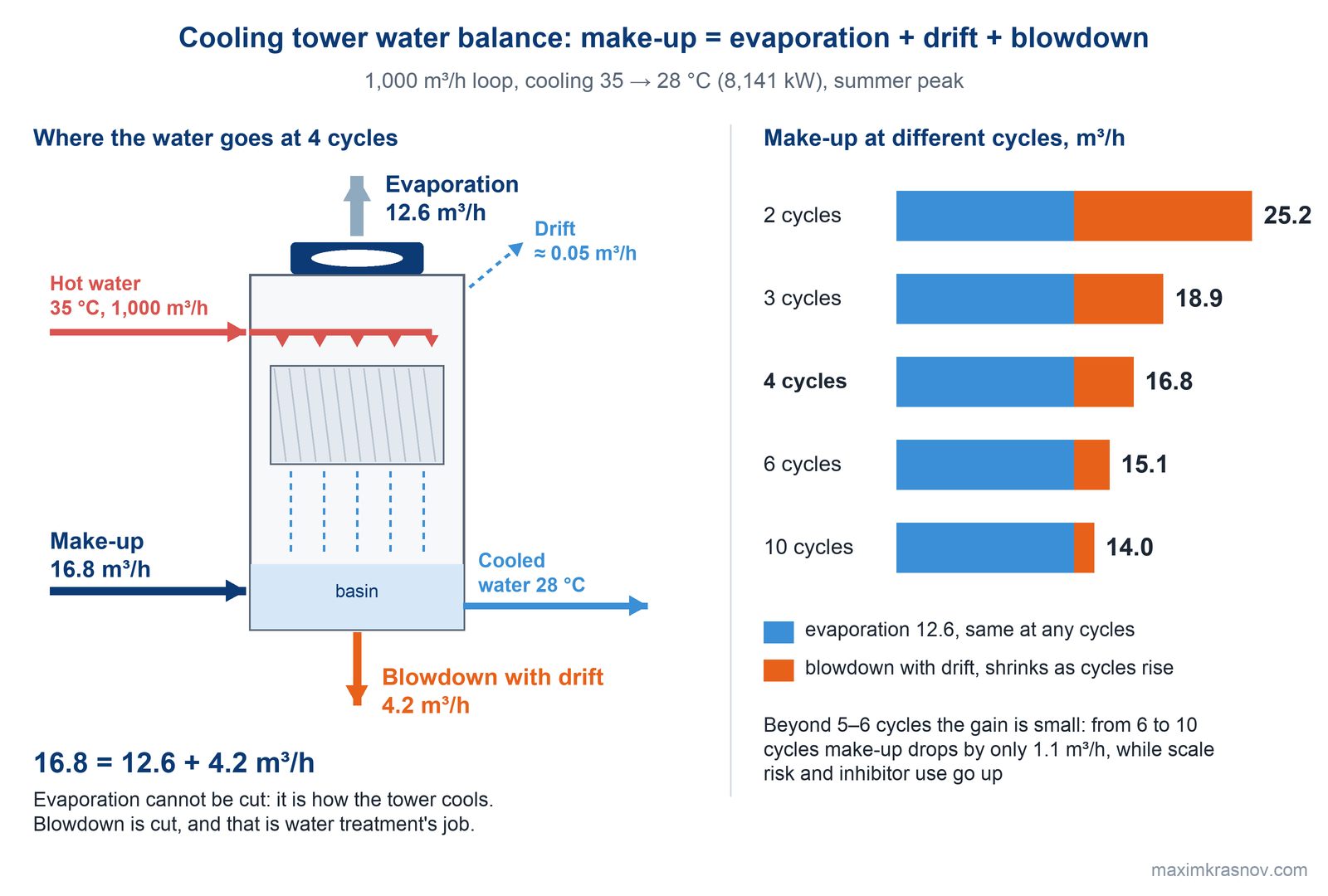
The more cycles, the less blowdown and make-up. For a 1,000 m³/h loop with 12.6 m³/h of evaporation:
| Cycles of concentration | Blowdown with drift, m³/h | Make-up, m³/h |
|---|---|---|
| 2 | 12.6 | 25.2 |
| 3 | 6.3 | 18.9 |
| 4 | 4.2 | 16.8 |
| 6 | 2.5 | 15.1 |
| 10 | 1.4 | 14.0 |
Beyond 5–6 cycles the curve is almost flat: from 6 to 10 cycles make-up drops by only 1.1 m³/h, while the risk of scale and inhibitor consumption go up. On hard mains water without softening, 3–4 cycles are realistic; with good make-up water and automatic blowdown, 5–6.
The cycle limit is set by the weakest water parameter and the most sensitive material in the loop, usually the consumer's heat exchanger rather than the tower. Example: make-up water with an alkalinity of 150 mg/L and a heat exchanger in 304 stainless steel with a 600 mg/L limit allow no more than 4 cycles, even though chlorides would allow 6.7.
How much water does a cooling tower take per year?
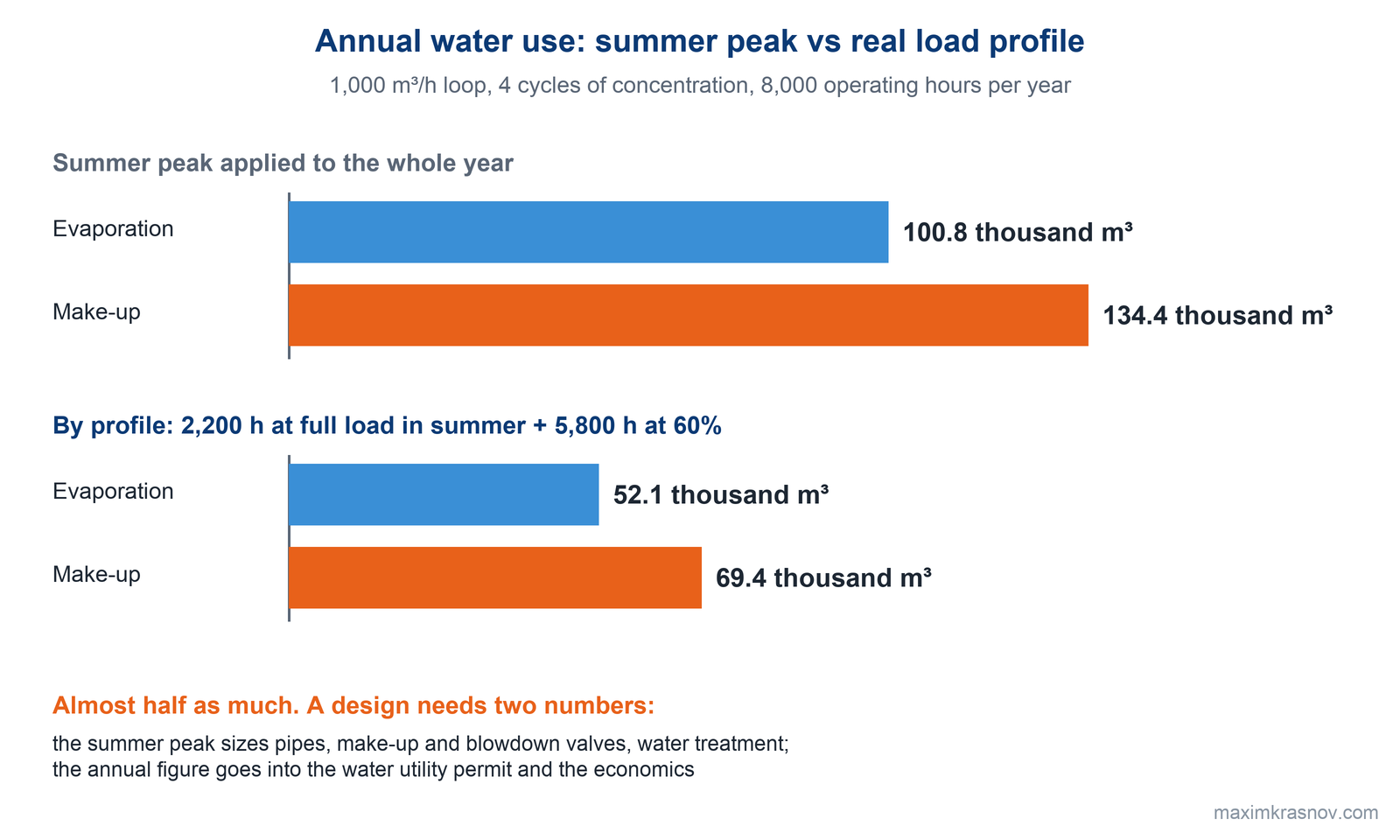
Annual consumption is calculated from the load profile and climate, not from the summer peak. A 1,000 m³/h loop at 4 cycles and 8,000 operating hours:
-
with the summer peak applied to the whole year: 100.8 thousand m³ of evaporation and 134.4 thousand m³ of make-up;
-
by profile (2,200 hours at full load in summer and 5,800 hours at 60%): 52.1 thousand m³ of evaporation and 69.4 thousand m³ of make-up.
So a design needs two numbers. The summer peak goes into pipe sizes, the make-up valve, the blowdown valve and the water treatment selection. The annual figure goes into the water utility's connection conditions and into the economics. The mistake of "the year at the summer peak" inflates the operating budget almost twofold and can push a project to dry coolers for no reason.
How can you reduce cooling tower make-up water?
Make-up is reduced by raising cycles of concentration to the limit the loop can stand. Five measures do this.
1. Automatic blowdown on conductivity. The setpoint equals make-up conductivity times the number of cycles: with 450 µS/cm make-up and 4 cycles, the valve opens at 1,800 µS/cm and closes at 1,710. A manual valve set "by eye" and overflow instead of blowdown keep cycles lower than needed and pour water down the drain.
2. Flow meters on make-up and blowdown. Without them cycles cannot be calculated. A free check: if cycles by chlorides come out at 6 and by conductivity at 4, some of the salts have already deposited on surfaces.
3. Inhibitor and biocide dosing. Blowdown alone without chemicals works only on water known to be good. In our supplies the standard is a panel with two dosing pumps: 55 of 63 contracts for water treatment systems in 2022–2026 were like that.
4. Side-stream filtration. 3–7% of the circulating flow passes through the filter continuously; for a 1,000 m³/h loop, about 50 m³/h. The filter type is checked by its backwash water: a multimedia filter with 7.5% backwash will not let cycles go above 4.4, a self-cleaning screen filter with 2% backwash allows up to 13.6.
5. Tower material. A hybrid internal coating of the casing allows the same cycles of concentration as stainless steel and, according to NCT data, saves up to 33% of water and chemicals.
Why does saving on water treatment cost more than the water?
Poor water does not break equipment at once: deposits grow a tenth of a millimeter at a time. We calculated what this means for a 1,000 kW chiller with a condenser on cooling tower water (COP 4.5, heat flux 8 kW/m², 4,000 hours per year, RUB 10 per kWh):
| 0.3 mm layer on the condenser | Rise in condensing temperature | Extra power use | Per year |
|---|---|---|---|
| Hard scale | +1.2 °C | 3.6% | about RUB 320 thousand |
| Biofilm | +4.0 °C | 12% | about RUB 1.06 million |
Three tenths of a millimeter of slime that wipes off with a finger costs three times more than the same layer of stone.
Cleaning without a water regime does not help. At one of our sites, the heat exchanger of an absorption chiller cooled by tower water was cleaned at a pressure drop of 1.2 bar. A week later the pressure drop was 1.2 bar again. In the end the client rebuilt the make-up system.
How much water do closed and hybrid cooling towers save?
A closed tower uses water in summer just like an open one: the spray water evaporates, it is made up and blown down. Its advantage is elsewhere: the process loop stays clean.
Water savings come from hybrid operation. A closed tower with a finned coil (NCT e-series) per the catalog runs without spray water from 0 °C and takes no make-up in the cold season. The switchover threshold depends on the winter load: at half load the unit can go into dry mode already at above-zero temperatures. How to account for this when choosing is covered in how to choose an industrial cooling tower.
If there is no water on site at all, dry units remain. A 1,300 kW adiabatic dry cooler in Moscow uses about 1.2 m³/h, and only in hot hours, while an evaporative tower of the same capacity uses up to 2.0 m³/h for thousands of hours a year. The price is warmer water and more electricity; details are in cooling tower vs dry cooler.
The global trend away from evaporation should not be copied blindly. By evaporating water you remove heat almost for free; by giving it up you pay in electricity. In Moscow and St. Petersburg the shortage is almost always in kilowatts, not cubic meters.
Key takeaways
1. A cooling tower evaporates about 1% of the circulating flow for every 7 °C of range; this loss cannot be avoided. On a 1,000 m³/h loop it is up to 12.6 m³/h in hot weather.
2. Make-up is reduced through blowdown: going from 2 to 4 cycles of concentration cuts make-up from 25.2 to 16.8 m³/h; beyond 5–6 cycles the gain is small.
3. Annual consumption on a load profile is almost half of the summer-peak figure. A design needs both numbers.
4. Water treatment pays back not in water but in power: 0.3 mm of biofilm on the condenser of a 1,000 kW chiller costs about RUB 1 million per year.
FAQ
What percentage of water does a cooling tower lose?
About 1% of the circulating flow per 7 °C of range goes to evaporation, up to 0.18% per degree in hot weather. With blowdown at 4 cycles, make-up on a loop with a 7 °C range is about 1.7% of circulation. Drift with modern drift eliminators is thousandths of a percent.
Can a cooling tower be fed with softened water?
Fully softened water is aggressive to metal, so make-up hardness is kept at no less than 30 mg/L. If make-up is softened, raw water is blended in to a residual hardness of 30–70 mg/L.
Is there a Russian standard for cooling tower circulating water quality?
There is no GOST (Russian national standard) in force, and SP 31.13330.2021 (Russian water supply code) has no section on recirculating cooling systems either. Designs rely on the limits set by the manufacturers of the tower and the loop materials, attached as a table to the supply contract.
Where does blowdown go?
To the sewer, under the conditions set by the network owner. Blowdown carries more salts than make-up by the number of cycles, plus residual inhibitor and biocide, so discharge conditions are obtained before design.
Sources
-
ASHRAE Handbook — HVAC Systems and Equipment, 2024, chapter 40 "Cooling Towers": evaporation, drift.
-
ANSI/ASHRAE Standard 188-2021 "Legionellosis: Risk Management for Building Water Systems".
-
Cooling Technology Institute: ATC-140 (drift measurement), WTG-122 (side-stream filtration).
-
SanPiN 3.3686-21, chapter XLII "Prevention of Legionnaires' disease".
-
SNiP 2.04.02-84, section 11; SP 31.13330.2021 "Water supply. External networks and facilities".
-
Experience and calculations of Cold Energy; NCT cooling tower catalogs, 2026.
More on cooling towers in the Cooling towers section.
Need a cooling solution for your site? Get a consultation