
Water vs Electricity in Cooling: the Trade-off Buyers Miss

founder and CEO of Cold Energy (NCT)
A cooling tower trades electricity for water: by evaporating water it lowers the condensing temperature and the power the compressors draw. At a 5,000 kW data center, a scheme with a wet cooling tower uses 0.87 million kWh a year less than dry packaged units with free cooling, and takes 63 thousand m³ of water. At RUB 10 per kWh the trade pays off as long as a cubic meter costs less than RUB 138.
Most of our customers in Russia do not know that electricity can be traded for water. They pick the familiar option and are then surprised by the power bill and by a refusal of grid capacity. In Western markets this choice is made deliberately: the owner runs the numbers and decides which resource is cheaper.
This article is not about the engineering of cooling towers and dry coolers. It is the economics of the trade-off for the owner: how many kilowatt-hours a cubic meter buys, where the break-even point is, why peak power weighs more than the annual bill, and how to run the numbers for your own site.
What is the water-for-electricity trade-off in cooling?
The trade-off is the choice of how to reject heat: by evaporating water in a cooling tower or by heating air in a dry unit. A cooling tower uses water and saves electricity. A dry cooler and an air-cooled chiller use no water but draw more electricity.
The physics is simple. Evaporating one kilogram of water carries away about 2.4 MJ of heat, so a cooling tower cools water toward the wet-bulb temperature. A dry unit is limited by the dry-bulb temperature, and on a hot day in central Russia the gap between them is 7–10 °C. Every degree of condensing temperature adds 1.8–4.0 % to compressor power.
I covered how the units themselves differ in cooling tower vs dry cooler, and what makes up water consumption in how much water a cooling tower uses. Here we count money.
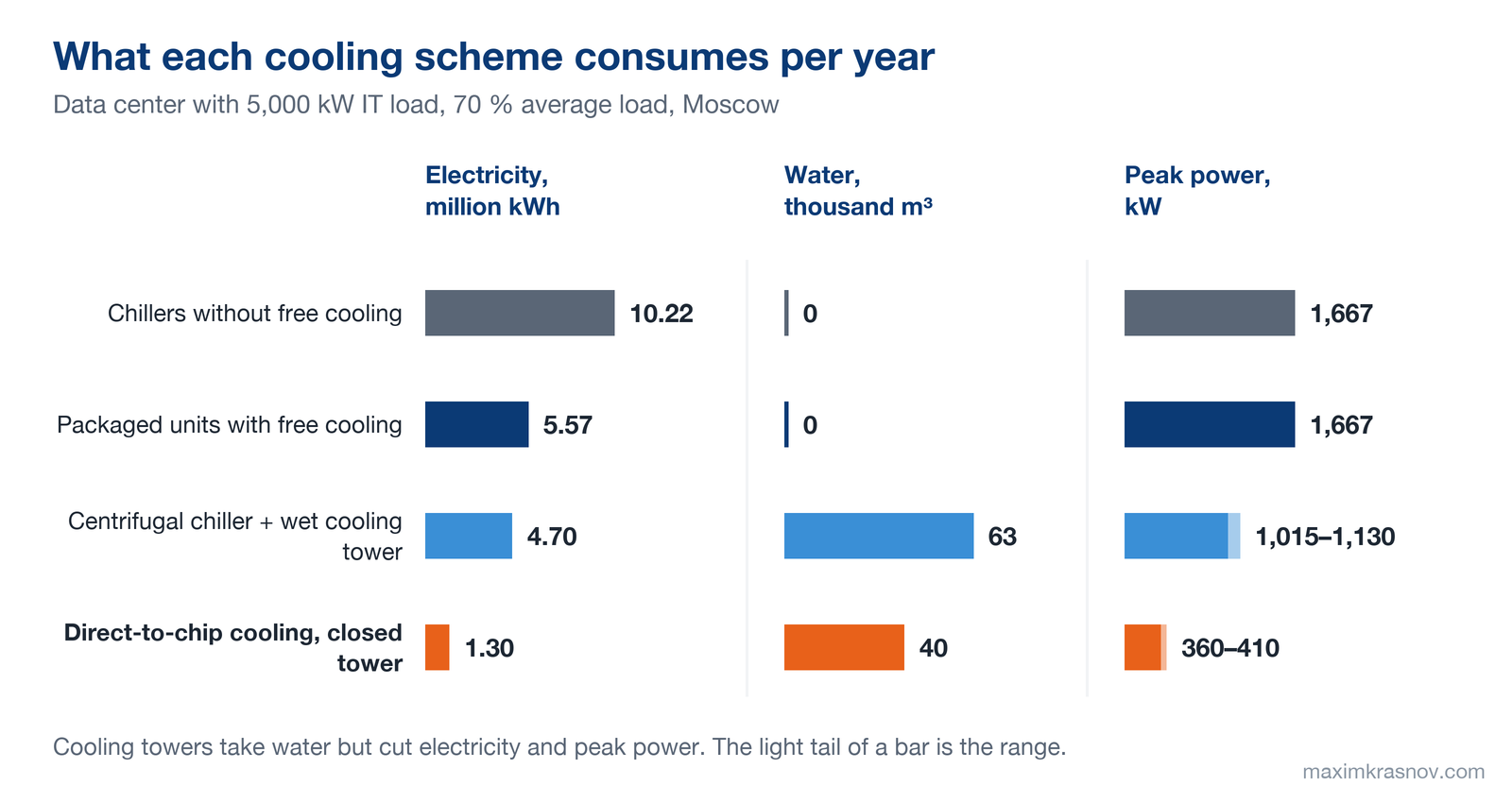
How much electricity and water do different cooling schemes use?
Schemes with evaporative heat rejection use less electricity but take tens of thousands of cubic meters of water a year. We modeled one site: a data center with 5,000 kW IT load, 70 % average load, Moscow, year-round operation.
| Cooling scheme | Cooling electricity, million kWh per year | Water, thousand m³ per year | Peak power, kW |
|---|---|---|---|
| Chillers without free cooling | 10.22 | 0 | 1,667 |
| Packaged units with free cooling, dry heat rejection | 5.57 | 0 | 1,667 |
| Centrifugal chiller and wet cooling tower | 4.70 | 63 | 1,015–1,130 |
| Direct-to-chip cooling, closed cooling tower | 1.30 | 40 | 360–410 |
The fair pair to compare is packaged units with free cooling against a chiller with a wet cooling tower: both cool without compressors in winter. The difference between them is 0.87 million kWh a year, or 16 % of the dry scheme's electricity. That difference includes not only heat rejection but also the compressor type: the wet scheme uses an oil-free centrifugal compressor.
A scheme without free cooling makes no sense in Russia; we do not consider it and show it only as a baseline. Direct-to-chip cooling is a separate case: there is no refrigeration machine at all, and it needs less water because the closed cooling tower runs dry 3–5 months a year.
How much is a cubic meter of water worth against a kilowatt-hour?
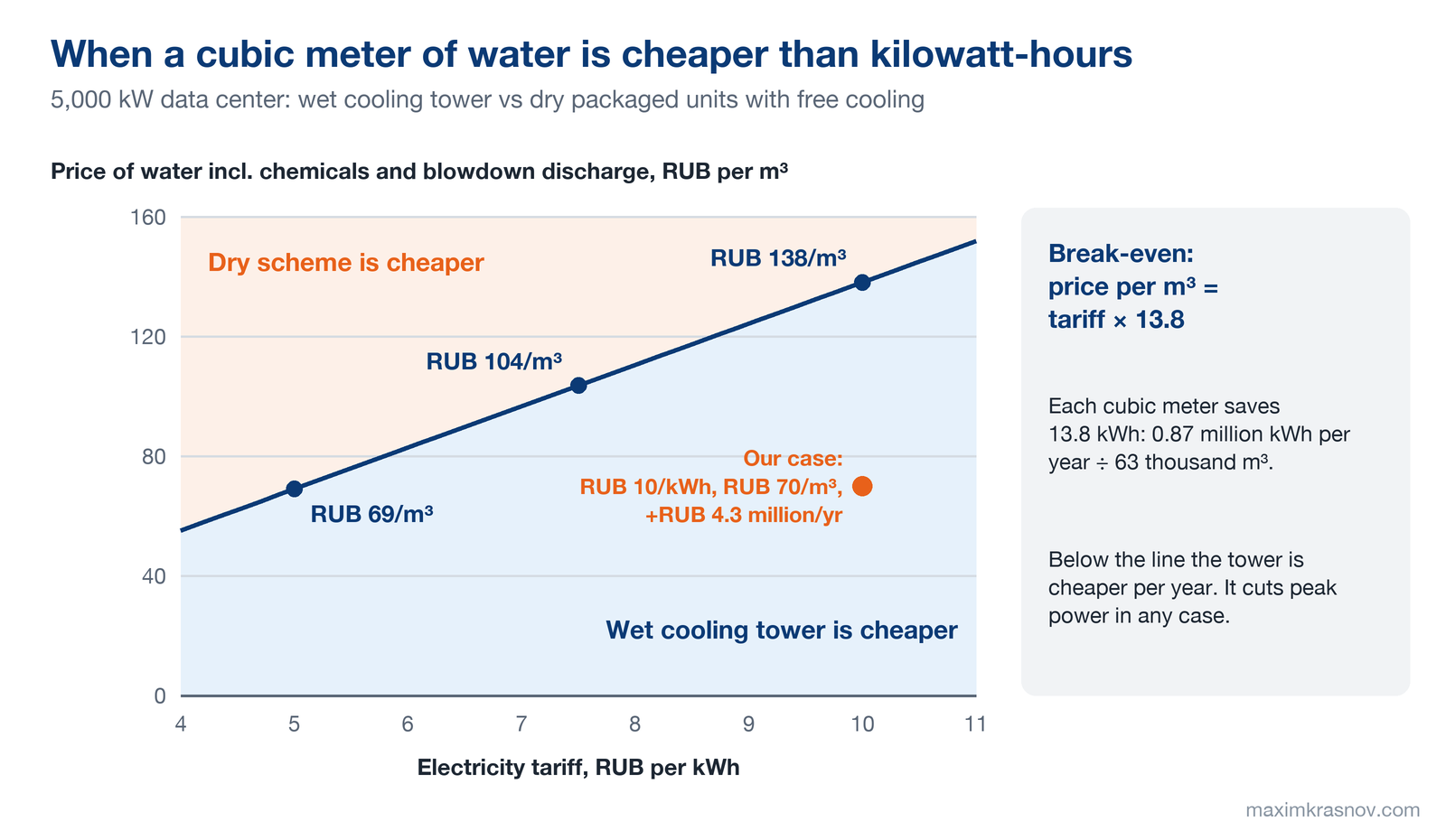
At a 5,000 kW data center, every cubic meter of water evaporated in a wet cooling tower saves about 13.8 kWh of electricity compared with dry packaged units with free cooling: 0.87 million kWh a year divided by 63 thousand m³. That gives the break-even point: the trade pays off as long as the full price of a cubic meter is below the tariff multiplied by 13.8.
| Electricity tariff, RUB per kWh | Water pays off if a cubic meter costs less than, RUB |
|---|---|
| 5 | 69 |
| 7.5 | 104 |
| 10 | 138 |
In our model water with treatment chemicals costs RUB 70 per m³, which is RUB 4.4 million a year. At RUB 10 per kWh the wet cooling tower saves RUB 8.7 million of electricity, a net gain of RUB 4.3 million a year. With water at RUB 30 per m³ the gain grows to RUB 6.8 million; at RUB 150 per m³ the cooling tower loses to the dry scheme by RUB 0.75 million a year.
The full price of a cubic meter includes the water itself, discharge of blowdown to the sewer and the chemicals. Sewer tariffs differ by region and should be confirmed before the calculation. Including service, the total cost of ownership comes to RUB 59.2 million a year for the packaged units and RUB 55.5 million for the chiller with a cooling tower: the annual bills are almost equal.
Why does peak power matter more than the annual bill?
Peak power matters more because annual kilowatt-hours are paid a little every month, while peak kilowatts are paid at once, through the grid connection fee, and only if the grid can supply them at all. The wet scheme cuts annual consumption by 16 %, and peak power by 32–39 %: from 1,667 to 1,015–1,130 kW.
Free cooling does not cut the peak. In summer, dry packaged units run on compressors at dry-bulb temperature, and the grid connection is sized for that peak. In summer a cooling tower works to the wet-bulb temperature, so the peak is lower.
A difference of 537–652 kW at a connection fee of RUB 47,000 per kilowatt is RUB 25–31 million, paid once. That equals the cost of water for the wet scheme over 6–7 years. In some regions a kilowatt of grid connection costs up to RUB 100,000, and then the difference doubles.
In Moscow the question is often not the price but whether capacity exists at all. Data centers draw about 1 GW today, they will need 3.1 GW by 2028, and the power reserve in 2026 is forecast below 5 %. Here a cooling tower sometimes decides whether a site gets a grid connection. Why AI growth runs into power and heat rejection, I explained in AI hits the cooling wall.
Why is Microsoft moving away from evaporative cooling, and why is that not always right in Russia?
Microsoft is moving away from evaporation because water is scarce at its sites, while in Moscow and St. Petersburg kilowatts are almost always the scarce resource. Since August 2024 Microsoft has been designing new data centers with a closed loop and no evaporation. By its estimate this saves more than 125 million liters of water a year per site; pilots in Phoenix and Mount Pleasant are in 2026, and the sites go live by the end of 2027.
The headlines skip it, but in the same announcement Microsoft states plainly that replacing evaporative cooling with mechanical cooling will raise PUE (the ratio of total data-center energy to IT equipment energy). The data center will use more electricity for the same compute.
This is not a flaw of the technology but a trade-off. Drop evaporation, and you reject the same heat through a dry surface into hot summer air. Higher condensing temperature, harder-working compressor, bigger bill.
Copy a global trend only after you have put your own numbers into the formula: your tariff, your climate and your return water temperature. In Arizona water decides whether a site can exist. In Moscow that question is more often about grid capacity.
When is a dry scheme without water the better choice?
A dry scheme wins when water is expensive or unavailable, the site is small, or nobody on site can run water treatment. Below 1,000 kW of cooling a wet cooling tower does not pay off: piping, water supply and an operations team do not earn back their cost. For such a site an ordinary chiller is the more honest and cheaper answer.
The second reason is the hidden cost of water. An evaporative cooling tower needs water treatment and biological control against Legionella. A water treatment unit costs around RUB 400 thousand, and chemicals for a 5 MW data center around RUB 70 thousand a year.
These are not impressive numbers, but without them the trade-off does not work: 0.3 mm of biofilm on the condenser of a 1,000 kW chiller costs about RUB 1 million a year in excess electricity.
There are intermediate options between the extremes. An adiabatic dry cooler sprays water only in hot hours: at 1,300 kW in Moscow it takes about 1.2 m³/h and no more than 106 m³ a year, while an evaporative cooling tower of the same capacity takes up to 2.0 m³/h for thousands of hours a year. A closed cooling tower with a finned coil runs wet in summer and switches to dry mode in cold weather, taking no make-up water.
Frankly, I do not mind what the customer chooses: we make open and closed cooling towers, dry coolers and chillers with free cooling. Our range works from Vorkuta to Bangladesh, where our closed cooling towers with finned heat exchangers run at the Rooppur nuclear power plant. So I can say it directly: the right answer comes from the calculation, not from habit.
How do I calculate the water-for-electricity trade-off for my site?
The trade-off is calculated in two lines: an annual one, electricity against water, and a one-time one, peak power against the grid connection fee. The steps are:
1. Calculate annual cooling electricity for the dry scheme and for the cooling tower scheme using seasonal efficiency, not the nameplate rating point.
2. Calculate annual water consumption from the load profile and the climate. A calculation based on the summer maximum overstates annual make-up water almost twofold.
3. Build up the full price of a cubic meter: water, blowdown discharge, chemicals.
4. Divide the kilowatt-hours saved by the cubic meters and multiply by the tariff. If the price of a cubic meter is lower, the cooling tower is cheaper per year.
5. Separately, calculate the difference in peaks, multiply it by the price of a kilowatt of grid connection, and check whether the grid can supply that capacity at all.
Before the calculation, ask your designer three questions. What is scarce for you: kilowatts or cubic meters? How many hours a year does the site run in the heavy mode? What water temperature can your equipment tolerate?
Our climate is an underrated advantage: for most of the year outdoor air does the work by itself, and the problem lives in thirty hot days, not in the annual balance.
Other ways to cut the cooling bill are collected in the Energy efficiency section, and a comparison of five data-center cooling schemes with capital costs is in data center cooling: five options for 5,000 kW.
Key takeaways
1. A cooling tower trades water for electricity. At a 5,000 kW data center the wet scheme saves 0.87 million kWh a year against dry packaged units with free cooling and uses 63 thousand m³ of water.
2. At such a site a cubic meter of evaporated water saves about 13.8 kWh. At RUB 10 per kWh the cooling tower is cheaper per year as long as a cubic meter, including discharge and chemicals, costs less than RUB 138.
3. A cooling tower cuts annual consumption by 16 %, and peak power by 32–39 %. The difference in peaks is worth RUB 25–31 million in one-time grid connection fees.
4. Dropping evaporation, as Microsoft does, is a deliberate trade of water for electricity. In Moscow and St. Petersburg kilowatts are scarce more often than cubic meters.
FAQ
Which is cheaper to run: a cooling tower or a dry cooler?
It depends on the tariff, the water price and peak power. At a 5,000 kW data center with electricity at RUB 10 per kWh, a wet cooling tower is cheaper if a cubic meter of water costs less than RUB 138, and it also cuts the peak by 537–652 kW. At sites below 1,000 kW of cooling the dry scheme is cheaper.
How much water does a data-center cooling tower use?
At a data center with 5,000 kW IT load, a scheme with a centrifugal chiller and a wet cooling tower takes about 63 thousand m³ of water a year; direct-to-chip cooling with a closed cooling tower takes about 40 thousand m³. Dry packaged units with free cooling take no water.
Why does free cooling not reduce peak power?
The peak of a cooling plant falls on the hottest hours, when free cooling does not work and the whole load is on the compressors. So packaged units with free cooling keep a peak of 1,667 kW, the same as chillers without it, and the grid connection is sized by the peak.
Can I get the savings of a cooling tower without high water use?
Partly, yes. A closed cooling tower with a finned coil runs dry in cold weather, and an adiabatic dry cooler uses water only in hot hours. This is a compromise: less water, but more electricity than an open cooling tower.
Sources
-
Microsoft, Sustainable by design: Next-generation datacenters consume zero water for cooling, 9 December 2024.
-
ASHRAE Handbook — HVAC Systems and Equipment, chapter 40 "Cooling Towers".
-
SanPiN 3.3686-21 (Russian sanitary rules on infectious disease prevention), chapter XLII "Prevention of legionellosis".
-
Cold Energy (NCT) experience and calculations: data center with 5,000 kW IT load, Moscow, tariff of RUB 10 per kWh, water with chemicals at RUB 70 per m³.
Need a cooling solution for your site? Get a consultation