
How to Cut Industrial Cooling Costs: 8 Measures with the Numbers
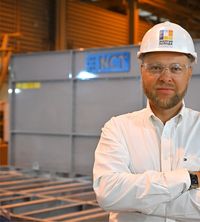
founder and CEO of Cold Energy (NCT)
Eight measures cut a plant's cooling costs: free cooling, a warmer water temperature regime, variable-speed drives, adiabatic cooling, water treatment, heat recovery, correct selection and service. Free cooling is the strongest: on a year-round 1,000 kW load in Moscow it saves about 1.78 million kWh a year, 61 % of compressor electricity, or RUB 17.8 million at RUB 10 per kWh.
A chiller's price is 5–15 % of what a plant will spend on cooling over 15 years. FacilitiesNet estimates the initial equipment cost at 5–10 % of the life-cycle cost of a chiller plant; our calculations give up to 15 %, depending on the system. The rest goes to electricity, water, service and spare parts. Yet cooling is most often chosen on the price of the machine.
All the calculations below are in kilowatt-hours, with money at RUB 10 per kWh. At a different tariff only the money line changes.
How much does free cooling save?
Free cooling is a mode in which water or glycol is cooled by outdoor air through a dry cooler or a cooling tower while the compressor is off. On a year-round 1,000 kW load, with a 12/18 °C water regime and a "cooling tower plus plate heat exchanger" system in Moscow, that is about 1.78 million kWh a year out of the 2.92 million a chiller without free cooling would use.
Our climate gives a large reserve: according to 2015–2024 reanalysis data, the wet-bulb temperature in Moscow stays below 5 °C for 4,696 hours a year, or 54 % of the time. In our calculation for a 5,000 kW data center, a packaged unit with free cooling had about 4,500 hours of free cooling, and the seasonal coefficient of performance (COP: kilowatts of cooling per kilowatt of electricity) rose from 3.0 to 5.5.
An example from practice: a powder metallurgy plant with 4.6 MW of cooling on 7/12 °C water. In summer a Thermax absorption chiller runs, and three NCT cooling towers reject its heat. In winter the machine rests: two cooling towers cool the water from 12 to 7 °C and send it through heat exchangers straight to production.
Free cooling pays off where cooling is needed in winter: data centers, process cooling, server rooms. And watch the changeover setpoint: the default setting eats up to a third of the free hours. The systems are described in detail in the article on chillers with free cooling.
Why raise the chilled water temperature?
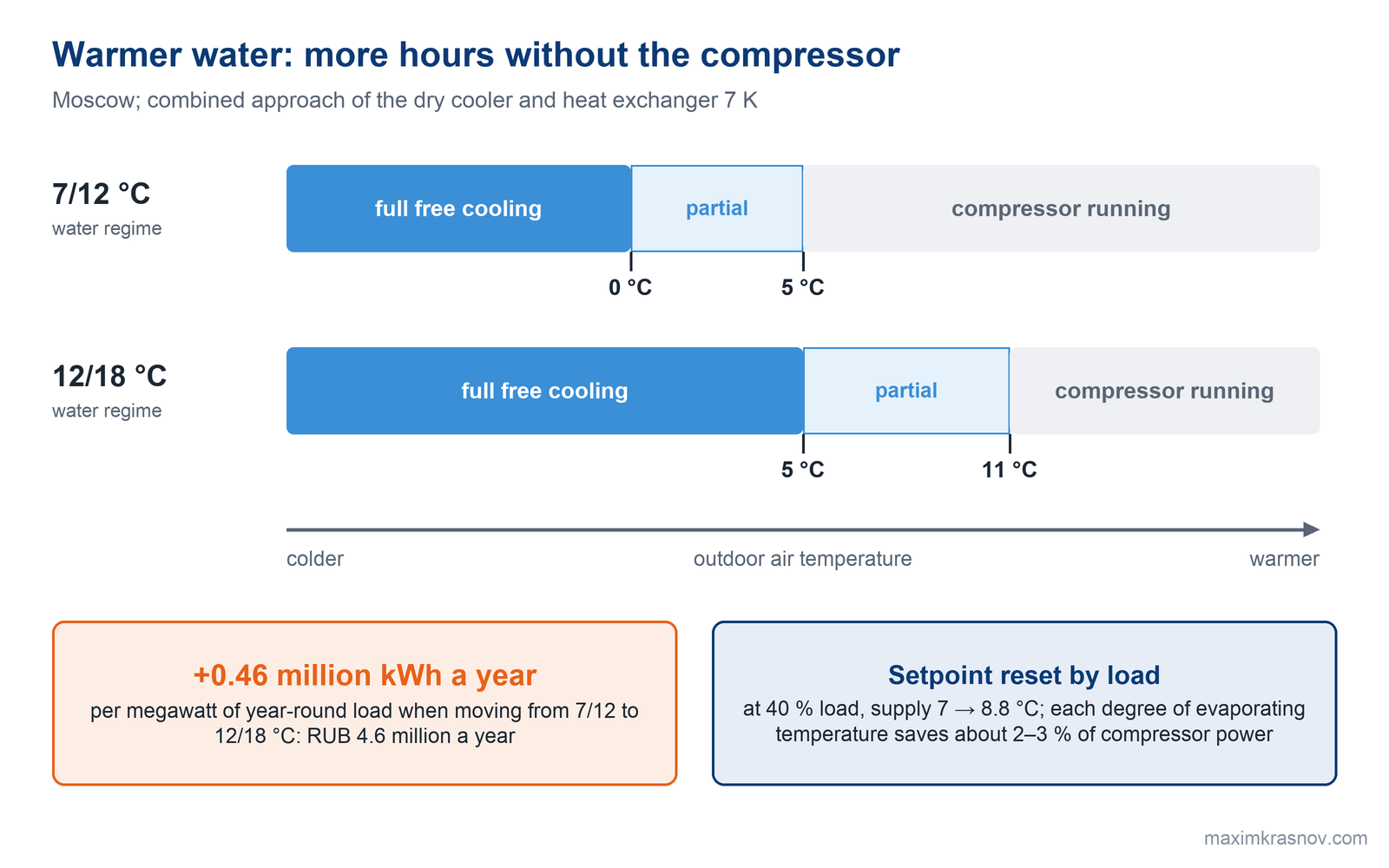
Every degree of supply temperature upwards shifts the free cooling threshold by a degree and adds hours without the compressor. Moving from a 7/12 °C to a 12/18 °C regime in Moscow adds about 0.46 million kWh of savings per megawatt of year-round load, RUB 4.6 million a year.
With a 7/12 °C regime and a combined approach of the dry cooler and heat exchanger of 7 K, partial free cooling starts below 5 °C outdoors and full free cooling below 0 °C. At 12/18 °C the thresholds rise to 11 and 5 °C.
The second technique is setpoint reset by load: at 40 % load the controller raises the supply temperature from 7 to 8.8 °C. Each degree of higher evaporating temperature gives about 2–3 % compressor savings. The limit: upward reset is not allowed for consumers that dehumidify air, otherwise room humidity will climb.
Where do variable-speed drives pay back fastest?
A variable-frequency drive (VFD, a device that smoothly changes motor speed) pays back fastest on cooling tower fans and secondary pumps. On a cooling tower with 60 kW of fans running 8,000 hours a year at an average airflow demand of 60 %, it saves about 173,600 kWh a year, or RUB 1.74 million.
The cube law is at work: fan power is proportional to the cube of speed. Without a VFD the fan cycles on and off and draws 36 kW on average; at 60 % speed it draws 14.3 kW, including drive losses.
For pumps, the position of the differential pressure sensor decides. In a 172 m³/h secondary loop, a pump without a drive uses 30,700 kWh a year, with the sensor at the pump skid 27,100, and with the sensor at the most remote branch 21,600 kWh. Lower limits: a cooling tower fan no lower than 30 % speed, a primary loop pump no lower than the minimum flow through the evaporator, usually 40–50 % of nominal.
Does adiabatic cooling pay off in a temperate climate?
In Moscow and St. Petersburg adiabatic cooling pays off not through annual energy savings but through capacity and reliability in hot weather. Adiabatic pre-cooling sprays water in front of the heat exchanger of an air-cooled condenser or dry cooler, and the air cools by 5–15 °C depending on the climate.
Minus 5 K at the inlet lowers condensing by about 5 K and saves about 16 % of compressor power in a hot hour. But Moscow has only about 88 hours a year above 28 °C: for a NASA43 chiller with 48 kW compressors that is only 0.7 thousand kWh. In return the machine stays in its operating envelope when the air goes beyond the design value: the base range of our packaged units is up to +35 °C, while the absolute maximum in Moscow per SP 131.13330 (Russian building climatology code) is 38 °C.
A risk that rarely gets mentioned: an adiabatic dry cooler is a radiator with water sprayed on it. Untreated water eats the aluminium fins with hardness salts, and within two years the dry cooler can be lost. That is why we install adiabatic systems when the customer has serious water treatment and a strong operations team.
How much money is lost to poor water?
In our experience, when equipment does not deliver its capacity, nine times out of ten the water is to blame, and 1 mm of scale on a heat exchanger means minus 30 % of capacity. The second loss is blowdown: evaporation carries away pure water, the salts stay, and part of the water has to be discharged.
An open loop of 1,000 m³/h evaporates 12.6 m³/h. A manual valve opened "with a margin" holds two cycles of concentration and discharges 12.6 m³/h; conductivity-based automatic control holds five cycles and discharges 3.15 m³/h. The 9.45 m³/h difference is lost both from make-up and to the drain: at notional tariffs of RUB 60 per m³ for water and RUB 40 per m³ for wastewater, that is about RUB 3.8 million over 4,000 hours of wet season. A blowdown panel with two water meters pays back within a season.
A free check: calculate the cycles by conductivity and by chlorides. Chlorides do not precipitate, so if they give 6 and conductivity gives 4, part of the salts has already settled in the heat exchangers.
How do you turn waste heat into cooling?
Heat from 80 °C (steam, hot water, gas engine exhaust) is turned into cooling by an absorption chiller. It needs 5–10 kW of electricity per megawatt of cooling, against 300–350 kW for a compressor machine.
At SIBUR's Polief plant, spent steam was vented to the atmosphere, while acid was cooled by a 1,000 kW compressor chiller drawing a constant 300 kW. We installed a Thermax absorption chiller running on that steam: 300 kW saved, payback in a few months. Running around the clock, that is up to 2.6 million kWh a year.
An absorption chiller is worth considering at a load from 300 kW of cooling and operation from 3,000–4,000 hours a year. More in the section on absorption chillers and trigeneration. If the heat is needed for space heating rather than cooling, there is the absorption heat pump: per 1 kW of driving heat it delivers 1.3–1.7 kW to the heating network. In Belarus we installed a 24 MW heat pump of this kind.
Which selection mistakes eat money for years?
The most expensive mistake is choosing the heat rejection system on the price of the machine. At 1,000 kW of cooling and 3,000 hours a year, a chiller with an air-cooled condenser uses about 198,000 kWh more than a water-cooled machine on a cooling tower, around RUB 2 million a year before deducting water and cooling tower maintenance. An air-cooled condenser condenses at 46 °C, a water-cooled one at about 35 °C, and each kelvin costs 1.8–4.0 % of compressor power.
1. A compressor you do not need. If the process needs water warmer than the design wet-bulb temperature plus 4 K, a cooling tower will cool it without a chiller. How to select one is in the article on choosing an industrial cooling tower.
2. Comparison at full load. A machine with COP 5.0 and IPLV (integrated part-load value) 6.3 saves 39,683 kWh a year against a machine with COP 5.2 and IPLV 5.6.
3. A cooling tower sized "for the cooling load". It receives the condenser heat: at COP 5 that is 1.2 kW per kilowatt of cooling.
4. A pump "with a margin". Without control it pushes excess water, and a throttled valve kills the excess head at the cost of electricity.
What is service worth in money?
Service returns money by keeping the machine at its rated consumption for longer and keeping it running in summer. A compressor overhaul in year ten costs half the price of the machine, glycol is replaced every 3–5 years, and these lines go into the total cost of ownership from day one.
At first start-up, pressures, superheat, subcooling, temperatures and current are written into a log. A year later this is the reference for the service engineer: deviations reveal heat exchanger fouling before capacity drops. In glycol loops the concentration is checked: a weak solution does not mean "holds frost slightly worse", it means a sharp rise in corrosion.
Which measure gives the most: eight measures compared
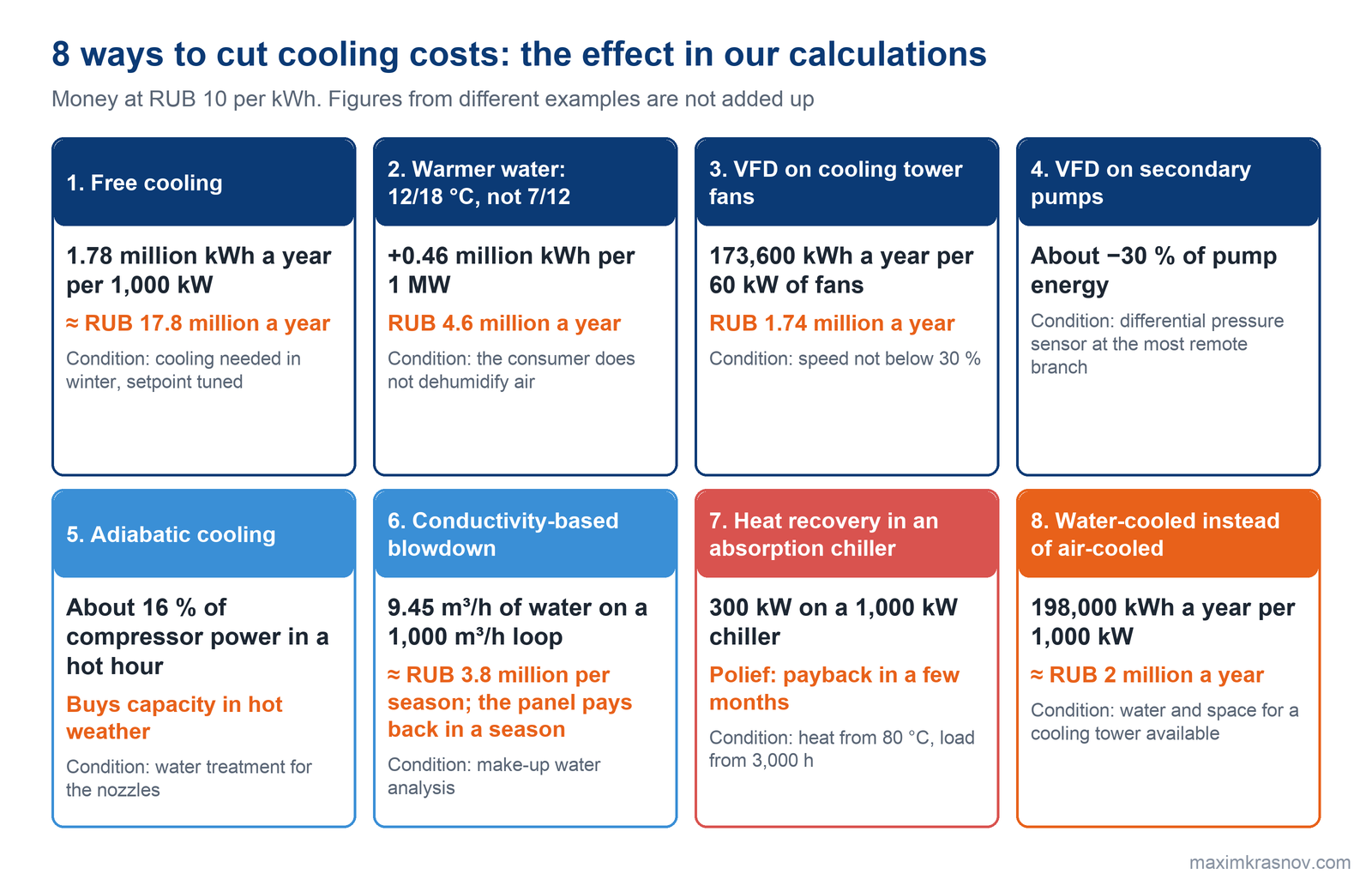
| Measure | Effect in our calculations | Main condition |
|---|---|---|
| Free cooling | 1.78 million kWh a year per 1,000 kW, 12/18 °C regime, Moscow | Cooling needed in winter, setpoint tuned |
| Warm water regime | +0.46 million kWh per 1 MW when moving 7/12 → 12/18 °C | The consumer does not dehumidify air |
| VFD on cooling tower fans | 173,600 kWh a year per 60 kW of fans | Not below 30 % speed |
| VFD on secondary pumps | About −30 % of pump energy | Differential pressure sensor at the most remote branch |
| Adiabatic cooling | About 16 % of compressor power in a hot hour | Water treatment for the nozzles |
| Conductivity-based blowdown | 9.45 m³/h of water on a 1,000 m³/h loop | Make-up water analysis |
| Heat recovery in an absorption chiller | 300 kW on a 1,000 kW chiller | Heat from 80 °C, load from 3,000 h |
| Water-cooled instead of air-cooled | 198,000 kWh a year per 1,000 kW | Water and space for a cooling tower available |
Figures from different examples cannot be added up: free cooling and the warm water regime are calculated on the same hours. The total for your own site comes from one calculation of the whole plant.
Key takeaways
1. The machine is 5–15 % of cooling costs over 15 years, so options are compared on total cost of ownership, not on chiller price.
2. Free cooling saves the most on a year-round load: about 61 % of compressor electricity at a 1,000 kW site in Moscow.
3. VFDs pay back where flow varies: on cooling tower fans and in secondary loops with the sensor at the most remote branch.
4. In a temperate climate, adiabatic cooling buys capacity in hot weather, not annual savings.
5. Steam and hot water in an absorption chiller take almost all compressor power off the grid: 5–10 kW per megawatt of cooling against 300–350.
FAQ
Where do you start cutting cooling costs?
With measurement. You need the annual consumption of the chiller plant in kilowatt-hours, the monthly load profile and the water temperature the process actually requires. Without these numbers any measure is a guess.
Can costs be cut with controls alone?
Partly, yes. The free cooling setpoint, water setpoint reset by load, moving the differential pressure sensor to the most remote branch and conductivity-based blowdown do not require replacing machines. In 2016 Google and DeepMind handed control of data center cooling to a neural network and cut cooling energy by up to 40 %.
Does free cooling pay off for office air conditioning?
Usually not. Office air conditioning barely runs in winter, there are few cold hours with load, and the pumps and valves of free cooling will add more than they save.
Which is cheaper to run: a cooling tower or a dry cooler?
A cooling tower cools down to the wet-bulb temperature and gives colder water, but it consumes water and needs water treatment. A dry cooler uses no water, but cools only down to the dry-bulb temperature. If the site has treated water and an operations team, a cooling tower is usually cheaper to run.
Sources
-
Thomas Bakane, FacilitiesNet: Chillers: Examine Life-Cycle Costs.
-
Google DeepMind, 2016: DeepMind AI reduces Google data centre cooling bill by 40%.
-
ASHRAE Climatic Design Conditions 2021; SP 131.13330 "Building Climatology" (Russian building code).
-
CTI ESG-151 on variable-speed drives for cooling tower fans; AHRI 550/590 on the IPLV metric.
-
Cold Energy experience and calculations: free cooling hours from ERA5 reanalysis 2015–2024, calculation for a 5,000 kW data center, the Polief site and the powder metallurgy plant; tariff RUB 10 per kWh.
All articles on cutting cooling costs are in the Energy efficiency topic; a comparison of systems on one site is in the analysis of five data center cooling options.
Need a cooling solution for your site? Get a consultation