
Food Plant Cooling Costs: Where a Food Factory Loses Money

founder and CEO of Cold Energy (NCT)
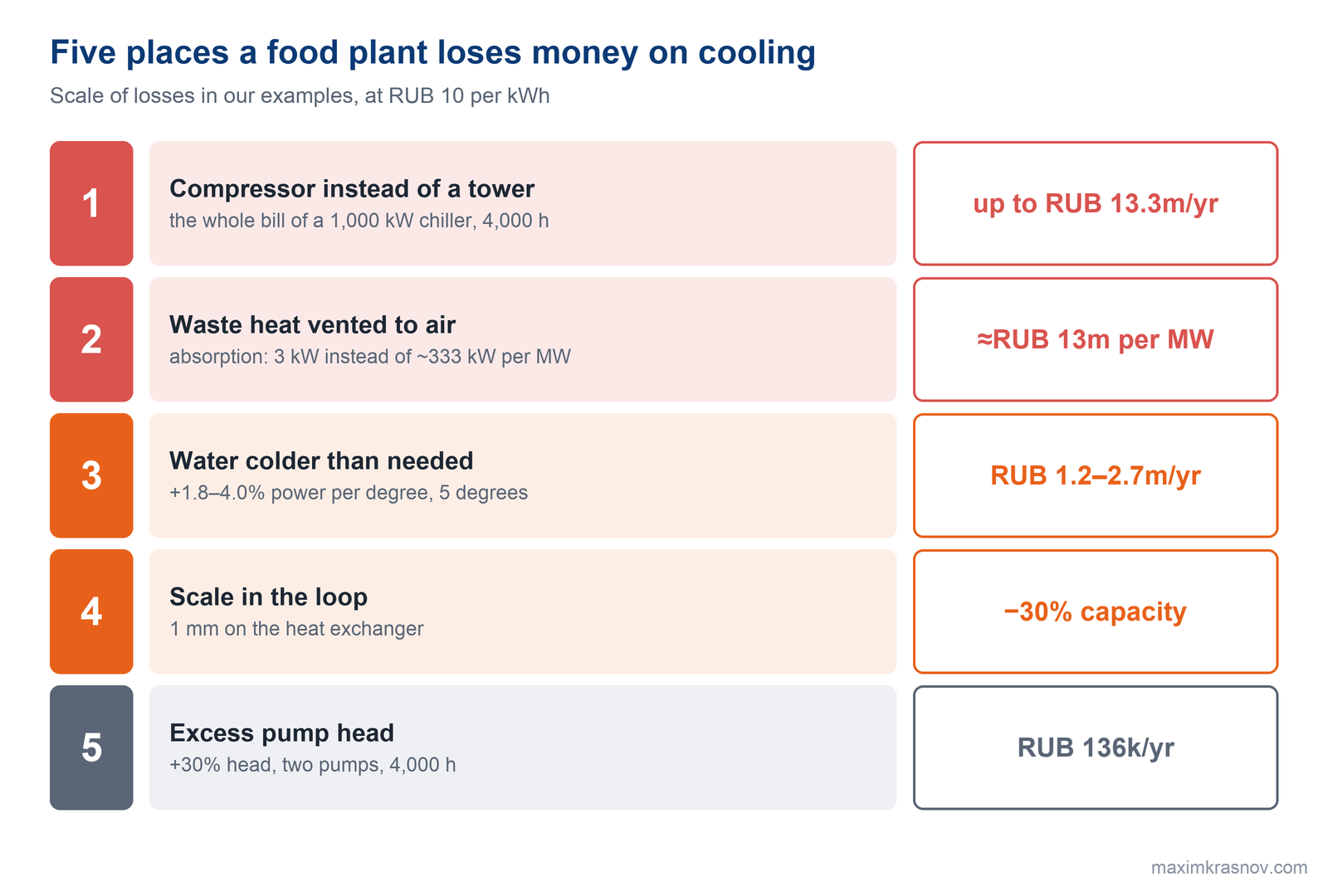
At a brewery or a meat processing plant, cooling takes up to 80–90% of the site's electricity. A food plant loses money on cooling in five places: a compressor where a cooling tower would do; water colder than the process needs; waste heat vented to the atmosphere; scale in the loops; and safety margins added "just in case". Every unnecessary degree of cooling costs 1.8–4.0% of compressor power.
This article is for the owner and the CFO of a food plant: where money leaks out of cooling and what pays back fastest. The examples come from dairy, confectionery, meat, oils and fats, and canning plants running our equipment: the agri-food section of the NCT reference list has more than a hundred entries.
All money figures below are at RUB 10 per kWh. At a different tariff, only the money line changes.
What water temperatures does a food plant need, and what produces them?
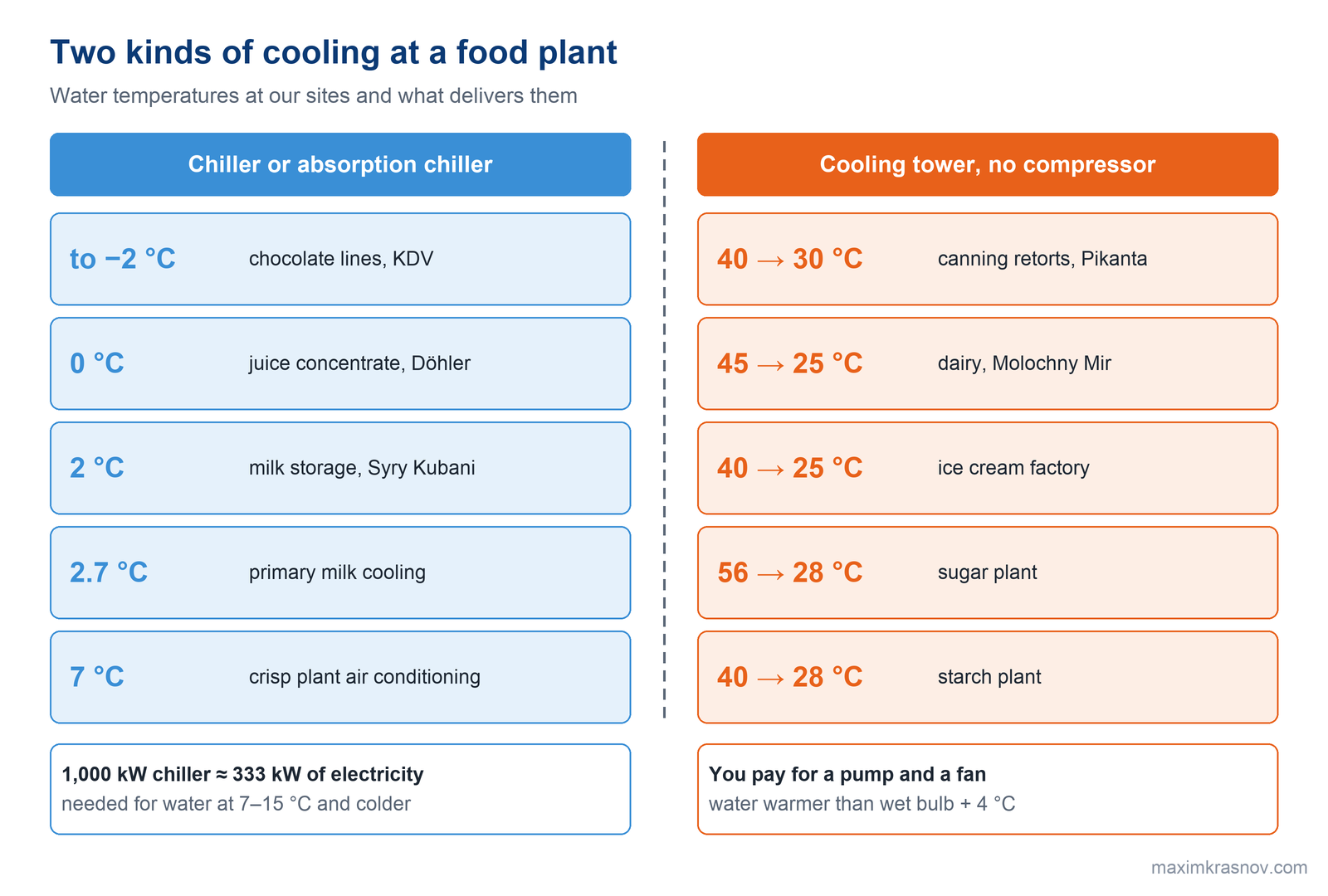
A food plant needs two different kinds of cooling: chilled water from −2 to 7 °C for the product and air conditioning, and warm process water at 25–56 °C for condensers, retorts, freezers and evaporators. The first comes from a chiller or an absorption chiller, the second from a cooling tower with no compressor.
| Process | Water temperature | Cooled by | Site |
|---|---|---|---|
| Milk storage, chilled water | 12 → 2 °C | Steam-fired absorption chiller | Syry Kubani, Krasnodar region |
| Primary milk cooling | 7.7 → 2.7 °C | Hot-water absorption chiller | Kropotkin dairy plant |
| Chocolate lines | down to −2 °C, 320 kW | NARA glycol chiller | KDV confectionery factory |
| Juice concentrate | 14 → 0 °C, propylene glycol | Absorption chiller plus dry coolers for free cooling | Döhler ingredients plant, Lobnya |
| Barley germination (air at 9–12 °C) | 8 → 3 °C | Absorption chiller on boiler-house steam | Kursky Solod malt plant |
| Air conditioning of a crisps production hall | 12 → 7 °C | Absorption chiller on fryer heat | Crisps plant, Moscow region |
| Sterilizing canned food in retorts | 40 → 30 °C | Cooling tower | Pikanta, Astrakhan |
| Dairy process water | 45 → 25 °C | Cooling tower | Molochny Mir, Grodno |
| Process water loop of an ice cream factory | 40 → 25 °C | Cooling tower | Kalinov Most, Dzerzhinsk |
| Process water loop of a sugar plant | 56 → 28 °C | Cooling tower | Atmis-Sakhar, Penza region |
The table shows the main fork in the money. Water at 7–15 °C for food lines, and anything colder, needs a refrigeration machine. Anything warmer than the wet-bulb temperature plus 4 degrees can be cooled by evaporation, and that puts the electricity bill in a different order of magnitude.
Where does a food plant overpay for compressors?
A food plant overpays for compressors wherever warm water is pushed through a chiller. If the process needs water warmer than the wet-bulb temperature plus 4 degrees, a cooling tower will cool it: you pay for a pump and a fan, not a compressor, and electricity use drops several times over.
One number shows the scale. A standard 1,000 kW chiller draws about 333 kW of electricity. At 4,000 operating hours a year, that is 1.33 million kWh, or RUB 13.3 million. If the load consists of condensers, retorts and oven cooling water, most of that money pays for a compressor this water does not need.
At most plants the right answer is "both". In summer the cooling tower takes heat from the chiller condenser; in winter it supplies cold water on its own and the compressors stay off. The second overpayment is an air-cooled condenser instead of a water-cooled one: for 1,000 kW of cooling at 3,000 hours a year, an air-cooled chiller uses roughly 198,000 kWh more, about RUB 2 million a year. More on choosing the scheme in the article on cooling towers versus dry coolers.
What does water colder than the process needs cost?
Every degree you make the chilled water colder raises compressor power by 1.8–4.0%. On a 1,000 kW chiller drawing about 333 kW, an extra 5 degrees adds roughly 30–67 kW. At 4,000 hours a year that is 0.12–0.27 million kWh, or RUB 1.2–2.7 million every year.
The extra degrees creep in unnoticed. Food process water is not sent through the chiller evaporator: the product is cooled through an intermediate heat exchanger, and only a water solution of propylene glycol may be used directly. That separation has a price, the approach of the heat exchanger: to deliver 7 °C at the user, the machine has to produce colder water.
The second item is glycol. Below +6 °C, NCT machines run only on ethylene or propylene glycol solution, and the solution itself takes capacity away: on 40% propylene glycol the machine delivers 0.90 of its capacity on water. The concentration should be the minimum that does the job, not "fifty, to be safe": 50% instead of 40% takes another 3% of capacity and adds almost a fifth to the pump head.
So the first question to the process engineer is simple: what temperature does the product really need. Every degree up that the process can tolerate is money the plant stops paying every year.
How much money does a food plant vent to the atmosphere as waste heat?
A food plant almost always has heat going to waste: boiler-house steam, hot water, oven heat. An absorption chiller turns that heat into cooling: for 1,000 kW of cooling it needs about 3 kW of electricity, against roughly 333 kW for a standard chiller. In return it consumes about 1.5 MW of heat per megawatt of cooling.
If the heat really is waste, the 330 kW difference at 4,000 hours a year comes to 1.32 million kWh, or about RUB 13 million a year per megawatt of cooling. This is how it works at food plants running Thermax machines and NCT cooling towers:
1. Kursky Solod: two steam-fired absorption chillers, 3.5 MW, hold 9–12 °C in the malting hall. The halls are cooled with waste heat.
2. A crisps plant in the Moscow region: hot water for a 1 MW machine is heated by a heat recovery unit on the fryer where the crisps are cooked.
3. Kropotkin dairy plant: a 0.5 MW hot-water machine handles primary milk cooling, offloading the existing chillers and saving electricity.
4. Syry Kubani: a 3.5 MW steam-fired machine supplies 2 °C water for storing milk and dairy raw materials.
In our experience an absorption chiller pays off from 300 kW of cooling. It costs 20% more than a standard chiller, but that is often offset from day one by savings on the grid connection. More on how it works in the article on absorption chillers.
What does dirty water in the cooling loop cost?
When equipment on site does not deliver its rated capacity, nine times out of ten the water is to blame, not the manufacturer and not the installers. One millimetre of scale on a heat exchanger means minus 30% capacity.
In a cooling tower part of the water evaporates, the salts stay behind, and without blowdown and inhibitors the loop scales up. A chiller adds glycol to the picture: too low a concentration does not mean "slightly less frost protection", it means a sharp rise in corrosion. That is why we supply cooling towers to food plants together with water treatment: NCT W2C or W0C panels run at Syry Kubani, Pikanta, Kursky Solod and the Kalinov Most ice cream factory.
The fastest payback in cooling of all belongs to a conductivity-controlled blowdown panel: on an open loop of 1,000 m³/h it cuts discharge by 9.45 m³/h and pays back within a season. The calculation is in the article on cooling tower water consumption.
Why does a "just in case" margin cost money every year?
A margin added several times over becomes an annual overpayment. A reasonable cooling margin is 10–15%, added once and in one place. If the process engineer adds 15%, the designer another 10%, and the model is rounded up, the machine ends up a third larger than needed and short-cycles for its whole life.
Pumps are the same. A head margin "by eye" of +30% (21.3 m instead of 16.4 m) forces you to throttle a valve, which burns off 4.9 m of head: about 1.7 kW wasted per pump, 13,600 kWh a year on two pumps at 4,000 hours, or RUB 136,000 every year.
How do you find cooling losses at an operating plant?
Losses at a running plant are found by measurement, not from the design: old plants often have no documentation. A case from practice: the vacuum evaporator at a dairy plant cannot keep up, the plant is thirty years old, the drawings are partly lost, and nobody knows the flows in each loop.
To a site like that we send a survey engineer with clamp-on flow meters, temperature and pressure sensors, a sound level meter and a laser rangefinder. In a day or two they capture the real picture, and a couple of weeks later the customer receives a technical proposal based on the measurements. This works best for retrofits with a loop flow from 100–200 m³/h. The survey is often free of charge.
Cooling upgrades pay back in more than electricity. At the Gulkevichi starch plant, two NCT cooling towers rated at 10 MW and 700 m³/h, together with other modern equipment, helped cut specific gas consumption by 90 m³ per tonne of product.
What pays back fastest? Comparing the measures
| Measure | Where money is lost | Effect in our practice | Condition |
|---|---|---|---|
| Conductivity-controlled cooling tower blowdown | Water and wastewater | −9.45 m³/h on a 1,000 m³/h loop, pays back within a season | Make-up water analysis |
| Cooling tower instead of a compressor | Compressor electricity | Up to RUB 13.3 million a year per 1,000 kW at 4,000 h | Water warmer than wet bulb + 4 °C |
| Absorption chiller on waste heat | Compressor electricity | 3 kW instead of ~333 kW per 1 MW of cooling | From 300 kW of cooling, steam or hot water available |
| Warmer chilled water setpoint | Compressor electricity | 1.8–4.0% of compressor power per degree | The process can tolerate it |
| Water treatment | Capacity | 1 mm of scale means minus 30% | Water and glycol monitoring |
| Pumps without excess head | Pump electricity | 13,600 kWh a year on two pumps | Honest loop calculation |
Figures from different rows cannot be added up: they were calculated on different examples. The total for your plant comes from one calculation of the whole cooling system. A general list of measures for any industry is in the article on cutting cooling costs and in the Energy efficiency topic.
Key takeaways
1. At a brewery or meat processing plant, cooling takes up to 80–90% of electricity, so cooling losses show up in every power bill.
2. Warm process water at 25–56 °C for retorts, freezers and condensers is cooled by a cooling tower with no compressor; a chiller is needed for water at 7–15 °C and colder.
3. Every degree colder than needed costs 1.8–4.0% of compressor power.
4. Boiler-house steam and oven heat in an absorption chiller produce cooling with almost no electricity: about 3 kW per megawatt of cooling against 333 kW for a chiller.
5. One millimetre of scale takes away 30% of capacity, and conductivity-controlled blowdown pays back within a season.
FAQ
We need water at +2 to +4 °C for washing or dough mixing. What should we install?
Usually not a chiller on plain water: at 2 °C a standard evaporator risks freezing. More often the setup is a glycol chiller, a heat exchanger so the glycol never meets the product water, a chilled water tank for peak draw, and a pump. If washing runs in shifts, look at ice thermal storage. Tell the supplier right away whether the water circulates or goes to drain: both the capacity and the tank depend on it.
Our old cooling towers are in good order, but in summer the water is 40 °C instead of 32 and the plant cuts output. What should we do?
Rebuild or expand; repairs will not help here. These units were sized to the old SNiP codes (Soviet-era Russian building codes) for milder summers, and in today's heat a working unit simply falls short. To defend the project in front of management, do a pre-design study: location, specifications, economics and payback. Compare it with the lost output: at one oils and fats plant with a 20–30% drop over six months, an additional unit would have paid for itself in a month or two.
Our plant dumps hot water. What data do we need to estimate how much cooling it could give?
A few numbers: supply and return temperatures, flow rate, electricity tariff, and cooling load split between process lines and air conditioning. The daily load profile tells the most: heat and cooling demand have to coincide in time, otherwise the machine sits idle. From a questionnaire we will calculate output, price, footprint and payback. If it comes out at more than five years, I would question the idea.
Sources
-
Cold Energy experience and calculations: reference lists of NCT equipment and Thermax absorption chillers, food and agri-food sites 2016–2026.
-
Cold Energy: engineering guide to NCT chillers (2026), covering glycol corrections, capacity and head margins, and intermediate heat exchanger approach.
-
SP 131.13330 (Russian building climatology code): design wet-bulb temperature for cooling tower selection.
Need a cooling solution for your site? Get a consultation
Watch: food industry (in Russian)
 NCT cooling towers and Thermax absorption chiller at Syry Kubani