
What Is an Absorption Chiller? How It Works, When It Beats a Chiller
founder and CEO of Cold Energy (NCT)
An absorption chiller makes cooling not from electricity but from heat: steam, hot water from 80 °C, natural gas or engine exhaust. The machine itself draws 5–10 kW from the grid per 1 MW of cooling, while a compressor chiller of the same capacity needs 200–350 kW. An absorption chiller pays off where heat is cheap or wasted, electrical capacity is short, and cooling is needed for 3,000–4,000 hours a year or more.
Cold Energy is the exclusive distributor of Thermax: we do not manufacture absorption chillers, we select, supply, commission and service them. Below is what I explain to a plant's chief engineer at the first meeting: how the machine works, where it pays back, and where it is more honest to install an ordinary chiller.
How does an absorption chiller work?
An absorption chiller is a refrigeration machine in which heat does the work of a mechanical compressor. The refrigerant is ordinary water, and the absorbent is a solution of lithium bromide, a salt with properties similar to table salt. Inside the machine there is a deep vacuum, about 6 mm of mercury, so water boils at 3–5 °C and takes heat from the water going to the consumer.
Four vessels keep the cycle going. In the evaporator, water boils and cools the consumer's water. In the absorber, strong lithium bromide solution absorbs that vapor. A pump sends the diluted solution to the generator, where steam, hot water or a burner boils water out of it. The vapor condenses in the condenser and returns to the evaporator, and the strong solution returns to the absorber.
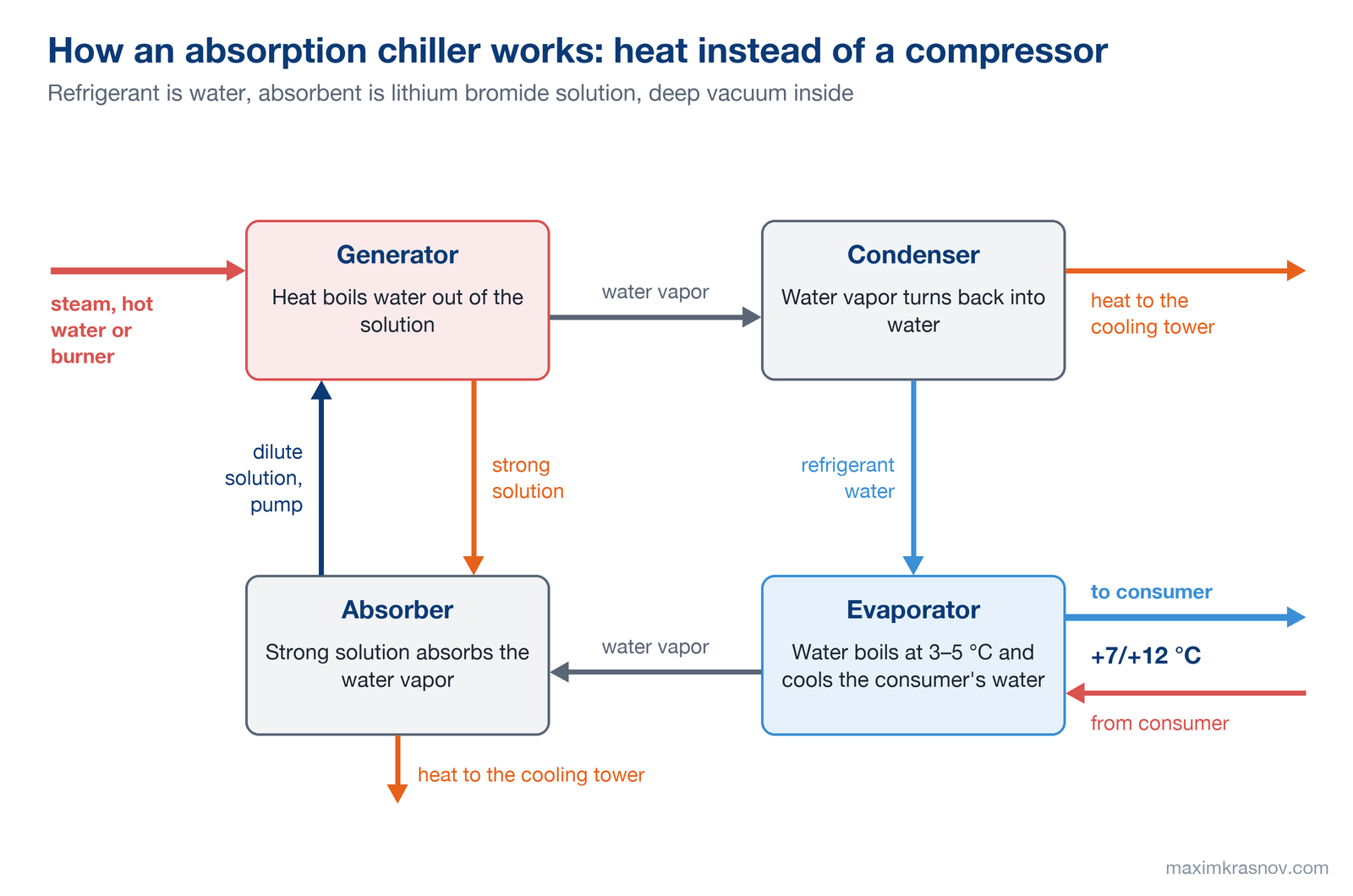
When talking to customers I call it a "chemical compressor": heat does the job of the chiller's electric motor. There is no refrigerant gas and no compressor; the only moving parts are the solution and refrigerant pumps.
The standard chilled water temperature is +7/+12 °C, with an outlet range from 0 to +25 °C. Lithium bromide absorption does not work below −5 °C.
What types of absorption chillers are there: steam, hot water, gas and exhaust?
Absorption chillers differ by heat source and by number of effects (stages). A single-effect machine runs on 70–110 °C hot water or low-pressure steam, and its thermal COP (coefficient of performance: cooling divided by heat input) is about 0.7. A double-effect machine needs 4–9 bar steam, gas or exhaust, but gives a COP of 1.30–1.45: almost twice as much cooling from the same ton of steam.
| Heat source | Thermax series | Effects | COP | What the site must provide |
|---|---|---|---|---|
| Hot water | LT, 5G, HS, 2G | single | about 0.7 | water at 70–110 °C, economically from 80 °C |
| Low-pressure steam | SS | single | about 0.7 | pressure at the valve, steam dryness, condensate return |
| Steam | SD, 2B | double | 1.30–1.45 | steam at 1.4–9.9 bar |
| Gas, direct-fired | 2V, GD | double | 1.40–1.45 | gas at 60–100 mbar before the burner, gas allowance |
| Gas engine or turbine exhaust | exhaust-fired | single or double | per data sheet | exhaust at 275–600 °C, allowable engine back pressure |
These figures match independent data. The US Department of Energy, in its fact sheet on absorption chillers for combined heat and power, gives a COP of 0.70–0.79 for single-effect and 1.35–1.42 for double-effect machines.
If the site has steam at 5 bar or more, compare a double-effect machine with a single-effect one over 10 years: the difference in steam over a season is often larger than the difference in machine price. A direct-fired gas machine can work as a heater for space heating in winter. I cover a machine running on gas engine heat in the article on trigeneration.
How much electricity does an absorption chiller itself use?
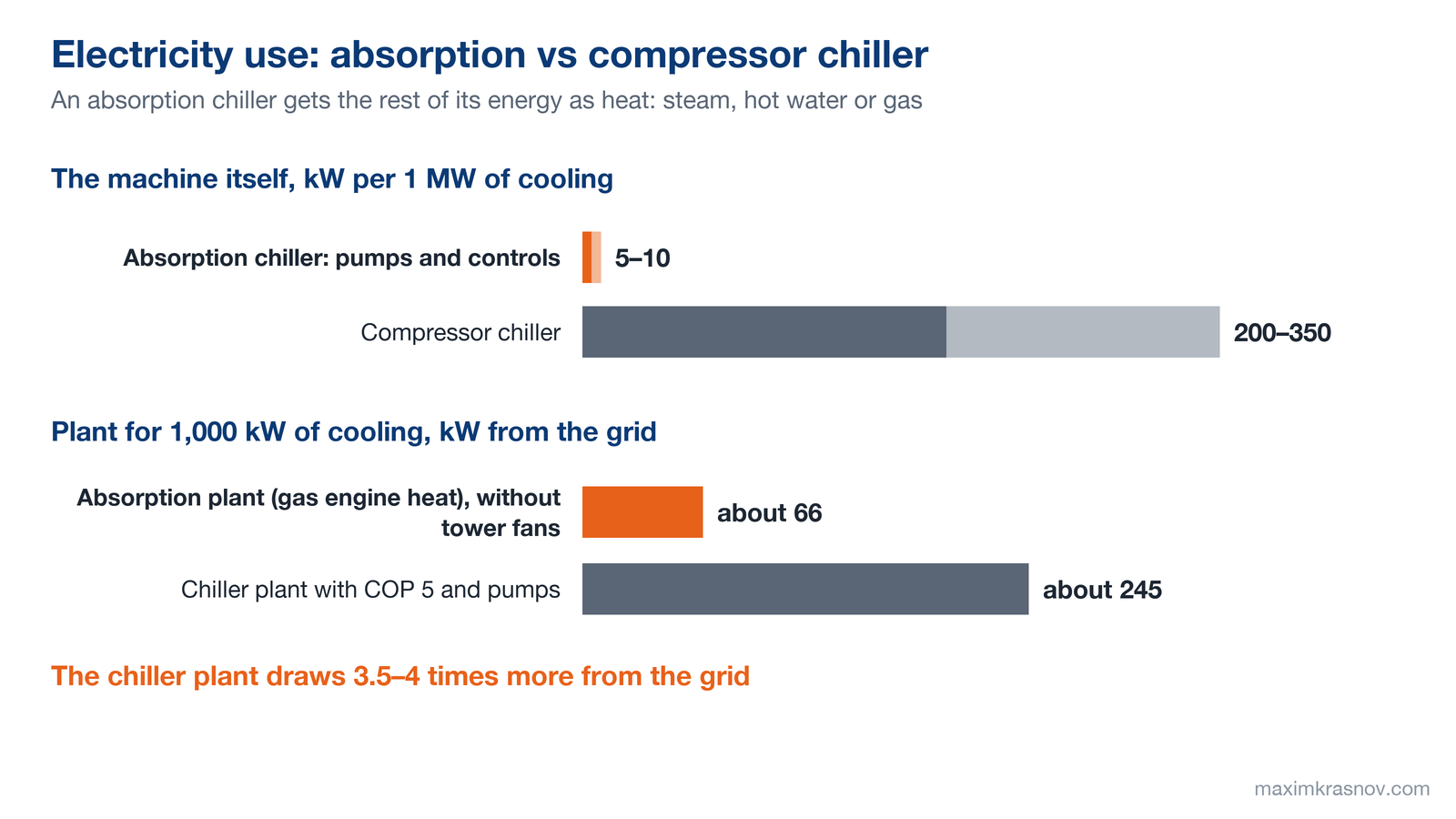
The absorption chiller itself uses 5–10 kW of electricity per 1 MW of cooling: the solution and refrigerant pumps and the controls. A gas-fired machine adds a burner, from 0.75 to 15 kW depending on the model. A compressor chiller of the same megawatt takes hundreds of kilowatts, 200–350 kW depending on the machine and the operating point.
It is important not to confuse the machine with the complete plant. The pumps of the three loops and the cooling tower fans also use electricity. In our calculation of a 1,000 kW cooling plant where the absorption chiller runs on hot water from a gas engine, plant electricity without cooling tower fans is about 66 kW. A plant on a chiller with COP 5 plus pumps is about 245 kW, 3.5–4 times more.
On a large site the difference turns into megawatts. On a data center with 5,000 kW of cooling, a gas absorption chiller cuts the cooling plant's peak power from 1,667 to 230 kW; the detailed calculation is in the article on absorption chillers for data centers. At the Triumph Plaza business center in Obninsk a Thermax absorption chiller freed 1 MW of electrical capacity, and it sits on the 12th floor.
When does an absorption chiller beat a compressor chiller?
An absorption chiller wins where heat is cheap or free and electrical capacity is expensive or unavailable. In practice I check five conditions:
1. The site has waste heat from 80 °C: summer hot water from a boiler house, jacket water and exhaust from a gas engine generator set, steam after a process, furnace heat.
2. Electrical capacity is short, and a grid connection means years and a separate budget.
3. There is gas and a gas allowance, while electricity is expensive: then a direct-fired gas machine fits.
4. The site needs electricity, heat and cooling at the same time: that is a job for trigeneration.
5. The load runs long: 3,000–4,000 hours a year or more. Then payback is 3–5 years.
The clearest case from our practice is SIBUR's Polief plant in Blagoveshchensk. Terephthalic acid there is first heated with steam and then cooled with water from 12 to 7 °C. The spent steam was vented to the atmosphere, and the cooling came from a 1,000 kW compressor chiller that constantly drew 300 kW of electricity. We installed a Thermax SS 40A-CU steam-fired machine on that waste steam: 300 kW of electricity came off the bill, and payback was a few months.
At a Frito-Lay chips plant, steam from frying potatoes goes into an absorption chiller, which supplies 5–7 °C water for air conditioning the same production hall.
For a gas-fired machine there is a simple limit. If gas costs more than RUB 11 per m³ or electricity less than RUB 5 per kWh, the gas scheme loses its economic sense. On waste heat there is no such limit: the fuel is already paid for, and the only questions are operating hours and the price of the machine.
When is an absorption chiller the wrong choice?
An absorption chiller does not fit if there is nothing to heat it with, the cooling load is small, or cooling is needed below −5 °C. In these cases I talk the customer out of it, even if they came specifically for an absorption chiller.
| Condition | Why it does not fit | What instead |
|---|---|---|
| No heat source now or planned | Nothing to heat the machine | Compressor chiller |
| Cooling under 100 kW | Expensive per kW, few models | Compressor chiller |
| Temperature below −5 °C needed | Limit of lithium bromide absorption | Compressor chiller on glycol |
| Site runs under 2,000 h a year | Will not pay back | Compressor chiller |
| No space for a cooling tower | The machine must reject heat to water | Rethink the site or the scheme |
| Gas above RUB 11 per m³ or electricity below RUB 5 per kWh | The gas scheme loses its point | Chiller or a machine on waste heat |
| No decent water and no water treatment planned | Scale and tube corrosion | Water treatment first, then the absorption chiller |
What must an absorption chiller project account for?
The main difference from a chiller is the cooling tower. The tower receives both the consumer's heat and all the heat from the source. A single-effect absorption chiller rejects 2.45 kW of heat per 1 kW of cooling, a double-effect one 1.72 kW, and an electric chiller with COP 5 1.20 kW. So the area for cooling towers in an absorption scheme is 2.3–2.5 times larger than in a compressor scheme.
A cooling tower and pumps sized "as for a chiller" will not carry an absorption chiller, and this shows up in the first hot summer.
Second, the solution does not like cold. Cooling water from the tower that is too cold overcools the concentrated solution, the salt crystallizes, and the machine stops. Hence the mandatory cooling tower bypass and a minimum cooling water temperature. The machine cannot simply be switched off: on shutdown it goes into a dilution cycle. It rides through a power dip of up to 3 minutes; for anything longer, a UPS or a backup feed for dilution is needed.
Third, water. Without water treatment, scale builds up in the absorber and condenser: 1 mm of deposits costs about 14% of capacity and up to 20% more energy use. We had a case at a shopping center: a year after start-up the machine's tubes rotted through, although the metal turned out to be the grade in the specification. The customer had flushed his own heat exchanger with acid, the acid got into the water loop, and for the winter the water was drained from the machine, although the manual forbids it. Droplets in the tubes evaporated, the acid concentration rose, and it ate through the tube.
Fourth, the plant room. The machine is charged with water, so the room must be heated: we require above +5 °C. The floor slab is designed for the machine's operating weight filled with water.
Absorption chiller or compressor chiller: do you have to pick one?
No, a common right answer is an absorption chiller and a compressor chiller in the same plant. There are two arrangements.
In series: the absorption chiller is first along the water flow and takes the warm part of the load, for example 12 to 9 °C, and the chiller finishes cooling to 7 °C. In parallel: the absorption chiller carries the base load, the electric chiller covers peaks and backup. An absorption chiller takes about 30 minutes to reach operating conditions, so in a data center or a continuous process it needs a buffer tank or a chiller alongside.
The third companion of an absorption chiller is the weather. At a powder metallurgy plant we commissioned a 4.6 MW cooling plant with +7/+12 °C water: a Thermax absorption chiller, three NCT cooling towers and an NCT pump station. In summer the absorption chiller runs and the towers reject its heat. In the cold season the machine stands idle, and two towers cool the water from 12 to 7 °C and deliver it directly to production through heat exchangers: that is free cooling (cooling with outdoor air).
Flow through the absorption chiller's evaporator must be constant: a flow switch trips the machine if flow drops below 50% of nominal. More articles on the subject are in the Absorption chillers and trigeneration section.
Key takeaways
1. An absorption chiller makes cooling from heat: steam, hot water from 80 °C, gas or exhaust. The refrigerant is water, the absorbent is lithium bromide solution, and inside there is a vacuum.
2. The machine itself uses 5–10 kW of electricity per 1 MW of cooling against 200–350 kW for a compressor chiller. A 1,000 kW cooling plant on an absorption chiller draws about 66 kW from the grid against 245 kW for a chiller plant.
3. A single-effect machine on hot water gives a COP of about 0.7, a double-effect machine on steam or gas 1.30–1.45.
4. An absorption chiller pays back in 3–5 years if there is cheap heat or gas, electrical capacity is short, and cooling is needed for 3,000–4,000 hours a year or more. The gas scheme loses its point with gas above RUB 11 per m³ or electricity below RUB 5 per kWh.
5. The cooling tower of a single-effect absorption chiller rejects twice as much heat as a chiller's: the area for cooling towers is 2.3–2.5 times larger, and water treatment is mandatory.
FAQ
What is an absorption chiller charged with, and is it safe?
The machine is charged with demineralized water and lithium bromide solution, a salt similar to table salt. Inside there is a vacuum, not pressure, so if the shell is breached, air goes in and nothing comes out. There is no refrigerant gas in an absorption chiller.
Can an absorption chiller deliver water below +5 °C?
Yes. Hot water machines of the LT and 5G series deliver down to 3.5 °C, 2V gas-fired machines down to 1 °C on water and −2 °C on glycol, and special versions down to −5 °C. Below that, only a compressor machine.
What happens to an absorption chiller if the power goes out?
The machine rides through a dip of up to 3 minutes. For a longer outage it needs a dilution cycle, otherwise the solution may crystallize. That is why the design includes a UPS or a backup feed for the machine.
How is an absorption chiller different from an absorption heat pump?
They are one family of machines with the same vessels. An absorption chiller produces chilled water, and the heat goes to the cooling tower. A heat pump produces hot water at 60–105 °C, taking waste heat from warm water that used to be cooled; more in the article on the absorption heat pump.
Sources
-
U.S. Department of Energy, Combined Heat and Power Technology Fact Sheet Series: Absorption Chillers for CHP Systems, DOE/EE-1608, May 2017: PDF — COP 0.70–0.79 for single-effect and 1.35–1.42 for double-effect machines.
-
Thermax: catalogs and manuals for absorption chillers of the LT, 5G, 2B, 2V and SD series — temperature and pressure ranges, water requirements.
-
Cold Energy experience and calculations: selection and supply of Thermax machines, the Polief (SIBUR), Triumph Plaza and powder metallurgy plant projects; an end-to-end calculation of a 1,000 kW cooling plant.
Need a cooling solution for your site? Get a consultation