
Exporting Russian Cooling Equipment: CIS and the Middle East

founder and CEO of Cold Energy (NCT)
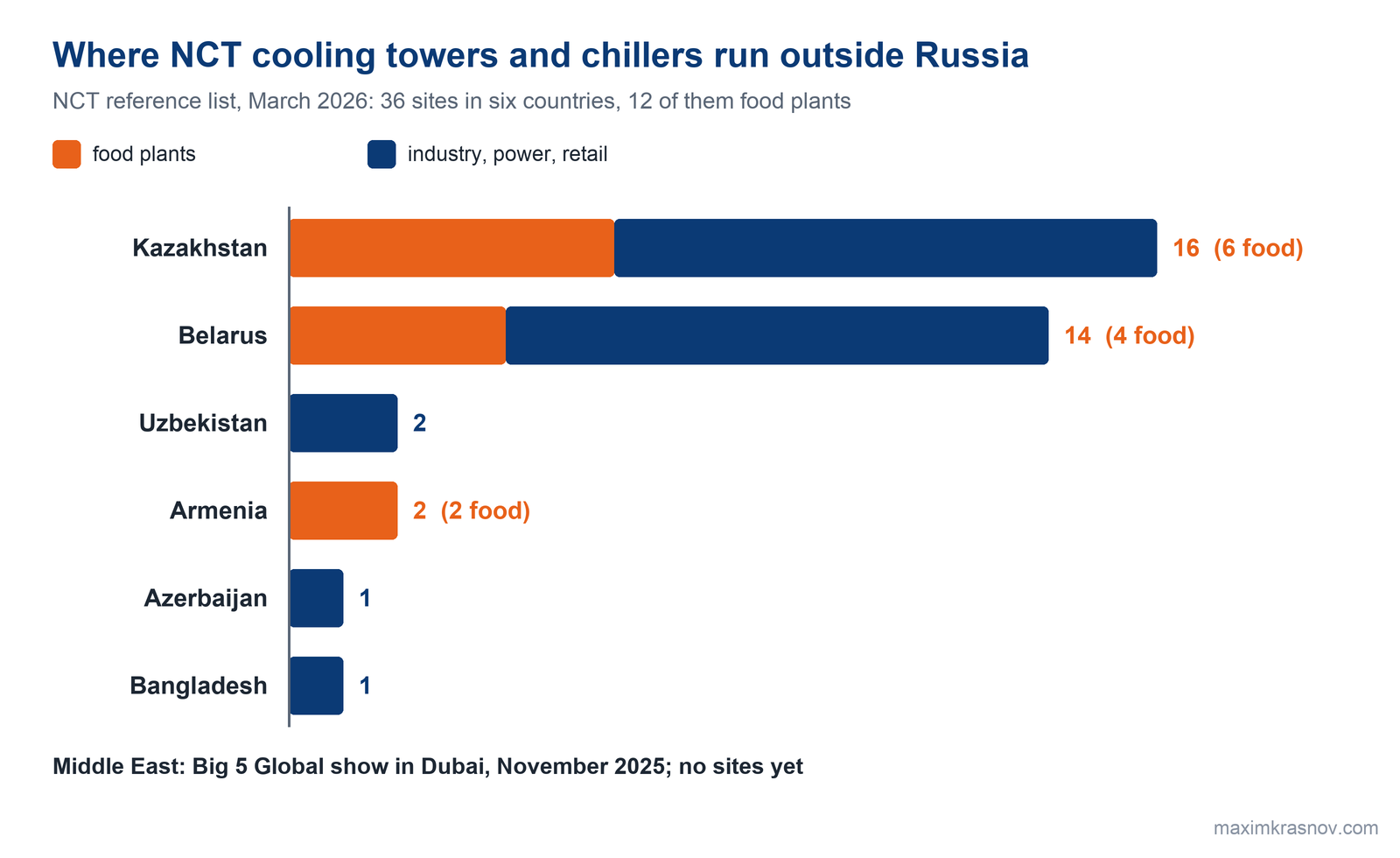
Russian industrial cooling equipment already runs abroad. As of March 2026, the NCT reference list includes 36 sites in six countries outside Russia: 16 in Kazakhstan, 14 in Belarus, two each in Uzbekistan and Armenia, and one each in Azerbaijan and Bangladesh. Among them are a 2.3 MW cooling tower in Grodno, a 3.2 MW absorption chiller in Aktobe and heat pumps delivering 12.7 MW of heat in Belarus.
I am writing as the owner of a manufacturing business, not as a seasoned exporter. We have had customers in Belarus and Kazakhstan since 2014, when NCT production started. We began working on foreign markets systematically in summer 2026, when we got a person responsible for international business. We have been opening up the Middle East since November 2025, starting with the Big 5 Global show in Dubai.
Where does Russian NCT cooling equipment operate abroad?
Most NCT sites outside Russia are in Kazakhstan and Belarus: 30 of 36 together. The rest are oil refining and mining in Uzbekistan, food plants in Armenia, tire recycling in Azerbaijan and a nuclear power plant in Bangladesh.
| Country | NCT sites | Examples | Industries |
|---|---|---|---|
| Kazakhstan | 16 | Atyrau refinery, DEP dairy plants in Kostanay and Lisakovsk, Aray City Mall in Kyzylorda and many others | Oil refining and petrochemicals, metals, dairy and beverages, retail, hotels |
| Belarus | 14 | Svetlogorsk Khimvolokno, Molochny Mir dairy in Grodno, Bellakt in Volkovysk, Omega Tower business center in Minsk and many others | Chemicals, metallurgy, machine building, dairy, pharmaceuticals, commercial real estate |
| Uzbekistan | 2 | Fergana refinery, Navoi Mining and Metallurgical Combinat | Oil refining, mining |
| Armenia | 2 | Pargev dairy plant, Grain Alco winery in Yerevan | Food industry |
| Azerbaijan | 1 | Brioil tire recycling plant in Baku | Tire pyrolysis into diesel fuel |
| Bangladesh | 1 | Rooppur nuclear power plant | Power generation |
A third of the foreign sites are food plants: 12 of 36, from a cheese plant in Brest to a freeze-dried fruit plant in Almaty. Thermax absorption chillers are not included in the table.
For scale: Cold Energy sites run about 1.8 GW of cooling in total, of which 1.6 GW are NCT cooling towers and 150 MW are Thermax absorption chillers.
What does Cold Energy supply to Kazakhstan?
To Kazakhstan we supply not individual machines but a complete cooling plant package: cooling tower, pump group, water treatment, control panels and tank.
| Site | What is installed | Parameters |
|---|---|---|
| DEP dairy plant, Kostanay | NCT VR1 cooling tower with a standby motor, PU-80/20 pump station, W2C water treatment, control panels | 12 m³ tank; cools the condensed milk production lines |
| Aray City Mall, Kyzylorda | 2 NCT VR2 cooling towers serving Thermax absorption chillers | 20,000 m² shopping center, variable frequency drives, online monitoring |
| Zhanazhol gas turbine power plant, Aktobe | Gas-fired Thermax absorption chiller | 3.2 MW of cooling for turbine inlet air at a 110 MW plant |
One more site in Kazakhstan is an absorption chiller running directly on 400 °C exhaust gas from a gas engine. From the same amount of heat, this arrangement produces twice as much cooling as the classic scheme on 90–95 °C hot water.
What does Cold Energy supply to Belarus?
To Belarus we supply NCT cooling towers for chemical, metallurgical, machine-building and dairy plants, and Thermax absorption chillers for power generation and heat recovery.
At Svetlogorsk Khimvolokno, a four-cell NCT VR1S cooling tower, selected through a tender, cools the air compressors. The Molochny Mir plant in Grodno processes more than 230,000 tonnes of milk a year: an NCT VR1 cooling tower rated at 2.3 MW cools 100 m³/h of water from 45 to 25 °C.
The largest Belarusian site in terms of heat is a pulp and board mill, where two Thermax absorption heat pumps of 3,458 and 9,221 kW recover about 5.4 MW of waste heat and deliver 12.7 MW of hot water. The waste water is cooled from 40 to 25 °C, the hot water is heated from 45 to 85 °C, and the share of free heat is 42%. I explained how such a heat pump works in the article on the absorption heat pump.
Belarus also has Thermax absorption chillers at Belorusneft cogeneration plants, running on hot water from gas engines, and cooling towers with water treatment at the Omega Tower business center in Minsk.
How do Russian cooling towers and dry coolers perform in hot climates?
A wet cooling tower works better in dry heat than in a temperate climate: in the desert at +45 °C and 30% relative humidity it delivers water at about 20 °C. The limit for a cooling tower is the wet-bulb temperature, and in practice the water leaves 3–4 °C warmer than the wet bulb. That is why, for wet cooling towers, even humid St. Petersburg is a harder climate than dry Uzbekistan.
| Condition | Risk | What we design for |
|---|---|---|
| Heat and dry air | Wrong design wet-bulb temperature | Each extra degree of wet bulb adds about 0.7 °C to the cold water, so we take climate data with a margin for the hottest hours |
| Dust and sand | Dirt in the circuit | A 1,000 m³/h cooling tower moves about 610,000 m³/h of air; at 0.1 mg/m³ of dust that is about 1.5 kg of dirt per day, so filtration and water treatment are needed |
| Sea air | Corrosion | NCT-Protect coating withstands more than 10,000 hours of salt spray; a stainless steel casing comes with a 20–25 year warranty against through-corrosion |
| Water shortage | Cooling tower make-up water | A dry cooler uses no water; adiabatic pre-cooling switches on only at peak hours |
| Frost | Icing | Electric basin heating when water drops below 5 °C, dry cooler on glycol down to −35 °C |
The dry cooler is the main answer where water is scarce. NCT dry cooler fans run at air temperatures from −35 to +55 °C; adiabatic humidification lowers the inlet air temperature by 5–15 °C and at peak cuts system energy consumption by up to 30%. At one plant, 100-atmosphere spray nozzles stand in front of our dry coolers: at +35 °C and 30% humidity the air cools by about 10 °C.
Dubai has a great many wet cooling towers, even though water is a problem in the region. I compared the two technologies on water and electricity in the article "Cooling tower or dry cooler".
What did the Big 5 Global show in Dubai bring?
Big 5 Global was Cold Energy's first international trade show: from 24 to 28 November 2025 we exhibited NCT cooling towers, chillers and evaporative condensers in Dubai.
Our participation was supported by the Russian Export Center (REC), and at the stand I held a series of meetings with foreign companies. By summer 2026 we had been to shows in Dubai and Saudi Arabia, and interest in our machines is strong.
To be straight: there are no Middle East sites in our reference list yet. A trade show opens the conversation, but after that you need partners on the ground, so we are looking for companies with access to the Middle East, Africa and the CIS. Specialists from neighboring countries already come to us: more than 65 people from Russia, Belarus and Kazakhstan attended the Third Education Session in October 2026.
What matters to foreign buyers of cooling equipment?
A foreign buyer compares a Russian machine with American and European ones. In my experience, Western machines lead in energy efficiency and water savings, ours lead in corrosion protection and in fitting the machine to a specific site.
1. Independent capacity verification. Cold Energy is the first and so far the only company from Russia admitted as a member of CTI (Cooling Technology Institute), the American institute that maintains the methods for cooling tower thermal design and field acceptance testing. CTI certification limits are a wet bulb up to 32.2 °C and water up to 51.7 °C.
2. Redundancy and remote monitoring. In Kostanay the cooling tower has a standby motor; in Kyzylorda the control panel was supplied with online monitoring.
3. Service life. A galvanized steel cooling tower casing carries a 10-year warranty against through-corrosion and a service life of up to 25 years; the range in one cooling tower is up to 40 °C for open towers and up to 60 °C for closed-circuit towers.
4. Foreign codes. For the Rooppur nuclear power plant in Bangladesh we spent 2 years adapting closed-circuit cooling towers to nuclear requirements, the customer inspected every weld, and the equipment has now been running for three years. Double weld inspection has since become standard on all our closed-circuit cooling towers; more in the article on cooling equipment made in Russia.
What barriers hold back Russian cooling equipment exports?
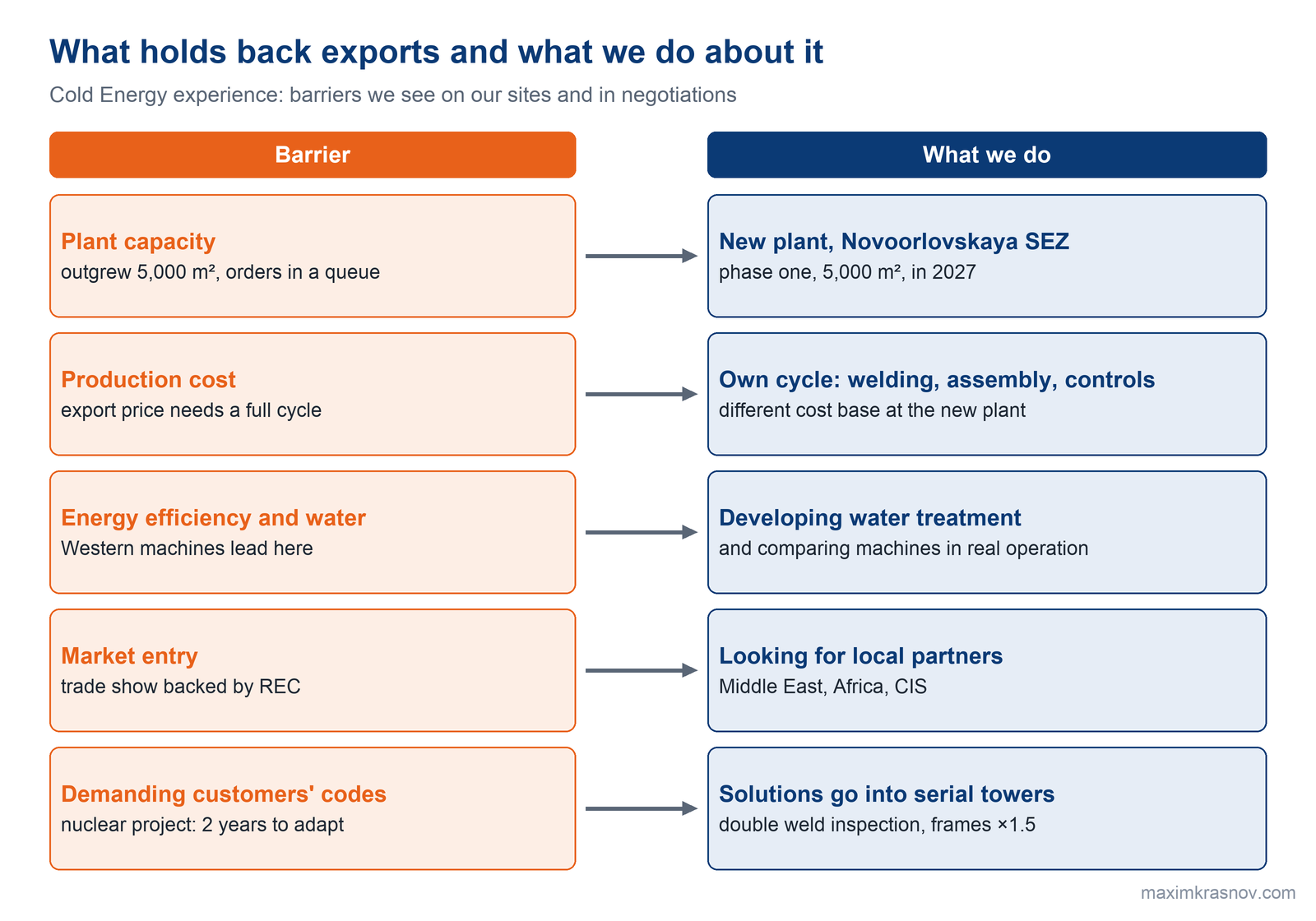
For us, the main export barriers are plant capacity, production cost, logistics and market entry.
| Barrier | What we see | What we do |
|---|---|---|
| Plant capacity | We have outgrown the current 5,000 m²; orders wait in a queue | Building a plant in the Novoorlovskaya Special Economic Zone: phase one, 5,000 m², in 2027 |
| Production cost | Only a full production cycle gives a world-market price: welding, assembly, controls | A new plant with a full cycle |
| Logistics and sanctions | Machines for a Belarusian customer were seized in the Netherlands during transshipment | Proved the cargo was not sanctioned and got it released |
| Trust in a new supplier | A letter of credit instead of an advance payment adds 2–3% to the contract | We invite buyers to the plant |
| Market entry | A dedicated person in charge appeared only in 2026 | Looking for partners in the Middle East, Africa and the CIS |
An export order competes for the same workshops as a domestic one. While orders are queuing, opening a new market is hard, and the company plan is to grow revenue from RUB 2 billion to RUB 20 billion in 7 years.
What will the new plant change for exports?
The new plant in the Novoorlovskaya Special Economic Zone in St. Petersburg removes the capacity limit and gives an export-level price. I signed the agreement at SPIEF (St. Petersburg International Economic Forum) on 18 June 2025: a 2.5 ha site and 180 new jobs.
Phase one, 5,000 m², starting in 2027, will cut lead times for standard machines by a factor of 1.5. Today the manufacturing benchmark is 12–14 weeks from contract, and on-site installation supervision and commissioning take 5–8 working days. A 17 m high workshop is needed for factory testing in a closed loop, and by 2032 the plant will reach 15,000 m² under one roof.
It has to be a plant we would be proud to show to any international delegation. I write about the construction and the company's growth in the Manufacturing and business section.
Key takeaways
1. Russian NCT cooling towers and chillers run at 36 sites in six countries outside Russia, 30 of them in Kazakhstan and Belarus.
2. The foreign sites range from a 2.3 MW cooling tower in Grodno to Thermax heat pumps delivering 12.7 MW of heat in Belarus.
3. In the desert at +45 °C and 30% humidity a wet cooling tower delivers water at about 20 °C, and where water is scarce a dry cooler works from −35 to +55 °C.
4. Cold Energy is the first and so far the only company from Russia in CTI; we have no Middle East sites yet and are opening the market through partners.
5. The main export barriers are plant capacity, production cost and logistics; the new plant in the Novoorlovskaya Special Economic Zone removes the first two.
FAQ
Does Russia export industrial cooling towers?
Yes. NCT cooling towers made by Cold Energy operate in Kazakhstan, Belarus, Uzbekistan, Armenia, Azerbaijan and Bangladesh: 36 sites according to the March 2026 reference list. In total, the company's sites run about 1.6 GW of our cooling towers.
Which countries does NCT supply equipment to?
According to the March 2026 reference list, six countries outside Russia: Kazakhstan (16 sites), Belarus (14), Uzbekistan and Armenia (2 each), Azerbaijan and Bangladesh (1 each). We supply Thermax absorption chillers as the exclusive distributor in Russia and the CIS.
Are Russian cooling towers suitable for hot climates?
Yes. A wet cooling tower works even better in dry heat than in a temperate climate: at +45 °C and 30% humidity it delivers water at about 20 °C. The key is choosing the right design wet-bulb temperature: each extra degree adds about 0.7 °C to the cold water. Dusty sites need filtration and water treatment.
Does NCT have sites in the Middle East?
Not yet. In November 2025 we first showed cooling towers, chillers and evaporative condensers at Big 5 Global in Dubai with support from the Russian Export Center, and then exhibited in Saudi Arabia. We are now looking for partners with access to markets in the region.
How do Russian cooling towers differ from Western ones?
In our comparison in real operation, Western machines lead in energy efficiency and water savings, ours in corrosion protection and in fitting the machine to a specific site. NCT cooling towers with a galvanized steel casing carry a 10-year warranty against through-corrosion, stainless steel ones 20–25 years. We rate capacity using the CTI method, and we are a CTI member.
Sources
-
Big 5 Global: official show website, Dubai World Trade Centre.
-
Cooling Technology Institute (CTI), standard STD-201RS — certification of cooling tower thermal performance.
-
Cold Energy: Russian cooling at Big 5 Global in Dubai, 27.11.2025.
-
Cold Energy: investment project for a new plant in the Novoorlovskaya Special Economic Zone, 18.08.2025.
-
Cold Energy: Third Education Session, 10.10.2026.
-
NCT equipment reference list, March 2026; reference list of Thermax absorption chillers supplied by Cold Energy.
-
Cold Energy experience and calculations: Rooppur nuclear power plant project, foreign deliveries 2014–2026.
Need a cooling solution for your site? Get a consultation