
Turnkey Chiller Plant: Choosing a Single-Responsibility Contractor
founder and CEO of Cold Energy (NCT)
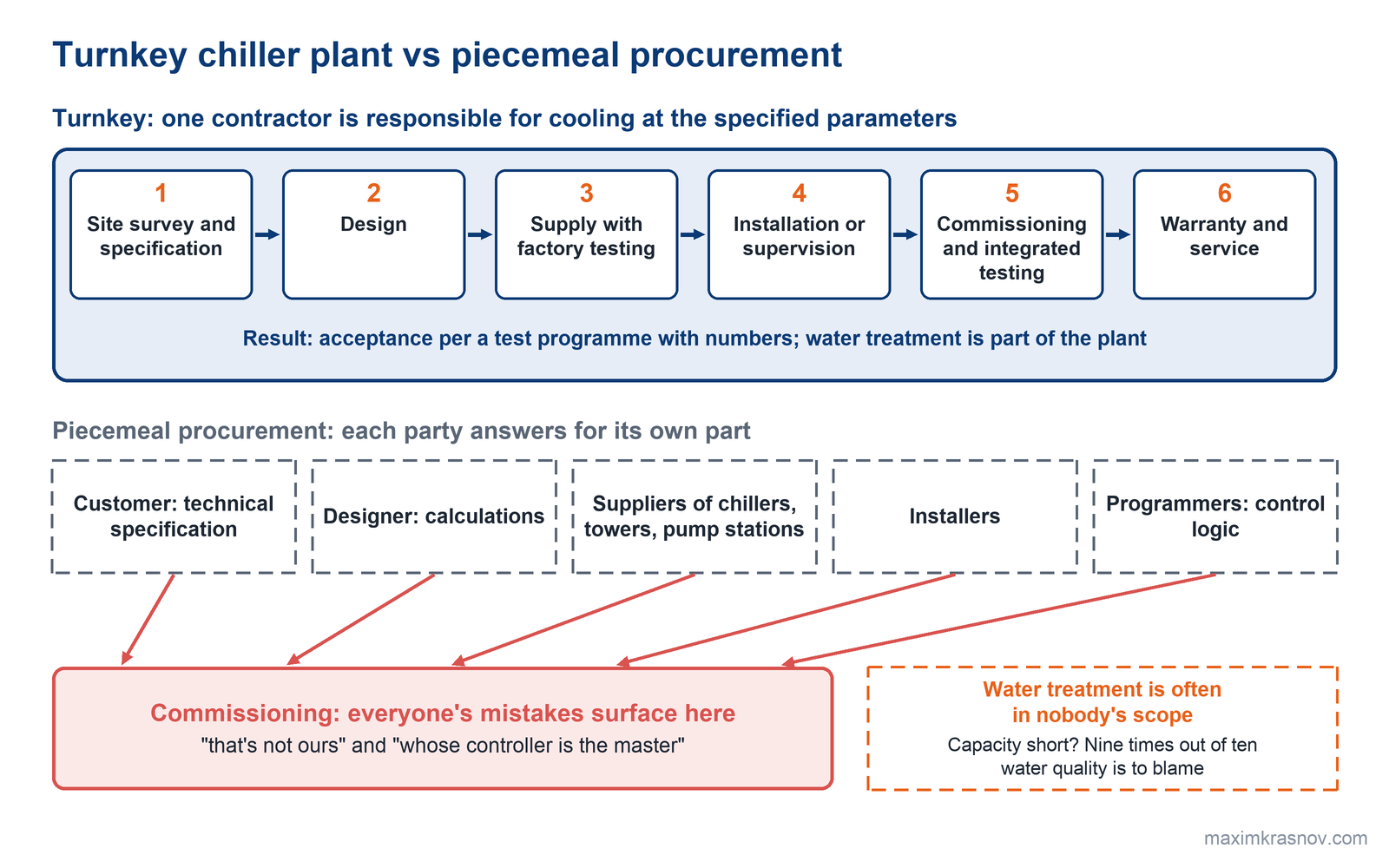
A turnkey chiller plant means one contractor is responsible for the site survey, design, supply, installation, commissioning and service, and hands the customer not a set of equipment but cooling at the specified parameters. It hands it over after integrated testing, usually 72 hours under process load. With piecemeal procurement, each party answers for its own part, and nobody answers for the result.
This article is for directors, chief engineers and buyers who are deciding whom to trust with a central chiller plant: one contractor or several, part by part. I run a company that does both, selling individual equipment and building complete plants, so I know where each option breaks.
What does a turnkey chiller plant include?
A central chiller plant is chillers, cooling towers or dry coolers, pump stations, tanks, water treatment, piping and controls assembled into one system. "Turnkey" means one company takes it from measurements on site to service after start-up.
The full scope of work looks like this:
1. Site survey and technical specification.
2. Design. For example, for the Tver foundry we issued a full set of sections: cooling supply, automation, reinforced concrete and steel structures, power equipment, architectural and construction solutions, and the cost estimate. The scope included an open cooling tower, a chiller with a remote condenser, a pump skid, water treatment and controls.
3. Equipment supply with factory testing.
4. Installation, or installation supervision if the customer installs.
5. Commissioning and integrated testing.
6. Warranty and service.
The scope boundary comes in three kinds: the machine only, the machine with a pump skid, or the whole chiller plant up to the consumer header. The further the boundary is from the machine, the fewer places where responsibility for water flow and water quality gets lost.
Why does piecemeal procurement cost more?
Because every party's mistakes surface at one point: commissioning, when the facility is already supposed to be running. The customer made a mistake in the specification, the designer in the calculations, the installers did not follow the drawing, the programmers did not finish the control logic. One service engineer sorts all of it out, and the customer pays.
The most expensive argument at commissioning is "that's not ours". Nobody ordered the cable between the panel and the unit, the sensor well was not welded in, the remote monitoring port is there but the customer's system has no mimic screens. The flow switch arrives with the chiller as a separate item and easily drops out of the installation.
A separate class of argument is "whose controller is to blame". When the chiller, cooling tower and pump station come from different suppliers, at commissioning they "cannot see" each other, because nobody decided which panel is the master. When the machines, cooling towers, pump stations and the plant's master panel come from one manufacturer, responsibility for the control logic sits with one party, and the argument disappears on its own.
Then there is the water. In our experience, when equipment does not deliver its capacity, nine times out of ten water quality is to blame, not the plant and not the installers. With piecemeal procurement, water treatment is often in nobody's scope of supply.
| Question | Piecemeal procurement | Turnkey |
|---|---|---|
| Who is responsible for cooling parameters | Nobody in full: each for their own equipment | One contractor for the system |
| Input data | From the customer's words, photos and a sketch | Measurements on site |
| Scope boundary | Found out at commissioning | A table for every item at the design stage |
| Plant control logic | Argument over whose controller is the master | Written by one party, which is responsible for it |
| Water treatment | Often in nobody's scope | Part of the plant |
| Acceptance | By an "equipment delivered" certificate | By a test programme with numbers |
Why should a contractor survey the site before making an offer?
To select equipment from real numbers, not from a story. Most manufacturers make a commercial offer with their eyes closed: from a phone call, from a photo in a messenger, from a sketch on a napkin. Then the installer finds a concrete column in the middle of the plant room, the pump head falls short and the piping has to be redone completely.
We send a survey engineer to the customer with clamp-on flow meters, temperature, pressure and humidity sensors, a sound level meter and a laser distance meter. In a day or two he captures the real picture of the site, and a couple of weeks later the customer gets a technical and commercial offer that works. Often free of charge: we are the manufacturer and earn on equipment, not on consulting.
It works best on retrofits: a plant from the 1980s, documentation partly lost, loop flow from 100–200 m³/h. If the cooling tower is going to blow its plume onto the wall of the neighbouring workshop, a competitor finds out at commissioning, and we find out at the survey.
What does factory assembly of modules give you?
Factory assembly moves the search for errors from the site to the factory. An NCT pump station arrives on site as one module: pumps, pipes, valves and panel assembled on a frame, welds inspected, hydraulic testing done at the factory at 0.675 MPa for at least 30 minutes. The design is left with three connection points: the suction nozzle, the discharge nozzle and the panel power supply.
When a module is assembled on site, weld quality depends on the crew, and leaks are found when the system is filled, during the commissioning schedule. The same goes for cooling towers: a modular cooling tower arrives in finished blocks and is installed on a prepared foundation in 1–2 days, while a field-erected one is assembled on site for months. How to choose the cooling tower itself is in the article on choosing an industrial cooling tower.
How do you accept a chiller plant: commissioning and testing
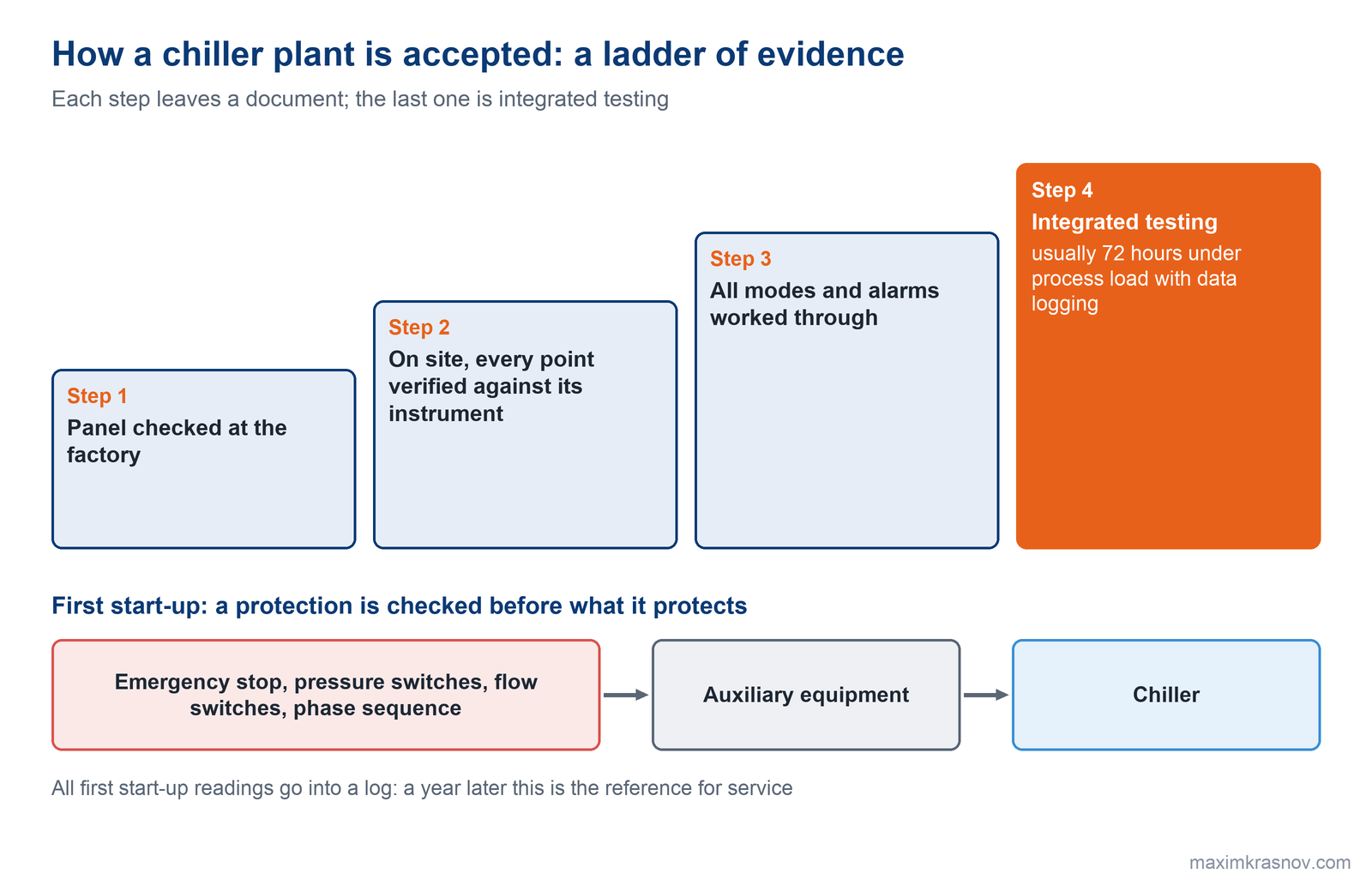
A chiller plant is accepted through a chain of evidence in which every step leaves a document. The panel is checked at the factory, on site every point is verified against its instrument, then all operating modes and alarms are worked through, and at the end comes integrated testing, usually 72 hours under process load with data logging.
The main rule of first start-up: a protection is checked before what it protects. First the emergency stop, pressure switches, flow switches and phase sequence, then the auxiliary equipment, and only then the chiller. All first start-up readings go into a log: a year later this is the reference for service.
Cooling tower capacity is worth confirming by testing and writing into the contract: the CTI ATC-105 code for an open cooling tower, within 12 months of operation, after at least 1,000 hours of fill run-in. For this, the design must include sensor wells and a straight pipe run for a flow meter in advance; otherwise an argument about capacity becomes an argument of opinions.
An example from practice: a powder metallurgy plant with 4.6 MW of cooling on 7/12 °C water. We did the detailed design, supply and commissioning; the system reached its design parameters and runs in two modes, in summer on an absorption chiller and in winter on free cooling through the cooling towers. How such systems cut the electricity bill I covered in the article on eight ways to cut cooling costs.
What should go into the contract with the contractor?
Verifiable obligations instead of wording without boundaries. The more detailed the contract up front, the calmer the start-up: the customer's strongest fear, which nobody says out loud, is "if something goes wrong, I will be the one to answer for it".
| Risky wording | How to make it verifiable |
|---|---|
| "In full scope, including all necessary work" | Scope per appendices; what is excluded is listed explicitly |
| "With optimized energy consumption" | A numerical criterion, measurement method, conditions and tolerance |
| "Commissioning within … from delivery" | Start date per the site readiness certificate, including heat load |
| "Accepted after operability is confirmed" | Acceptance per a test programme with criteria |
| "24-month warranty" with no conditions | Warranty on the configuration and software version recorded in the commissioning report |
Deadlines deserve separate attention. If a supplier refuses to accept financial liability for deadlines, he does not believe in them himself.
10 questions to ask a contractor before signing
1. Do you come out for a site survey, and what measurements do you take?
2. Which equipment do you manufacture yourselves and which do you buy in? Will you write the origin into the specification?
3. Where is the scope boundary: at which flange, valve, terminal? Is there a table of who supplies, installs, connects and sets up each item?
4. Who writes the plant control logic and is responsible for the master panel?
5. Who has water treatment in their scope, and what happens if water quality deviates?
6. Are commissioning and service done by your own engineers or by a subcontractor?
7. How will capacity be confirmed: test code, tester, tolerance?
8. How long does integrated testing last, and at what load?
9. What documents will you hand over: setpoint schedule, program backups, test reports?
10. Can we visit your plant and call the chief engineer of an operating site of the same capacity?
When does piecemeal procurement make sense?
Sometimes buying in parts is reasonable: when a retrofit keeps pumps that work, when a module will not fit through existing openings, or when the customer has a strong in-house installation team. In 2025 a plastics manufacturer took installation on itself, and we supplied a dry cooler of about 740 kW, a pump skid with a variable-frequency drive and the plant's master panel, and did the commissioning. It worked because the scope boundary had been fixed in advance.
What decides is not the size of the supply but a precise boundary: which panel, which cables and which work are included. If the boundary is written down, parts can be bought from different companies. If not, the "that's not ours" argument will come back at commissioning.
Key takeaways
1. A turnkey buyer purchases not equipment but cooling at specified parameters, confirmed by testing.
2. With piecemeal procurement, the parties' mistakes converge at commissioning, and nobody is left to answer for the result.
3. A site survey before the offer removes selection errors that are otherwise found during installation.
4. A chiller plant is accepted per a test programme and after integrated testing, usually 72 hours under load.
5. Buying in parts works only with a scope boundary written down before the design.
FAQ
Who should be responsible for water treatment in a chiller plant?
The same contractor that is responsible for capacity. When equipment does not deliver its capacity, nine times out of ten the water is to blame, and if water treatment is not in that contractor's scope, an argument about the cause is inevitable. A water treatment panel is selected only from an analysis of the make-up water, so the analysis is needed at the design stage.
How long does chiller plant commissioning take?
It depends on the plant, but the last step is integrated testing, usually 72 hours under process load. Commissioning should start per the site readiness certificate: power on, loops filled and pressure-tested, load available.
Can equipment be bought from one supplier and installation from another?
Yes, if the scope boundary is written down for every item before the design: who supplies, installs, connects and sets up. Without that table, the "that's not ours" argument is almost inevitable.
What matters more when choosing a contractor: price or deadlines?
Neither on its own. There is always someone cheaper, and a 20 % price gap usually hides selection for the wrong parameters, no proper controls or no in-house service. Compare who is responsible for the result and how the contract backs that up.
Sources
-
ASHRAE Guideline 0-2019 "The Commissioning Process": description of the guideline on the ASHRAE website.
-
SP 77.13330.2016 "Automation Systems" (Russian code of practice): individual tests, integrated testing, acceptance certificate.
-
CTI ATC-105 on acceptance testing of open cooling towers; CTI STD-201RS on thermal performance certification.
-
Cold Energy experience: site surveys, projects for the Tver foundry and the powder metallurgy plant, supply for a plastics manufacturer, 2025.
More on how our manufacturing and projects work is in the Manufacturing and business topic.
Need a cooling solution for your site? Get a consultation