
How to Read a Chiller or Cooling Tower Quote: 10 Questions

founder and CEO of Cold Energy (NCT)
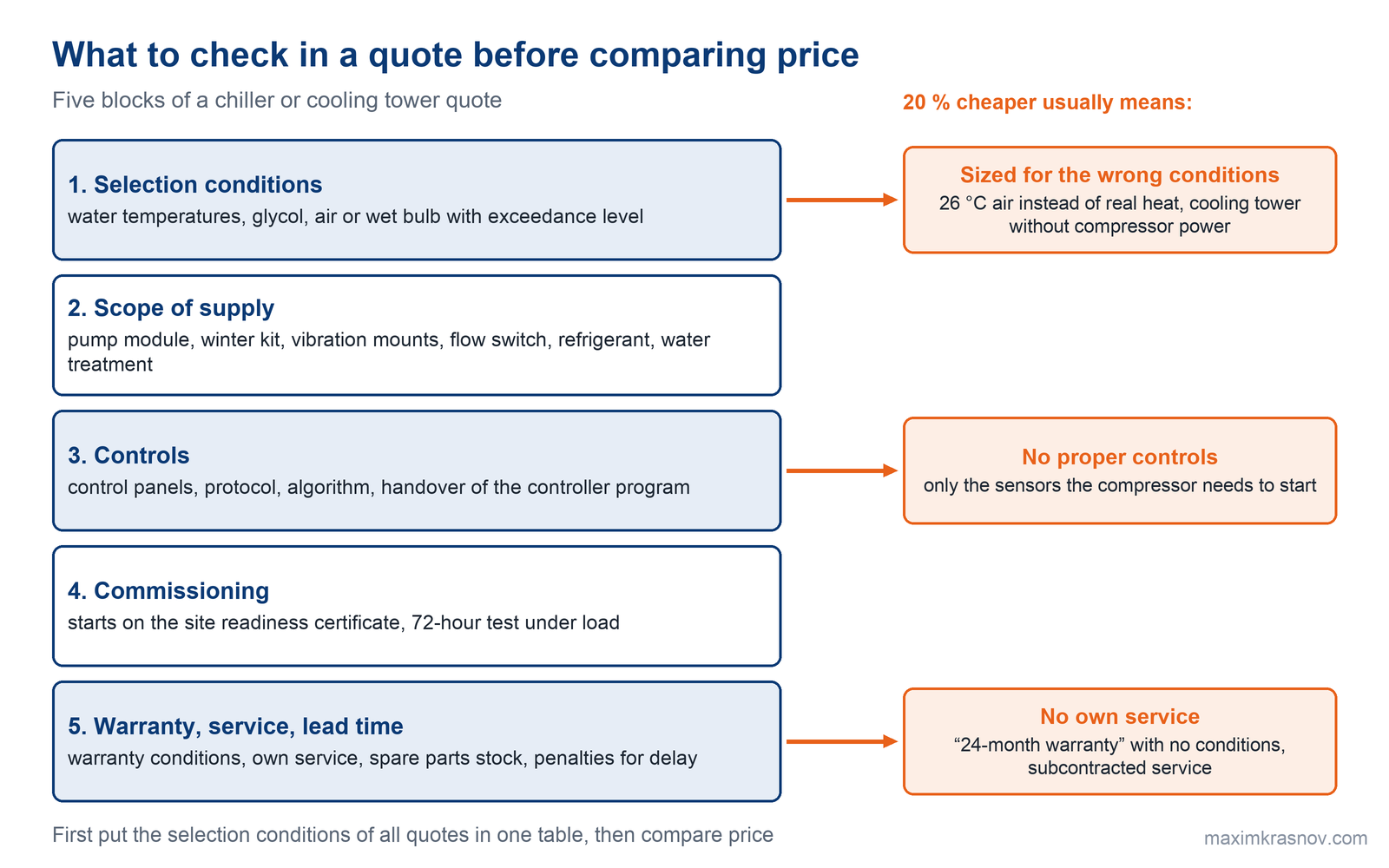
A commercial quote for a chiller or a cooling tower gets compared by the bottom-line price, and the difference in that price is rarely explained by margin. A 20 % gap usually hides one of three things: the machine was sized for the wrong conditions, there are no proper controls, or there is no in-house service. So a quote is read in five blocks: selection conditions, scope of supply, controls, commissioning, warranty and service.
This article is for the plant director, chief engineer and procurement manager who have three or four quotes on the desk for the same job: what to check so that you compare machines, not "total" lines. How to choose the machine itself is covered in How to Choose an Industrial Chiller: 13 Mistakes; how to choose a contractor for a whole chiller plant, in Turnkey Chiller Plant.
What is a technical and commercial proposal, and why can't two quotes be compared on price?
A technical and commercial proposal is a machine selection for given conditions plus the price and the scope of supply. The price only makes sense together with the selection conditions: the same model at a different air or water temperature is a different machine with a different capacity.
The selection is made from a questionnaire, and the signed questionnaire becomes a document, not correspondence. An empty field reads as "no limit": if you did not enter the maximum available electrical power, the selection will ignore it.
Many buyers give price a weight of 85–95 %, while service and commissioning barely count. The first thing I advise: put the selection conditions of all quotes into one table. If they differ, you are comparing different machines.
What conditions is the chiller in the quote sized for?
The chiller in a quote is sized for four numbers, and all of them must be written out: supply and return temperature of the coolant, the fluid (water or glycol, type and concentration), the design outdoor air temperature with its source document, and the installation site. If even one is missing, you cannot say what exactly you are being sold.
The most common difference hides in the air temperature. For Moscow, warm-season parameter B under SP 131.13330 (Russian building climatology code) is 26 °C, the ASHRAE 0.4 % dry bulb is 29.9 °C, and the absolute maximum is 38 °C. The 0.4 % level means about 35 hours a year when the air is hotter than 29.9 °C, almost 4 degrees above the 26 °C design point. And an air-cooled condenser runs 10–15 degrees hotter than the air.
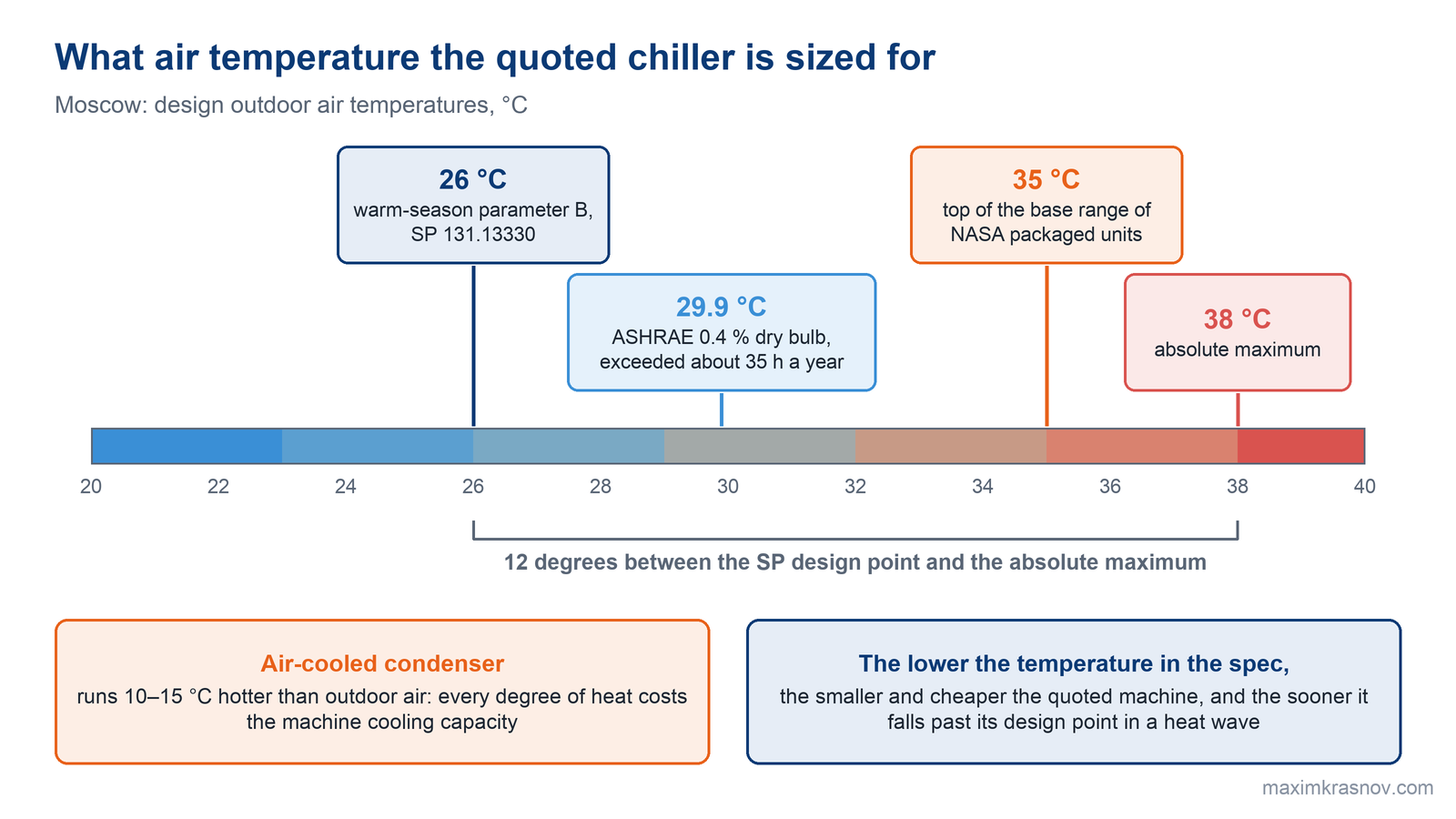
The lower the air temperature in the spec, the smaller and cheaper the machine in the quote. A machine sized strictly for 26 °C goes past its design point in a heat wave. For a continuous process this is written down separately: what temperature the condenser is sized for and what happens above it.
How do you compare two cooling tower quotes?
Two cooling tower quotes are comparable only if they have the same flow, the same inlet and outlet water temperatures, and the same design wet bulb with its exceedance level. A cooling tower cools water down to the wet bulb temperature plus the approach, so the wet bulb degree in the spec decides the size of the unit.
Every degree of wet bulb above design adds about 0.7 degrees to the cold water. In NCT cooling tower data we state the wet bulb together with its exceedance level, 0.98 by default; another supplier may not give it at all. Moving the approach from 6 to 4 degrees takes a cooling tower with 1.6 times the thermal characteristic; more on this in the article on choosing an industrial cooling tower.
The second trap is the load. If the cooling tower serves a chiller condenser, it must reject the cooling load plus the compressor power: for a 1,000 kW chiller drawing 200 kW that is 1,200 kW, not 1,000. A cooling tower quoted "on the cooling load" is cheaper because the tower in it is smaller than needed.
Next, look at what the tower is made of: a plastic casing cracks from sun and frost within a couple of years, and a field-erected tower takes months to assemble on site. If the quote has no variable frequency drives and no vibration sensors, that is a saving on controls that gets paid for in breakdowns.
What is included in the supply, and what comes as a separate line?
The supply includes only what is listed in the quote's specification, not what the machine's name implies. A cheap quote easily becomes an expensive one after the options are ordered.
In our 2026 proposal templates the options are: pump module with shut-off valves, standby pump, coolant line filter, winter start kit, condensing pressure control, liquid receiver, electronic expansion valve, vibration mounts and mating flanges for the hydraulic circuit. In another supplier's quote, look for each of these items: included, moved to options, or not mentioned at all.
A flow switch (a sensor that lets the machine run only while water flows through the evaporator) and vibration isolators came separately even at the Western manufacturers where I used to work. Without the switch, when the pump stops, the water in the evaporator freezes and bursts it.
Another question is refrigerant. NCT chillers ship under nitrogen, with factory charging on request, and machines with a remote condenser are charged only on site, after the refrigerant piping is assembled. If the quote does not say who charges the machine and at whose cost, this work will surface at commissioning.
For a cooling tower, a water treatment panel with a starter set of chemicals and its commissioning should be a separate line. When equipment does not deliver its capacity, water quality is to blame nine times out of ten, so a quote without water treatment is incomplete.
What should a quote say about controls?
The quote should state which control panels are included, which protocol the plant uses to send data, who writes the algorithm and who receives the controller program. Two lines saying "provide automatic control and dispatching" promise nothing.
Cheap machines come only with the sensors the compressor needs to start, and the problem becomes known when the machine has already stopped. Control panels for NCT cooling towers and pump stations are an option per the questionnaire, with Modbus TCP as the default protocol. If the chiller, cooling tower and pump station come from different suppliers, ask separately whose panel is the master: otherwise at commissioning they "don't see" each other.
When reviewing the controls specification, look for four things: a points list, a setpoints table, a section on behavior under failures, and acceptance criteria. If any of them is missing, the scope is open and will be settled during start-up week. Write down separately in what form the program file is handed over and who has the right to change the algorithm after start-up: the warranty depends on it.
How do you read commissioning, warranty, service and lead time in a quote?
Commissioning, warranty and service in a quote must be described as conditions, not as the words "included" and "24 months".
Commissioning starts on the site readiness certificate: power is on, circuits are filled and pressure-tested, and there is a heat load of at least the agreed share. It ends with integrated testing, usually 72 hours under process load. A chiller's minimum stage is 25–50 % of capacity; without load the machine goes into frequent starts and stops, so the way to create load is agreed before the engineers travel.
I would replace a "24-month warranty" with no conditions by a warranty on the configuration and software version recorded in the commissioning certificate. NCT cooling towers carry a catalog warranty of 10 years against through-corrosion and a service life of up to 25 years. The table of water quality requirements is attached to the contract: if the water stays outside it, the manufacturer has the right to void the warranty.
Service is checked with two questions: is it in-house or subcontracted, and does the compressor and heat exchanger manufacturer have an official representative with a warehouse in Russia. Once a customer insisted on a cheap imported machine. It arrived at our warehouse, nobody managed to start it, and the supplier offered to have our service engineers repair it.
On lead time, look at three things: own warehouse, own production, and willingness to put penalties in the contract. If a supplier refuses to accept financial liability for lead time, it does not believe in that lead time itself. Cooling capacity and parameters from the selection are also fixed in the contract.
Where does a quote usually hide the price difference?
The price difference hides where the buyer does not check line by line: in selection conditions, options, controls and warranty terms.
| Quote block | What to check | What "cheaper" looks like |
|---|---|---|
| Chiller selection conditions | Water temperatures, fluid and glycol concentration, air temperature with source document and exceedance level | Air at 26 °C instead of real heat, glycol not stated |
| Cooling tower selection conditions | Flow, t1/t2, wet bulb with exceedance level, load including compressor power | Wet bulb without exceedance level, tower sized for cooling load without compressors |
| Scope of supply | Pump module, standby pump, filter, winter kit, vibration mounts, mating flanges, flow switch | Items moved to options or not mentioned |
| Refrigerant and water | Who charges the machine, is water treatment with chemicals and commissioning included | Machine under nitrogen, no water treatment |
| Controls | Panels included, protocol, algorithm, program handover | Only the sensors needed to start the compressor |
| Commissioning | Start on site readiness certificate, test duration, load | "Commissioning included" with no conditions |
| Warranty and service | Warranty conditions, in-house service, spare parts stock in Russia | "24-month warranty", subcontracted service |
| Lead time | Warehouse, production, penalties in the contract | Lead time with no liability |
10 questions to ask the supplier before comparing quotes
1. What water temperatures, fluid and glycol concentration is the machine sized for?
2. What outdoor air or wet bulb temperature is assumed, from which document and at what exceedance level?
3. For a cooling tower: does the load include the chiller compressor power?
4. Which items from the options list are in the price and which are not, and where is the scope boundary?
5. Who charges the machine with refrigerant, and who supplies water treatment?
6. Which control panels are included, who writes the algorithm and who receives the program?
7. When does commissioning start, and how long does integrated testing last?
8. Under what conditions does the warranty apply, and who provides service: your own engineers or a subcontractor?
9. Will you put lead times with penalties and the cooling capacity from the selection into the contract?
10. Can we visit your plant and call the chief engineer of a running site of the same capacity?
Key takeaways
1. The price in a quote only makes sense together with the selection conditions: water temperatures, fluid, and climate with source document and exceedance level.
2. A 20 % gap between quotes usually comes from sizing for the wrong conditions, stripped-down controls or no in-house service.
3. A quote for a cooling tower behind a chiller must account for the condenser load: for 1,000 kW of cooling with 200 kW of compressors, that is 1,200 kW.
4. The flow switch, vibration mounts, winter kit, refrigerant charging and water treatment most often drop out of the comparison.
5. Commissioning, warranty and lead time are compared by conditions: start on the site readiness certificate, 72 hours of testing, warranty on the configuration, penalties for delay.
FAQ
Why do quotes for the same capacity differ in price by 20 % or more?
Because the same capacity in the model name does not mean the same selection conditions and scope of supply. The difference is usually in the design temperature, options behind the price, controls and in-house service.
Can chillers be compared by the COP in the quote?
Only under the same conditions. The coefficient of performance (COP, kilowatts of cooling per kilowatt of electricity) appears in a catalog next to its conditions, for example "EER 12/7/35 °C": water at 12/7 °C, air at 35 °C. Part-load metrics from different standards, IPLV, ESEER and GB-IPLV, are not compared directly.
What if the quote does not state the selection conditions?
Ask for the selection printout with the design point, and do not compare the quote until you have it. Without these numbers you can neither compare machines nor make a claim if the capacity falls short in hot weather.
How do you protect an advance payment to a supplier?
The best way is to visit the plant and see the workshops, people and shipments. If a visit is impossible, a letter of credit works, but it adds 2–3 % to the contract. On capacity, the most honest check is to ask for references to running sites of the same capacity and call their chief engineer.
Sources
-
SP 131.13330 "Building Climatology" (Russian code): design outdoor air parameters; ASHRAE Climatic Design Conditions, 2021 edition: dry bulb and wet bulb at 0.4 % exceedance.
-
AHRI Standard 550/590: IPLV part-load metric.
-
Cold Energy (NCT) experience: NCT questionnaires and proposal templates 2026, NCT chiller and cooling tower catalogs, chiller plant commissioning, webinar "13 Critical Mistakes in Choosing a Chiller" (February 2026).
More on how procurement and projects work is in the Manufacturing and Business section.
Need a cooling solution for your site? Get a consultation