
Absorption Heat Pump: How to Recover Waste Heat from 25–50 °C Water

founder and CEO of Cold Energy (NCT)
An absorption heat pump takes 25–50 °C warm water that a plant now cools in a cooling tower, adds steam, gas or hot water, and delivers 60–105 °C water to the consumer. A single-effect machine gives 1.65–1.75 kW of heat per 1 kW of driving heat, so about 40% of the heat comes free. Against a gas boiler, that saves about a third of the gas.
In Russia the subject is still almost untouched, although there is plenty of waste heat: cooling tower circulating water, process discharges, district heating return water, data center cooling loops. Cold Energy is the Thermax distributor; we do not manufacture heat pumps, we select, supply and commission them. Below: how the machine works, where it pays back, and what we learned on our own project in Belarus.
What is an absorption heat pump?
An absorption heat pump is a lithium bromide absorption machine that turns waste heat into useful heat with the help of a driving heat source. Inside are the same vessels as in an absorption chiller: generator, condenser, evaporator, absorber; the refrigerant is water, and the absorbent is lithium bromide solution.
The easiest way to remember it is one sentence: a heat pump is a chiller whose cooling tower has been replaced by a heat consumer.
| Absorption chiller | Type 1 absorption heat pump | |
|---|---|---|
| Product | chilled water from the evaporator | hot water from the absorber and condenser |
| Evaporator connected to | the cooling consumer | the customer's waste heat stream |
| Absorber and condenser connected to | the cooling tower | the heat consumer |
| Product temperature | standard +7/+12 °C | 35–90 °C, up to 105 °C in selections |
| If the product is not needed | the cooling tower takes any heat | the consumer is "full" and the machine stops |
I covered how the chiller from the same family works in the article what is an absorption chiller.
How does a type 1 absorption heat pump work?
The driving heat source, whether steam, gas or hot water, boils water out of the lithium bromide solution in the generator. The water vapor condenses in the condenser and heats the water being heated. The condensate boils in the evaporator under vacuum and takes heat from the waste stream, and this vapor is absorbed by the solution in the absorber, which also heats the water being heated.
The machine's balance fits in one line: heat to the consumer = heat from the driving source + heat from the waste stream. The thermal COP (coefficient of performance) is the heat to the consumer divided by the heat supplied to the generator. For a single-effect machine it is 1.65–1.75, for a double-effect one 2.05–2.15. For type 1 it cannot be less than one.
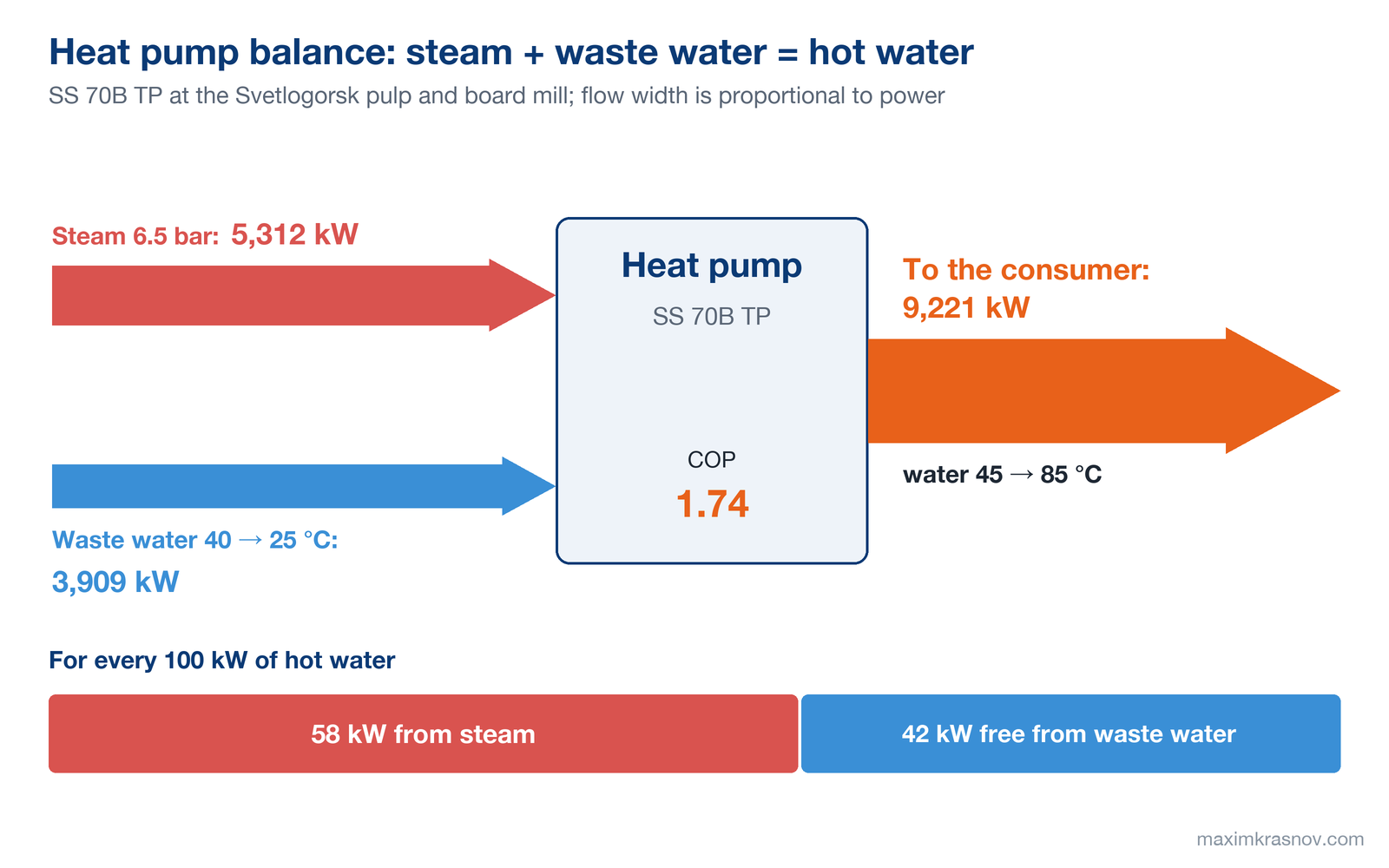
An example on our Thermax SS 70B TP machine: waste water cooled from 40 to 25 °C gives up 3,909 kW, 6.5 bar steam supplies 5,312 kW, and the consumer gets 9,221 kW of water heated from 45 to 85 °C. COP is 1.74. For every 100 kW of hot water the machine spends 58 kW of steam and takes the other 42 kW from water that used to go to the cooling tower.
How is a heat pump different from a heat transformer?
Type 1 increases the amount of heat; type 2 raises the temperature of part of the waste heat without external fuel. Confusing the two is the most common mistake in a technical specification.
| Type 1: heat pump | Type 2: heat transformer | |
|---|---|---|
| What drives it | expensive heat + waste heat | waste heat only |
| What else is needed | a consumer able to take all the heat | a cold medium to reject to: 15–20 °C water |
| Thermal COP | 1.65–1.75 (single effect), 2.05–2.15 (double) | about 0.5 |
| Temperature lift per stage | 30–60 °C | 15–30 °C |
| How common | most of the installed base worldwide | isolated installations |
You cannot compare 0.5 and 1.7 directly: for type 1 the denominator is purchased fuel, for type 2 it is heat that was being thrown away anyway. In the Thermax reference list, only four of 74 exported heat pumps are type 2.
Where does an absorption heat pump pay off?
An absorption heat pump makes sense when the site has three things at once. If even one is missing, there is most likely no project.
1. A steady flow of 25–50 °C warm water that now goes to a cooling tower, the sewer or a river.
2. A consumer of 60–105 °C hot water: a process, washing, boiler feedwater preheating, a district heating network, domestic hot water.
3. A driving heat source: 2–10 bar steam, 140–180 °C hot water, 275–600 °C exhaust gas, or gas for direct firing.
No consumer, and the heat has nowhere to go; no waste stream, and the machine becomes an expensive boiler. Operating hours make the economics:
| Waste heat source | Hours per year | Assessment |
|---|---|---|
| Process loop of a continuous production line | 8,000+ | best case |
| Circulating water of a year-round cooling tower | 7,000–8,000 | very good |
| Data center cooling loop | 8,760 | very good |
| District heating return water | 5,000–6,000 | average |
| Cooling tower that runs only in summer | 2,500–3,500 | poor |
| Seasonal process | 1,500–2,500 | usually does not work |
Typical sites are combined heat and power plants and boiler houses, pulp and paper mills, chemicals and food production. The main world market for absorption heat pumps is district heating in Denmark and Sweden.
Which is better: an absorption heat pump, a boiler or an electric heat pump?
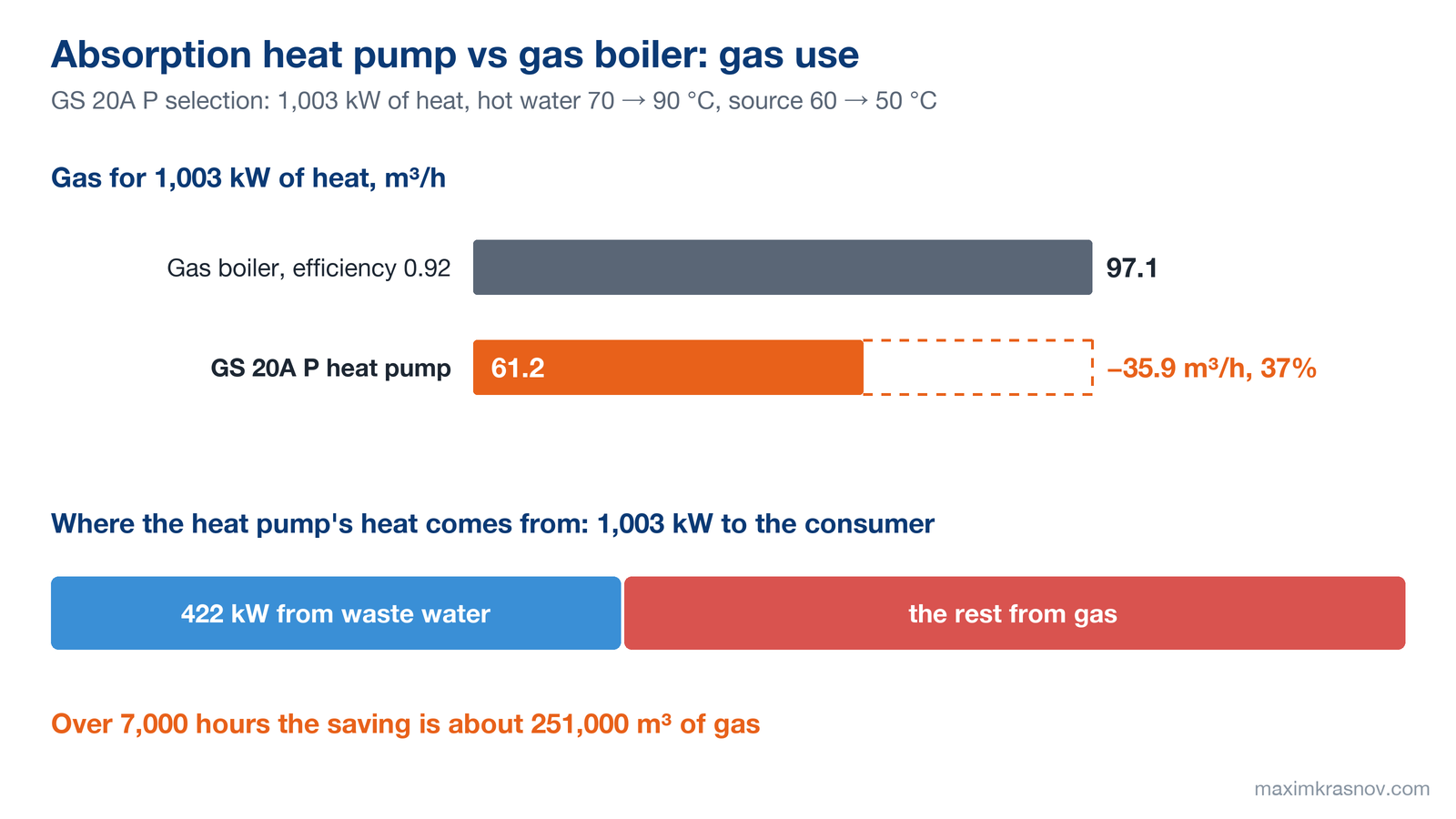
Without a waste heat source an absorption heat pump loses to a boiler: a boiler is simpler, cheaper and faster to install. With a source, the calculation changes. Take a real Thermax GS 20A P gas-fired selection: source 60 to 50 °C, hot water 70 to 90 °C, 1,003 kW of heat, 7,000 hours a year, and for comparison a boiler with 0.92 efficiency.
| Metric | GS 20A P absorption heat pump | Gas boiler |
|---|---|---|
| Heat to the consumer | 1,003 kW | 1,003 kW |
| Taken from waste water | 422 kW | — |
| Gas | 61.2 m³/h | 97.1 m³/h |
| Gas saving | 35.9 m³/h, 37% | baseline |
| Saving over 7,000 hours | about 251,000 m³ | — |
There are two coefficients here, and it is important not to mix them up. 1.72 is the cycle efficiency, used to compare machines. 1.46 is the efficiency at the gas meter including the burner, used to calculate money.
An electric heat pump consumes electricity, an absorption heat pump consumes heat: its own power use is 0.3–0.4% of the heat it delivers. An electric heat pump for 5 MW of heat needs around 1.5–2 MW of electrical capacity, and many plants have no such reserve.
The second difference is the temperature ceiling. According to the International Energy Agency report on industrial heat pumps, most production electric machines deliver below 65 °C, absorption machines 90–105 °C. An electric heat pump is for small capacities and 60–65 °C; an absorption heat pump is for when there is steam or gas, megawatts are needed, and water above 65 °C.
How much can an absorption heat pump raise the temperature?
Temperature lift is the difference between the hot water outlet temperature and the waste source inlet temperature. A single-effect machine comfortably lifts up to 40 °C; the working limit in the Thermax brochure is 55 °C. The higher the lift, the lower the COP.
| Lift | Thermal COP | What it means |
|---|---|---|
| up to 40 °C | 1.65–1.75 | standard duty |
| 40–55 °C | 1.5–1.65 | workable duty |
| 55–65 °C | 1.3–1.5 | borderline, needs factory confirmation |
| over 65 °C | 1.2–1.3 | only for a specific selection |
| over 80 °C | — | not possible in one stage, needs a cascade of two machines |
The lift is limited by the solution: to give heat to 90 °C water it has to be very strong, and that brings it close to crystallization. So write both temperatures in the specification, "source 24 °C, outlet 70 °C", not "lift 46 °C".
How does the absorption heat pump work at the Svetlogorsk pulp and board mill?
Our project with absorption heat pumps is the Svetlogorsk pulp and board mill in Belarus. Two Thermax type 1 steam-driven machines take heat from waste water and heat process water. We supplied the equipment and carried out installation supervision and commissioning.
| Parameter | SS 40C TP | SS 70B TP |
|---|---|---|
| Waste water | 40 to 25 °C, 84.1 m³/h | 40 to 25 °C, 226.2 m³/h |
| Heat taken from waste water | 1,453 kW | 3,909 kW |
| Steam at 6.5 bar | 3,039 kg/h, 2,005 kW | 8,098 kg/h, 5,312 kW |
| Heated water | 45 to 85 °C, 75 m³/h | 45 to 85 °C, 200 m³/h |
| Heat output | 3,458 kW | 9,221 kW |
| Thermal COP | 1.72 | 1.74 |
Both machines run on the same temperature pair: a 45 °C lift and a 42% share of free heat. Together they take about 5.4 MW from waste water and deliver 12.7 MW of hot water. The equipment arrived on site in December 2022, the large machine was started in December 2023, and the second is scheduled to start after the reconstruction of the mill's heat source.
Two lessons from this project for the designer. The machine arrives empty, the solution is shipped separately, and the operating weight is 40% more than the dry weight, so the slab is designed for the operating weight. The data sheet and the contract specification may differ in dimensions and electrical data, so take the larger value.
Can you heat homes with data center waste heat?
You can, and an absorption heat pump suits this best. Server cooling water at 30–45 °C goes to the evaporator, and 65–90 °C hot water goes to space heating, to neighbors or into the district heating network. Every data center is a huge stove, and today its heat is blown into the atmosphere through cooling towers.
The conditions are strict. The machine sits in parallel with the regular cooling system, through an isolating heat exchanger and with its own pump, so that stopping it changes nothing in the server loop. Heating is seasonal, while a data center produces heat all year, so a year-round heat sink, such as greenhouses, a neighboring plant or district heating make-up, has to be found in advance.
Germany has already passed a law requiring owners of large data centers to reuse their heat. Russia is far from that, but we are now working out such a project for a data center. I covered how a data center saves electricity on the cooling itself in the article on absorption chillers for data centers.
What are the most common mistakes in an absorption heat pump project?
Almost all mistakes come from the input data, not from the machine:
1. Source temperature taken from the data sheet or at peak. In winter and on the night shift the machine does not reach capacity. Use the minimum steady temperature from the year's operating log.
2. Lift calculated from the return water, not from the source. The lift is understated, the COP overstated, and the capacity will not be confirmed.
3. No heat sink for the summer. The consumer switches off, the machine goes into dilution and stops, and steam is wasted. A backup cooling tower or dry cooler is needed.
4. Open cooling tower water without an isolating heat exchanger. The evaporator tubes foul within a season, because the selection was made for clean tubes.
5. Machine sized for peak load. Frequent starts, few hours, poor payback. The machine carries the base load; the boiler covers peaks and backup.
Key takeaways
1. An absorption heat pump makes 60–105 °C hot water from 25–50 °C waste water and a driving heat source: steam, gas, hot water or exhaust.
2. A single-effect machine gives a COP of 1.65–1.75: about 40% of the useful heat is taken free from waste water.
3. Against a gas boiler, an absorption heat pump saves about a third of the gas: 37% in the GS 20A P selection, about 251,000 m³ over 7,000 hours.
4. At the Svetlogorsk pulp and board mill, two Thermax machines take about 5.4 MW from waste water and deliver 12.7 MW of 85 °C hot water at a COP of 1.72–1.74.
FAQ
How much electricity does an absorption heat pump use?
0.3–0.4% of the heat it delivers: only the solution pumps and the control panel. A machine delivering 9,221 kW of heat draws 28.9 kVA. An electric heat pump for 5 MW of heat needs around 1.5–2 MW of electrical capacity.
Where does the heat go in summer when space heating is not needed?
To a backup sink: a cooling tower or dry cooler for the remaining capacity. Without it the machine hits its upper temperature limit and stops. Better to look for a year-round consumer from the start, such as a process or domestic hot water.
Can one machine provide both cooling and heating?
Yes, this is the chiller-heater version: cooling in summer, heating in winter, or both products at once. According to the Thermax brochure, one machine instead of a separate chiller and hot water generator saves up to 32% of steam. It is justified if each mode accumulates 2,500–3,000 hours a year or more.
Sources
-
IEA Heat Pumping Technologies, Annex 35 / IETS Annex 13 "Application of Industrial Heat Pumps", 2010–2014: project page.
-
Herold K. E., Klein S. A., Radermacher R. Absorption Chillers and Heat Pumps — the cycle and the COP of a heat transformer.
-
Thermax: Absorption Heat Pump XP and Heat Pump Chiller XP brochures, heat pump reference list, technical data sheets for SS and GS selections.
-
Cold Energy experience and calculations: supply, installation supervision and commissioning of Thermax heat pumps at the Svetlogorsk pulp and board mill; comparison with a boiler for the GS 20A P selection.
More articles are in the Energy efficiency and Absorption chillers and trigeneration sections; if the site has a gas engine generator set, read about trigeneration.
Need a cooling solution for your site? Get a consultation