
Cooling Equipment Made in Russia: What Is Local, What Is Imported

founder and CEO of Cold Energy (NCT)
Industrial cooling equipment made in Russia today means, above all, domestic cooling towers, chillers, dry coolers, pump stations and controls. We started in 2014, when the dollar doubled against the ruble, and in 2025 we launched Russia's first production line for finned tubes for closed-circuit cooling towers. Dependence on imports remains in specific components: nobody in Russia yet has serial production of a centrifugal compressor.
For twelve years I have been building an industrial cooling plant in Sertolovo near St. Petersburg, and before that I worked as a representative of York International and Trane Technologies. So I see the subject from both sides: as a seller of imported equipment and as a manufacturer that replaces it. Below is what worked, what did not, and how a customer can tell real manufacturing from a nameplate stuck on someone else's product.
Why did a trading company become a manufacturer in 2014?
Because selling imports became impossible. In 2014 the dollar doubled in price, and the American, Chinese and Indian equipment we represented became too expensive for customers. Western partners began restricting sales without explanation and did not deliver equipment to Russia that had already been paid for.
I founded Cold Energy in 2011 as an engineering and trading company: we supplied Thermax absorption chillers and imported chillers, and in 2012 we added a design department and an engineering office. The decision to manufacture cooling towers locally changed the business completely. In 2014 we launched our own production under the NCT brand: mechanical-draft cooling towers, chillers, condensers. In 2017 we added control cabinets, pump skids and chemical water treatment systems.
Today the company's solutions run at more than 1,000 plants and facilities in Russia and abroad. The logic behind the product choice was simple: almost every industry needs cooling, from a small food workshop to the largest plants in the country.
What cooling equipment is already made in Russia?
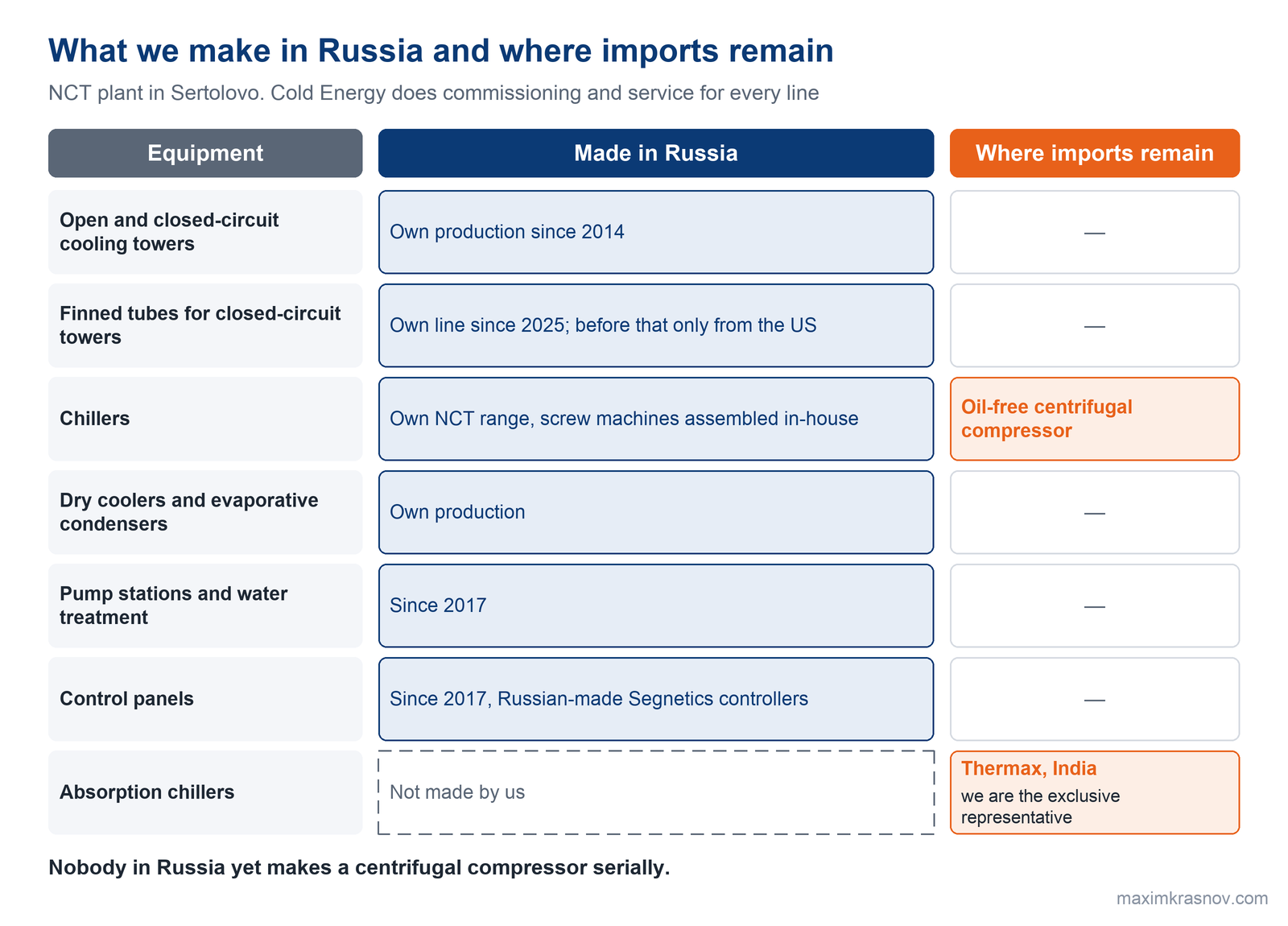
Almost the whole industrial cooling loop, except the most complex machinery. At the NCT plant in Sertolovo we make open and closed-circuit cooling towers, chillers, dry coolers and evaporative condensers, pump stations, tanks, water treatment panels and control panels. We assemble the screw chillers and the cooling towers ourselves.
| Equipment | What we make in Russia | Where imports remain |
|---|---|---|
| Open and closed-circuit cooling towers | Own production since 2014, galvanized steel casing, 10-year warranty against perforation corrosion | — |
| Finned tubes for closed-circuit cooling towers | Own line since 2025; before that such tubes came only from the US | — |
| Chillers | Own NCT range, screw machines assembled in Sertolovo | Oil-free centrifugal compressor: nobody has serial Russian production |
| Dry coolers and evaporative condensers | Own production | — |
| Pump stations and water treatment | Since 2017; pump skids are pressure-tested at the plant at 0.675 MPa | — |
| Control panels | Since 2017; built on Russian-made Segnetics controllers | — |
| Absorption chillers | Not made by us | Thermax, India; we are the exclusive representative in Russia and the CIS |
The table shows where each component is made. Commissioning and service for every line, including Thermax machines, are done by us.
What did the finned tube line change?
A finned tube is a heat exchanger tube with fins on the outside: the fins increase the heat transfer surface, and a closed-circuit cooling tower becomes lighter and more economical. In November 2025 we launched Russia's first production line for such tubes.
"Until now such tubes were only supplied from the USA, and now Cold Energy is the only company in Russia doing this. We adopt the best from our foreign colleagues and keep moving forward," I said at the launch. The line covers the need for imported tubes for this class of cooling tower.
What a finned coil gives the customer: lower weight and a smaller footprint for the same duty, less fan power, and dry operation without spray water from 0 °C. Without spraying there is no make-up water and no plume over the tower in winter. In our product ranges these towers carry the "e-" prefix.
Closed-circuit towers used to go mainly to oil refineries; now they also go to data centers: with direct-to-chip cooling, warm water does not need to be chilled by a refrigeration machine. More in the analysis of five data center cooling options.
What can a Russian manufacturer learn from the nuclear industry?
A demanding customer raises a production standard faster than anything else. For the Rooppur nuclear power plant in Bangladesh, we spent two years adapting closed-circuit cooling towers with a finned heat exchanger to nuclear codes and six months manufacturing them. The customer's representatives checked every weld. The equipment has been in place at the plant for three years and is running.
I was honest at the start: we make equipment for ordinary industry, and nuclear is a different world. What passes as "good enough" in a civil project is taken apart in a laboratory there. We redid practically everything.
Most of the "nuclear" solutions we later carried over into our standard civil cooling towers, and it turned out to be inexpensive:
1. Double inspection of welds became the standard for all our closed-circuit cooling towers.
2. The finned heat exchanger increased component life and heat transfer without a noticeable price increase.
3. A reinforced structure: the frames now withstand loads 1.5 times higher than design loads.
My conclusion from this project: demanding customers rewrite your standards, and the new standards turn out better for everyone.
Where does dependence on imports remain?
It remains in two places: centrifugal compressors and absorption chillers. Nobody in Russia has serial production of a centrifugal compressor today, and lithium bromide absorption chillers we supply from Thermax of India, a manufacturer with forty years of experience and thousands of installations worldwide.
If a component is made abroad, a direct question from the customer should get a direct answer and, if wanted, a line on origin in the specification attached to the contract. The contract is still with a Russian legal entity, and commissioning and service are done by us.
We are building the new plant precisely to raise the share of domestic components in cooling towers and chillers. That is a five-year task, not a one-year one.
Where does Russian equipment fall behind Western equipment, and where does it win?
When you compare your own machines in real operation with American and European ones, the picture is honest. In some areas they are ahead: energy efficiency and water saving. In others we are: corrosion protection and an integrated approach tailored to a specific site.
The conclusion is simple: we are a mature, ordinary part of the global cooling systems market. Our cooling towers run from Vorkuta to Bangladesh, we deliver to CIS countries, and in 2025 we exhibited for the first time at an international show, Big 5 Global in Dubai.
Where the whole industry lags is water treatment. In the US it is an industry in its own right: institutes, research, dedicated specialists. In Russia it is still treated as an afterthought, so we develop and manufacture water treatment systems ourselves.
What will the new plant in the Novoorlovskaya Special Economic Zone deliver?
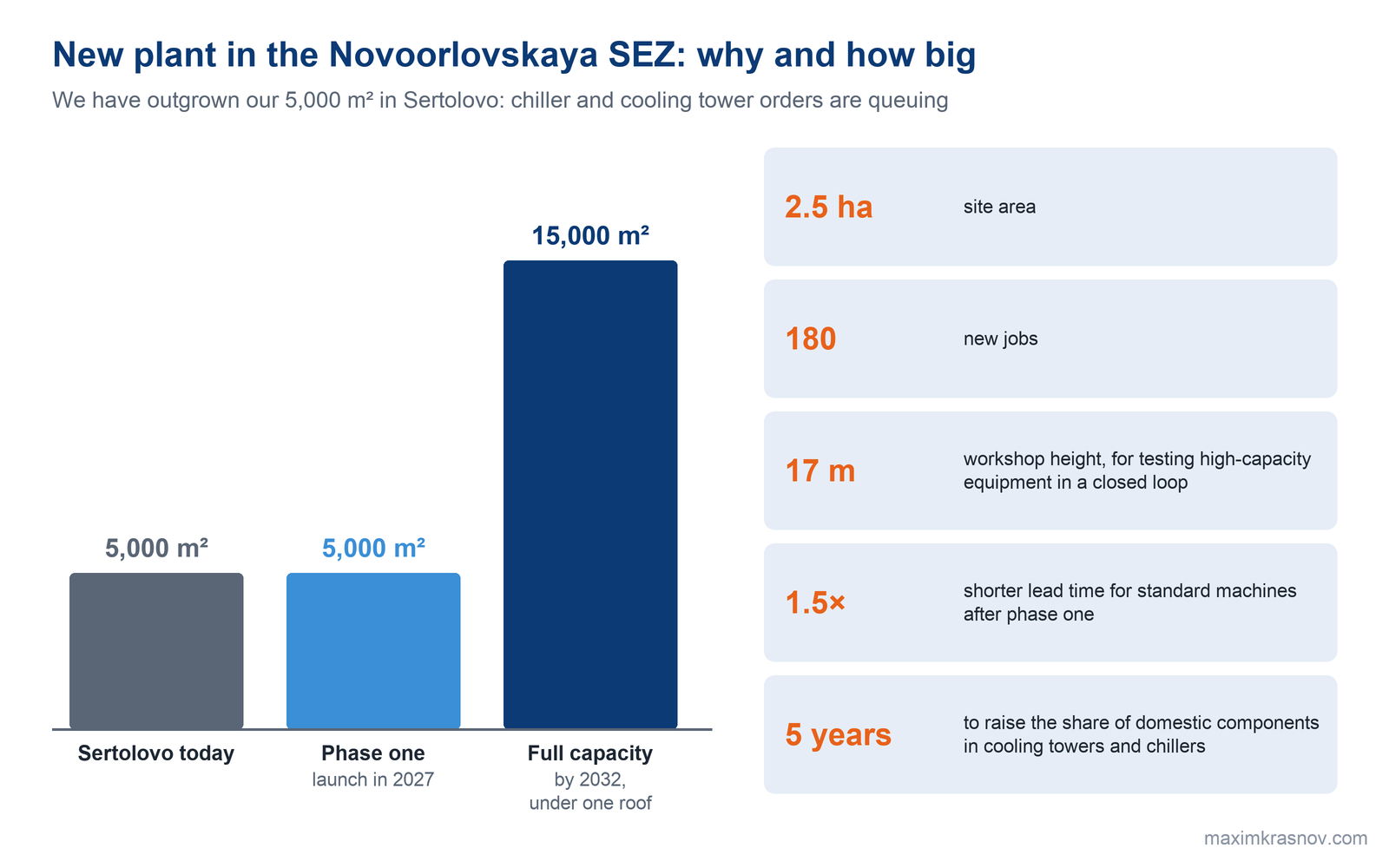
We need the new research and production complex in the Novoorlovskaya Special Economic Zone in St. Petersburg because we have outgrown our current 5,000 m²: orders for chillers and cooling towers are waiting in a queue. I signed the agreement with the city at SPIEF (St. Petersburg International Economic Forum) on 18 June 2025.
| Parameter | Value |
|---|---|
| Site area | 2.5 ha |
| New jobs | 180 |
| Phase one | 5,000 m², launch in 2027 |
| Full capacity | 15,000 m² under one roof by 2032 |
| Workshop height | 17 m, for factory testing of high-capacity equipment in a closed loop |
| Localization | Cooling towers and chillers with a high share of domestic components within 5 years |
For the customer this means three things. Phase one will cut the lead time for standard machines by a factor of 1.5 through proper logistics and overhead cranes. The test bench will let us ship equipment already run through all operating modes. And our own full cycle (welding, assembly, controls) gives a different cost base and lets us compete on the global market.
How can you check that equipment is really made in Russia?
Visit the plant. It is the only check that cannot be faked: a website, certificates and presentations can be assembled, but workshops, people and shipments cannot. That is why we opened our production: in September 2026, for the first time, we took customers through every area, including inside cabinets behind closed doors, and discussed not only the strengths of the equipment but also its weaknesses.
1. Ask directly where each main component is made, and ask for its origin to be written into the specification attached to the contract.
2. Look at the welding, assembly and controls areas and at quality control before shipment.
3. Ask for the contact of the chief engineer at an operating site of the same capacity and call them. A testimonial on a website does not replace a live conversation.
4. Find out who does commissioning and service: the manufacturer's own engineers or a subcontractor.
How to choose the cooling tower itself I covered in the article on choosing an industrial cooling tower, and I write about construction, the team and the company's growth in the Manufacturing and business topic.
Key takeaways
1. Local manufacturing in industrial cooling already covers cooling towers, dry coolers, pump stations, water treatment and controls.
2. Since 2025 Russia has its own production line for finned tubes for closed-circuit cooling towers; before that they came only from the US.
3. Imports remain for centrifugal compressors, which nobody in Russia yet produces serially, and for absorption chillers.
4. The new 2.5 ha plant in the Novoorlovskaya Special Economic Zone is meant to raise the share of domestic components in cooling towers and chillers within five years.
5. The origin of equipment is checked by a visit to the plant and a line in the specification, not by words in a presentation.
FAQ
Are there Russian manufacturers of industrial cooling towers?
Yes. Cold Energy has been making NCT cooling towers in Sertolovo since 2014: open and closed-circuit, modular and field-erected. A modular cooling tower arrives on site in finished blocks; installation on a prepared foundation takes 1–2 days.
Can an imported chiller be fully replaced with a Russian one?
For cooling towers, dry coolers, pump stations and controls, yes. For large centrifugal machines, not yet: nobody in Russia makes a centrifugal compressor serially. So a manufacturer must answer a direct question about the origin of such a machine honestly.
Why are absorption chillers not made in Russia?
We do not make them and we do not hide it. Cold Energy is the exclusive representative of Thermax in Russia and the CIS: we supply the machines, design the systems, and do commissioning and service.
What changed for buyers of cooling equipment after 2014?
Back in 2014 some Western suppliers began restricting sales and did not deliver equipment to Russia that had already been paid for. Demand shifted to Russian manufacturers, and customers now have to verify the manufacturing themselves: at the plant, not from a catalogue.
Sources
-
Cold Energy: Russia's first finned tube line for closed-circuit cooling towers, 20.11.2025.
-
Cold Energy: investment project for a new plant in the Novoorlovskaya Special Economic Zone, 18.08.2025.
-
Cold Energy experience: NCT production in Sertolovo since 2014, Rooppur nuclear power plant project.
Need a cooling solution for your site? Get a consultation