
Data Center Cooling: 5 Options for 5,000 kW and Their Annual Cost

founder and CEO of Cold Energy (NCT)
A 5,000 kW data center cooling plant built on the classic chiller scheme uses 10.22 million kWh and costs RUB 105.2 million per year at RUB 10 per kWh. A packaged chiller with free cooling brings this down to RUB 59.2 million, a centrifugal chiller with a wet cooling tower to 55.5, a gas-fired absorption chiller to 43.4, and direct-to-chip liquid cooling to RUB 18.9 million per year.
Every figure in this article is total cost of ownership: electricity, gas, water, chemicals and service for one year. We modeled all options on the same site: 5,000 kW of cooling, central Russia, year-round operation, electricity at RUB 10 per kWh, gas at RUB 7 per m³. With a different tariff only the electricity line changes.
Why does water temperature decide what cooling costs?
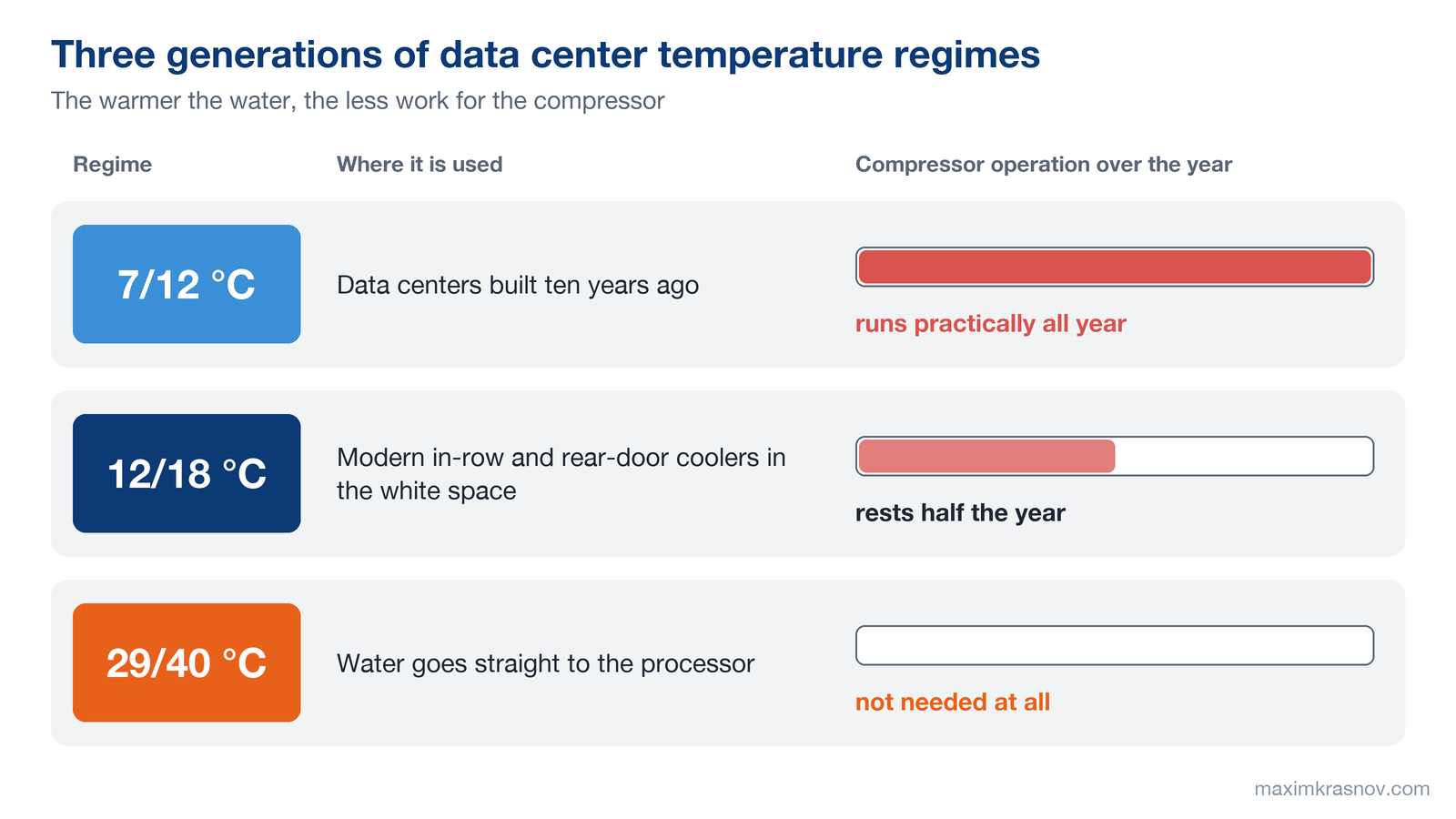
The higher the water temperature in the system, the less work the compressor has to do. All five options rest on this rule, and the three temperature regimes are three generations of data centers.
At 7/12 °C, the way data centers were built ten years ago, the compressor runs practically all year. At 12/18 °C, for modern in-row and rear-door coolers, it rests half the year. At 29/40 °C the water goes straight to the processor, and no compressor is needed at all.
The last regime only looks impossible. NVIDIA GB200 and GB300 NVL72 accept inlet water up to 45 °C (ASHRAE class W45), and the die itself holds 80–90 °C. We supply 32–40 °C to the chip.
The second lever is the energy source: gas and waste heat free up grid kilowatts for computing.
How much does a packaged chiller with free cooling save?
A 5,000 kW packaged chiller with free cooling (cold taken from outdoor air without running the compressor) costs RUB 59.2 million per year against 105.2 for the classic scheme. That saves RUB 46.0 million per year, and electricity use is 1.8 times lower than for a scheme without free cooling.
When it is warmer outside than the setpoint, the compressors run. When it is colder than the glycol, a three-way valve routes the flow through the free cooling coil, and in frost that coil carries the whole load. In central Russia this gives about 4,500 hours a year, in the south about 3,000, in the north about 6,000.
That is where COP (coefficient of performance: kilowatts of cooling per kilowatt of electricity) climbs: 3.0 nominal, 5.5 seasonal. Annual consumption is 5.57 million kWh, or RUB 55.7 million. No water is needed, capital cost is about RUB 150 million, and PUE (total data center energy divided by IT equipment energy) is 1.25–1.35.
In Russia we do not even consider a scheme without free cooling: there is no point. But the packaged chiller has two honest drawbacks. It has the highest consumption of the five options, and free cooling does not cut the peak: in summer it stays at 1,667 kW, and the grid connection is sized on it. Also watch the changeover setpoint: the factory default eats up to a third of the free hours.
When does a centrifugal chiller with a wet cooling tower pay off?
A centrifugal chiller with a wet cooling tower pays off when the site has water and a team ready to run water treatment. Total cost of ownership is RUB 55.5 million per year, with 2.2 times less electricity than the classic scheme: 4.7 million kWh, or RUB 47.0 million.
COP here is 6.0–7.0. Two factors are at work: an oil-free centrifugal compressor on gas-dynamic bearings, and condensing to water at 35 °C instead of 55 °C in an air-cooled condenser. A wet cooling tower works off the wet-bulb temperature: in Moscow that is 19–20 °C against a dry bulb of 28–30 °C.
In winter a plate heat exchanger takes over and the compressor switches off. System peak is 1,015–1,130 kW, PUE is 1.20–1.30.
The price of this efficiency is water. The scheme takes about 10 m³/h, which is RUB 4.4 million per year. A wet cooling tower is warm and humid inside, so it needs water treatment and biological control against Legionella. A water treatment unit costs around RUB 400 thousand, and chemicals for a 5 MW data center around RUB 70 thousand per year.
In money, the packaged chiller with free cooling and the centrifugal chiller with a tower are close: RUB 59.2 and 55.5 million per year. What decides between them is not economics but whether treated water is available on site.
Can you cool a data center without a chiller?
Yes, if the servers are designed for liquid cooling. Direct-to-chip cooling with a closed-circuit cooling tower costs RUB 18.9 million per year: about 1.3 million kWh, or RUB 13.1 million of electricity. Across the whole system that is 7.9 times less than the classic scheme in kilowatt-hours and 5.6 times less in money.
A cold plate with channels is pressed against each chip, and coolant flows through it. The finned closed-circuit tower delivers 29–31 °C water to the CDU (coolant distribution unit), and 32–40 °C glycol goes to the chip. The loop is sealed; water is spent only on spraying the tubes from outside. Below +5 °C outdoors the spray switches off, and for 3–5 months a year the tower runs dry.
At a webinar I opened the topic like this: "The biggest saving comes not from buying a more efficient chiller, but from removing the refrigeration machine altogether." For the cooling-producing equipment the difference from the chiller scheme is 33–47 times: on average over the year, 1,167 kW of compressors and condenser fans against 25–35 kW of cooling tower fans. Pumps and terminal coolers are present in both schemes, so they are left out of this comparison.
System peak is 360–410 kW, capital cost about RUB 100 million against roughly 150 for the packaged chiller, PUE 1.06–1.12, payback 1.1–1.9 years. Internationally, NREL ESIF, a US Department of Energy laboratory, works this way: 24 °C water, no mechanical chillers, PUE 1.036. The SuperMUC supercomputer in Munich takes water up to 50 °C and uses 40% less energy.
There is one limitation: the scheme only works with servers designed for liquid cooling. Primary loop pressure is below atmospheric, so if a seal fails, air is drawn in rather than water leaking out.
Why would a data center use a gas-fired absorption chiller?
A gas-fired absorption chiller is for sites where the grid cannot supply the electrical capacity. The peak demand of a 5,000 kW cooling plant drops from 1,667 to 230 kW. That frees 1,437 kW: 28 full 50 kW racks, or RUB 67 million at a grid connection fee of RUB 47,000 per kW.
The compressor's work is done by the heat of burning gas: a burner boils water out of a lithium bromide solution, and there is no refrigerant gas and no mechanical compressor. Inside the machine the vacuum is 6 mm of mercury, and water boils at 3.5 °C.
The absorption chiller itself draws 5–10 kW of electricity per megawatt of cooling, a compressor chiller 300–350 kW: for the machine alone that is a 30–70-fold difference. The complete plant with cooling towers and pumps is about 46 kW per megawatt.
Over a year the scheme burns 2.44 million m³ of gas for RUB 17.1 million, takes 1.41 million kWh of electricity for RUB 14.1 million and 12.5 m³/h of water for RUB 6.2 million. Total cost of ownership is RUB 43.4 million per year, and a kilowatt-hour of cooling costs RUB 1.9 against RUB 4.6 for the classic scheme. Capital cost is RUB 325 million, payback 2.2 years, PUE 1.15–1.25.
I will name the limits myself: if gas costs more than RUB 11 per m³ or electricity less than RUB 5 per kWh, the scheme loses its point. The strongest example is the Judicial Quarter in St. Petersburg: 12,000 kW, four absorption chillers on natural gas, project under construction. There is no way to get that much power in the Petrogradsky district; with electric chillers the project would not have happened.
Cold Energy is the exclusive distributor of Thermax. Worldwide, absorption chillers account for around 30% of large-capacity cooling, in Russia around 5%, and in 2025 Vertiv and Tecogen announced a partnership on gas-powered cooling for data centers.
When does trigeneration pay off for a data center?
Trigeneration on a 5,000 kW cooling plant pays back in 1.9 years at a capital cost of RUB 715 million. Energy costs for the whole facility fall from RUB 443.5 to 133.5 million per year, a saving of RUB 310.0 million per year. Total cost of ownership for cooling is RUB 17.1 million per year.
A gas engine generator set burns gas and supplies electricity directly to the IT load. One megawatt of gas yields roughly 500 kW of electricity and 500 kW of waste heat. We take the 90–95 °C hot water and feed it to an absorption chiller, which turns that heat into cooling. Fuel utilization is 85% instead of 35–40%.
Own electricity costs RUB 3.45 per kWh against RUB 10 from the grid; the calculation includes gas and gas engine service at RUB 1.3 per kWh.
Drawbacks: RUB 715 million up front and two service contracts. The international example is the Green Data Center of Syracuse University and IBM: Capstone microturbines and Thermax absorption chillers, 50% less energy. Our data center reference is the Central Customs Administration in Moscow: Capstone microturbines and two Thermax machines, part of the cooling goes to the server rooms, the project dates from around 2014, and everything is running.
Which option to choose: five schemes for 5,000 kW compared
| Scheme | Peak power, kW | Electricity, million kWh/year | Total cost of ownership, RUB million/year | Capital cost, RUB million | PUE | Payback |
|---|---|---|---|---|---|---|
| Classic: chillers | 1,667 | 10.22 | 105.2 | — | 1.45+ | baseline |
| Packaged chiller with free cooling | 1,667 | 5.57 | 59.2 | ~150 | 1.25–1.35 | under 1 year |
| Centrifugal chiller + wet cooling tower | 1,015–1,130 | 4.7 | 55.5 | +5–10% over packaged chiller | 1.20–1.30 | — |
| Direct-to-chip cooling | 360–410 | ~1.3 | 18.9 | ~100 | 1.06–1.12 | 1.1–1.9 years |
| Gas-fired absorption chiller | 230 | 1.41 + 2.44 million m³ of gas | 43.4 | 325 | 1.15–1.25 | 2.2 years |
| Trigeneration: gas engine + absorption chiller | 230 own | 1.41 own | 17.1 | 715 | — | 1.9 years |
Payback here is the difference in capital cost against the baseline divided by the annual saving in total cost of ownership.
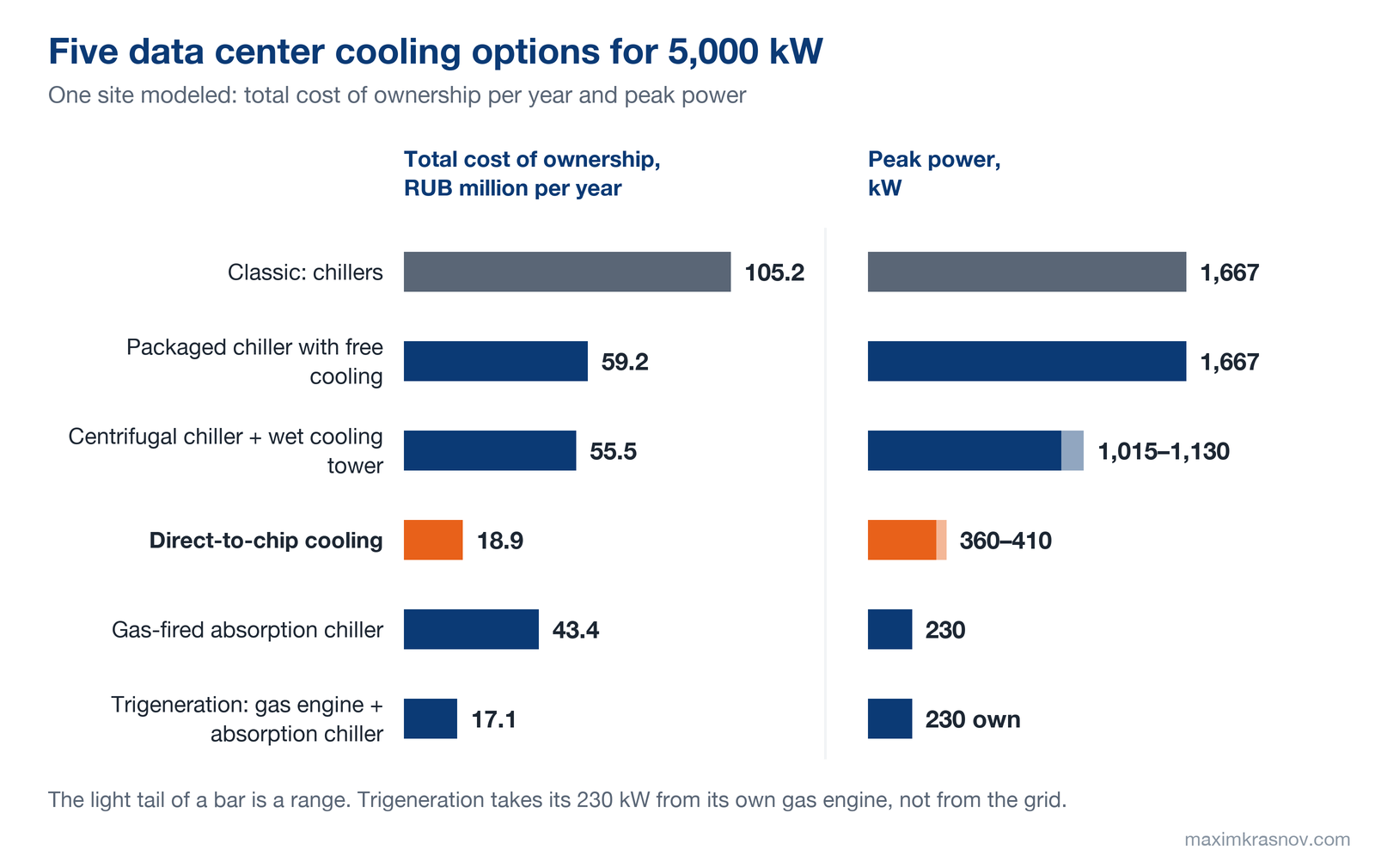
The choice comes down to four questions. Racks go beyond 50 kW: air cannot remove that density, you need direct-to-chip cooling. The grid cannot supply the capacity: a gas-fired absorption chiller or trigeneration. There is waste heat, steam, a gas engine or a boiler house nearby: an absorption chiller on hot water or steam pays back faster than anything else.
No treated water: a packaged chiller with free cooling; water available: a wet cooling tower. The schemes can be combined: some racks on liquid, some on air, and that is normal.
What to budget for besides the equipment?
Grid connection. RUB 47,000 per kW, in some regions up to RUB 100,000. With this line in the estimate, options with electric chillers often drop out at once.
Part-load operation. A data center runs at peak 5–7 days a year, so calculate seasonal efficiency, not the rated point from the catalog.
Overhaul and consumables. A compressor overhaul in year ten costs half the price of the machine. Glycol is replaced every 3–5 years.
Water and chemicals. A separate operating line for every wet scheme. Check the regional wastewater tariff.
Building works. A plant room for two absorption chillers is 15 × 8–10 m with a height of at least 5.5 m: each machine needs space alongside for pulling the heat exchanger tubes.
More on each option: liquid cooling for data centers without a chiller, absorption chillers when electrical capacity is short, chiller free cooling, trigeneration. All articles on the topic are in the Data center cooling section.
Key takeaways
The money in data center cooling is decided by the scheme, not by the chiller brand. Between a packaged chiller with free cooling and direct-to-chip cooling on the same 5,000 kW site there are RUB 40 million per year.
If racks are dense and servers are liquid-cooled, the cheapest scheme to run is one without a refrigeration machine: RUB 18.9 million per year. If the grid cannot supply capacity, a gas-fired chiller and trigeneration free up kilowatts for computing.
The decision is made once, at the design stage, and before the grid connection is paid for. After that, the main argument for gas and absorption is already spent.
FAQ
What PUE do different cooling schemes achieve?
The industry average PUE is 1.6–1.8. A classic chiller scheme for 5,000 kW gives 1.45 and above, direct-to-chip cooling 1.06–1.12.
Does a wet cooling tower ice up in winter?
In the VR series the centrifugal fan sits at the bottom, above a heated room, so there is nothing to freeze. In closed-circuit towers the tubes are finned, and at +5 °C the spray switches off and the unit goes dry for 3–5 months. The price for this is that a centrifugal fan uses more power than an axial one.
Is an absorption chiller safe in a data center?
There is a vacuum inside, and the working fluids are demineralized water and lithium bromide. If the shell is breached, air goes in and nothing comes out. Every machine is helium leak tested before shipment and installed in a heated room under boiler house rules.
Does a small data center need a wet cooling tower?
Below 1,000 kW of cooling a wet cooling tower is not economically justified: the piping, water supply and operating staff do not pay back. For such a site an ordinary compressor chiller is the more honest and cheaper choice.
Sources
-
NREL ESIF, US Department of Energy laboratory: direct liquid cooling with 24 °C water and no mechanical chillers, PUE 1.036.
-
LRZ, Munich, SuperMUC supercomputer: inlet water up to 50 °C, 40% lower energy use.
-
Syracuse University and IBM, Green Data Center: 12 Capstone microturbines and Thermax absorption chillers, 50% less energy.
-
Vertiv and Tecogen, 2025: partnership on gas-powered cooling for power-constrained data centers.
-
Cold Energy calculation for the webinar of 6 August 2026, tariff RUB 10 per kWh.
Need a cooling solution for your site? Get a consultation