
Liquid Cooling for Data Centers Without a Chiller: Water to the Chip

founder and CEO of Cold Energy (NCT)
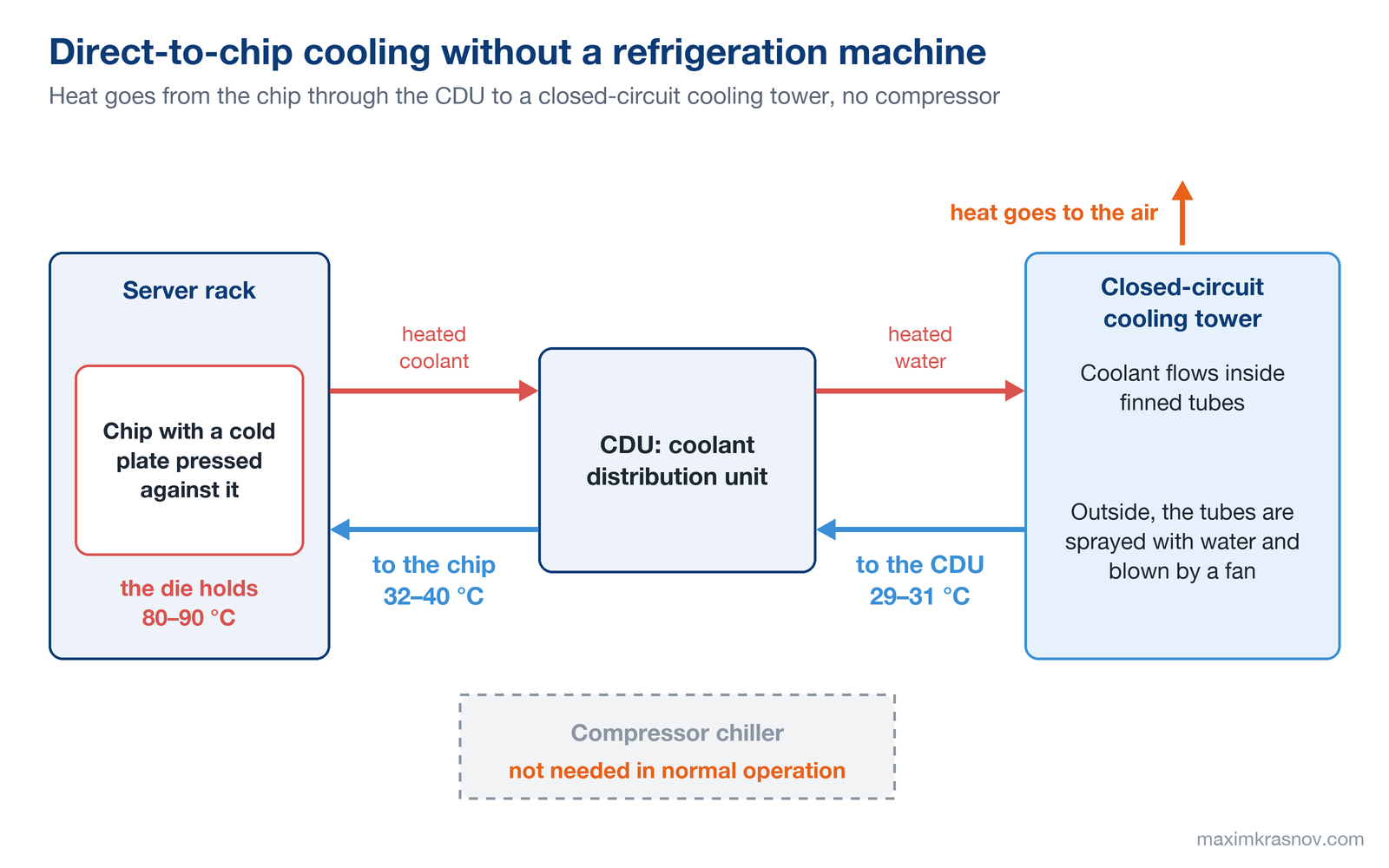
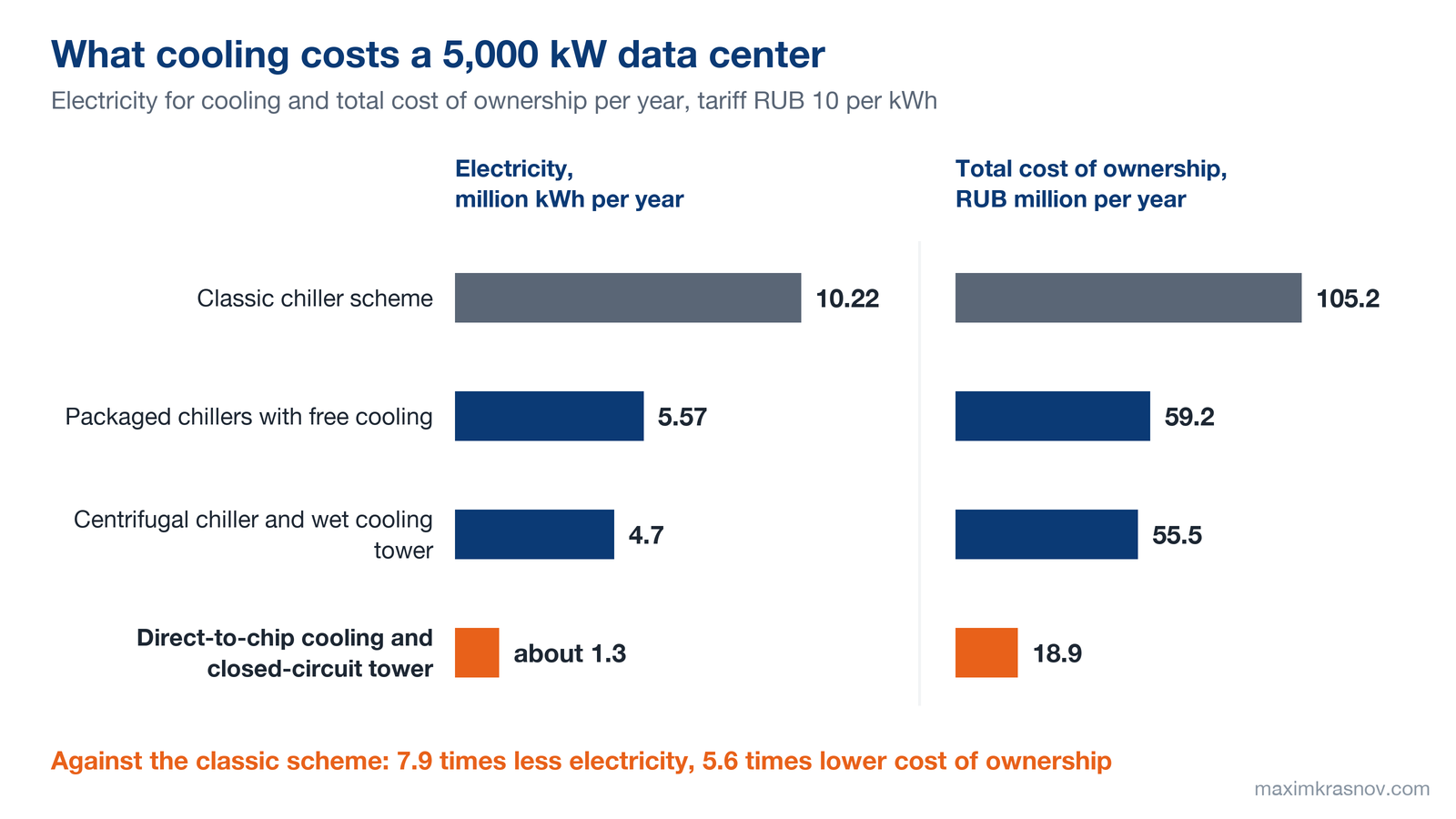
With direct-to-chip cooling, a compressor chiller is not needed in normal operation. Coolant at 32–40 °C goes to the processor, and a closed-circuit cooling tower with finned tubes returns 29–31 °C to the loop. On a 5,000 kW data center, cooling then uses about 1.3 million kWh a year instead of 10.22 million for the classic chiller scheme, and total cost of ownership falls from RUB 105.2 to 18.9 million per year.
All calculations below are for the same 5,000 kW site at RUB 10 per kWh. I compare the other options, from packaged chillers with free cooling to trigeneration, in the article on five data center cooling options.
Why can direct-to-chip cooling work without a refrigeration machine?
The processor does not need cold water. The die holds 80–90 °C, and we supply coolant to it at 32–40 °C. The weather gives that temperature, and a compressor, whose job is to make cold below outdoor temperature, becomes redundant.
The temperature regime (the pair of supply and return water temperatures in the chilled water system) shows this clearly. There is one rule: the higher the water temperature, the less work the compressor does. Data centers have gone through three generations of regimes in recent years.
| Temperature regime | Where it is used | What the compressor does |
|---|---|---|
| 7/12 °C | Classic chilled water, how data centers were built 10 years ago | Runs practically all year |
| 12/18 °C | Regime for modern in-row and rear-door coolers in the white space | Rests half the year |
| 29/40 °C | Water goes straight to the processor | Not needed at all |
The design is simple: a cold plate with channels is pressed against each chip, and coolant flows through the channels. Heat leaves through the coolant distribution unit (CDU) to a closed-circuit cooling tower; there is no refrigeration machine in the chain.
I put the main idea this way: "The biggest saving comes not from buying a more efficient chiller, but from removing the refrigeration machine altogether."
How has rack density grown, and why is air no longer enough?
Server rack power is rising fast. Once a rack goes beyond 50 kW, air physically cannot remove the heat, and the conversation turns straight to liquid cooling.
An example is NVIDIA GB200 and GB300 NVL72 servers on the Grace Blackwell architecture. A rack is 120–140 kW, a single chip 1,200–1,400 W. They allow inlet water up to 45 °C and return up to 65 °C, which is class W45 in the ASHRAE classification. Lenovo, HPE and Dell have certified servers for direct cooling since 2018.
Internationally, sites have run without mechanical chillers for a long time. The NREL laboratory of the US Department of Energy cools its computers with 24 °C water and no mechanical chillers, and holds PUE (total data center electricity divided by IT equipment energy, ideal 1.0) at 1.036. The LRZ center in Munich supplies water up to 50 °C to the SuperMUC supercomputer and has cut energy use by 40%. By industry estimates, direct-to-chip cooling holds 47% of the liquid cooling market for AI data centers, and since July 2025 Microsoft has been rolling out liquid cooling across its Azure campuses.
In Russia this is no longer the future: at our webinar on 6 August 2026 a participant wrote that he supplies 60–70 °C to the chips. In my view that is a bit high; I would still not break the manufacturer's temperature limits.
What replaces the chiller: a closed-circuit cooling tower or an adiabatic dry cooler?
The main option is a closed-circuit (hybrid) cooling tower with finned tubes. Coolant flows inside the tubes in a sealed loop; outside, the tubes are sprayed with water and blown by a fan. Water is spent only on that spray and never mixes with the loop.
When it is below +5 °C outdoors the spray switches off, and for 3–5 months a year the tower runs dry, with no make-up water. So there is nothing to freeze.
Finning (spiral fins on the tube) adds 30–40% of heat transfer surface. Such tubes used to be imported into Russia only from the US. In November 2025 we launched our own finned tube line at the Sertolovo plant, the first in Russia.
The second option is a dry cooler (a radiator with fans that cools liquid by air) with adiabatic pre-cooling (water is sprayed onto the coil and cools it by evaporation). It works, but a dry cooler means a lot of aluminum, and with copper tubes it is also expensive. There is also a risk: if aluminum fins are sprayed with untreated water, hardness salts can put the dry cooler out of service within two years. I offer it when the customer has serious water treatment and a strong operations team.
Why does a cooling tower deliver about 30 °C even in hot weather?
A cooling tower works not off air temperature but off wet-bulb temperature (the lowest temperature to which air can cool water by evaporation). In Moscow in summer that is 19–20 °C with a dry bulb of 28–30 °C. In St. Petersburg, at +25 °C outdoors, a wet cooling tower delivers 19–20 °C water.
For direct-to-chip cooling the tower only needs to deliver 29–31 °C, so there is a large margin on wet bulb. Even at +40 °C outdoors, water from the tower will be around 30 °C. This is how the physics works, not a safety margin, and we write that temperature into the contract.
Rain does not get in the way: humidity rises, but the air cools, and the wet bulb does not exceed the design value. In a dry climate a wet cooling tower works even better than in central Russia: in the desert at +45 °C and 30% humidity it delivers water at about 20 °C. We are the only members in Russia and the CIS of the US-based CTI (Cooling Technology Institute), which writes the standards for cooling towers.
How much does it save on a 5,000 kW data center?
Compared with the classic chiller scheme, direct-to-chip cooling with a closed-circuit cooling tower cuts electricity for cooling 7.9 times and total cost of ownership 5.6 times: RUB 18.9 million per year instead of RUB 105.2 million. The saving is RUB 86.3 million per year.
Calculation basis: 5,000 kW cooling load, year-round operation, central Russia, electricity at RUB 10 per kWh. The baseline is a classic chiller scheme without free cooling with a coefficient of performance (COP) of 3.0.
| Metric | Classic chiller scheme | Packaged chillers with free cooling | Centrifugal chiller and wet cooling tower | Direct-to-chip cooling and closed-circuit tower |
|---|---|---|---|---|
| Electricity for cooling, million kWh per year | 10.22 | 5.57 | 4.7 | about 1.3 |
| Peak power, kW | 1,667 | 1,667 | 1,015–1,130 | 360–410 |
| Total cost of ownership, RUB million per year | 105.2 | 59.2 | 55.5 | 18.9 |
| Saving vs classic scheme, RUB million per year | — | 46.0 | 49.7 | 86.3 |
| PUE | 1.45 and above | 1.25–1.35 | 1.20–1.30 | 1.06–1.12 |
| Capital cost | — | about RUB 150 million | +5–10% over packaged chillers | about RUB 100 million |
| Water, thousand m³ per year | 0 | 0 | 63 | 40 |
A word on the "50 times" figure I quote in talks. It comes from switching to direct-to-chip cooling with cooling towers instead of a refrigeration machine, and it is counted on the cooling-producing equipment. In the chiller scheme that means compressors and condenser fans, in the chiller-free scheme cooling tower fans: on average over the year 1,167 kW against 25–35 kW, or 33–47 times. Hence the rounded "50 times".
Pumps and terminal coolers are present in both schemes, so across the whole system the annual difference is more modest: 7.9 times in kilowatt-hours and 5.6 times in money. Looking at the whole data center at an average load of 70%, annual electricity consumption drops from 42.41 to 33.49 million kWh. The servers consume the same; only cooling changes.
Capital cost is about RUB 100 million against roughly RUB 150 million for packaged chillers with free cooling: there is no chiller plant room at all. Payback is 1.1–1.9 years. A low peak of 360–410 kW also shrinks the grid connection, which costs RUB 47,000 per kW and up to RUB 100,000 in some regions.
How much water does a chiller-free scheme need, and what are the risks?
For a 5,000 kW site, closed-circuit cooling towers use about 40 thousand m³ of water a year, a chiller with a wet cooling tower about 63 thousand m³. The difference is that a closed-circuit tower runs dry 3–5 months a year. At RUB 70 per cubic meter, water and chemicals cost about RUB 2.8 million per year.
The main risk of a wet scheme is bacteria, Legionella among them. A wet cooling tower has 100% humidity and 30–35 °C inside, an ideal environment for them. The methods have long been proven: a closed-circuit tower, water treatment with biocide dosing, biological monitoring.
A water treatment unit costs around RUB 400 thousand, chemicals for a 5 MW data center around RUB 70 thousand per year. You pay with a heavier load on the operations team and get a multiple saving in electricity. Everyone decides for themselves, but in my view it is worth it.
If there is no treated water on site, in the south for example, packaged chillers with free cooling remain. They need no water, but they spend 5.57 million kWh a year on cooling against 1.3 million for the closed-circuit tower scheme.
When is a compressor chiller still needed?
The chiller stays in the design as backup, for air-cooled racks, on small sites and where there is no water. The direct-to-chip scheme itself only works with servers designed for it.
1. Backup. For a pump failure we design N+1, a 30–120 second buffer and a backup chiller sized at 10–20% of capacity. Here the compressor is insurance; it does not run every day.
2. Hybrid data center. Sites are already being built with some racks on liquid and some on air. The cooling schemes are combined on them, and that is a normal solution, not a compromise.
3. Small site. Below 1,000 kW of cooling a wet cooling tower is not economically justified. For 100 kW the piping, water supply and operating staff will not pay back, and I honestly advise an ordinary compressor chiller.
Leaks are the first thing people ask about. Primary loop pressure is below atmospheric: if a seal fails, air is drawn in and water does not leak out, and every CDU has leak detection. The responsibility boundary runs at the CDU; up to it, we guarantee temperature, flow and water quality.
Related: how to choose an industrial cooling tower, cooling tower or dry cooler, how much water a cooling tower uses. All articles are in the Data center cooling section.
Key takeaways
1. With 32–40 °C supplied to the chip, the cooling comes from the weather: a closed-circuit cooling tower with finned tubes delivers 29–31 °C, and a compressor is only needed as backup at 10–20% of capacity.
2. On a 5,000 kW site, total cost of ownership is RUB 18.9 million per year instead of 105.2 million. Across the whole cooling system electricity use is 7.9 times lower, and for the cooling-producing equipment 33–47 times lower.
3. The price of the scheme is water and water treatment. Without water, on sites under 1,000 kW and for air-cooled racks, compressor cooling stays.
FAQ
Can ordinary servers be converted to direct-to-chip cooling?
No. The scheme only works with servers designed for liquid cooling: the chip must carry a cold plate with coolant channels. If the room also has air-cooled racks, the cooling schemes are combined.
Is it true that electricity savings reach 50 times?
Almost, if you compare only the cooling-producing equipment: compressors and condenser fans against cooling tower fans, 1,167 kW against 25–35 kW on average over the year, or 33–47 times. Across the whole cooling system on a 5,000 kW site the difference is 7.9 times in kilowatt-hours and 5.6 times in money.
What happens if a pump stops?
Pumps are redundant on an N+1 basis, and the loop is designed with a 30–120 second buffer. On top of that, a backup chiller at 10–20% of capacity is installed.
From what data center size does a cooling tower scheme make sense?
From 1,000 kW of cooling; a wet cooling tower starts at one to one and a half megawatts. A site of about 1 MW can also save 100–300 kW, but not as much as a 5 MW site.
Sources
-
The Data Center Engineer: cooling NVIDIA GB200 and GB300 NVL72 with 45 °C water
-
Cold Energy calculation for the webinar of 6 August 2026, tariff RUB 10 per kWh.
Need a cooling solution for your site? Get a consultation