
Absorption Chiller for Data Centers: Free Up 1,437 kW of Grid Power
founder and CEO of Cold Energy (NCT)
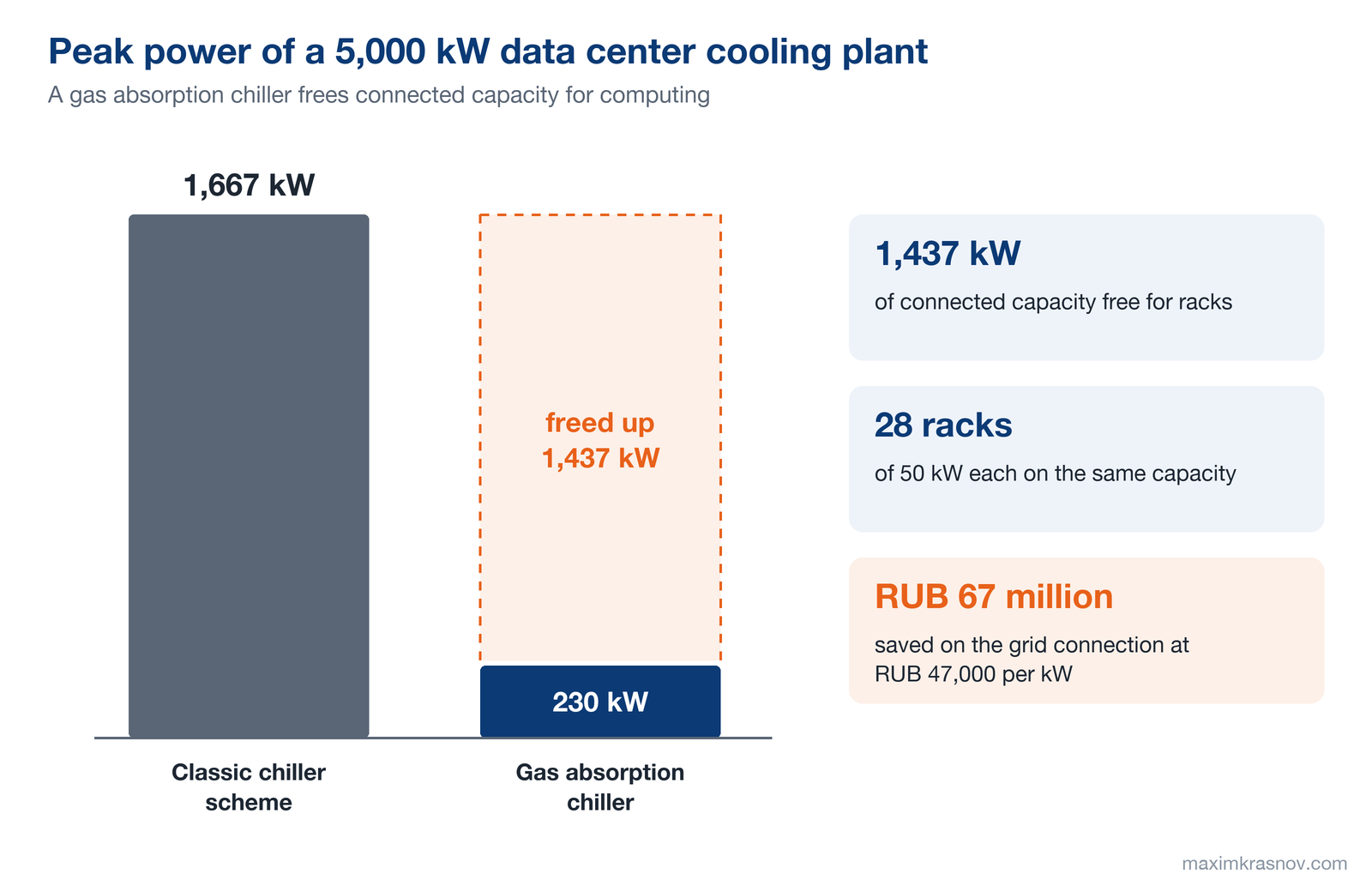
A gas-fired absorption chiller takes data center cooling off the electrical grid. On a data center with 5,000 kW of cooling, the peak power of the cooling plant falls from 1,667 kW for the classic chiller scheme to 230 kW. That frees 1,437 kW of connected capacity: at RUB 47,000 per kW, RUB 67 million on the grid connection alone.
All calculations below are for one site and in the same money, at RUB 10 per kWh. I compare the other options in the article on five data center cooling options.
Why has electrical capacity become the main constraint for data centers?
By our calculations, cooling eats around 40% of all data center electricity. When the grid will not give a single kilowatt above the limit, every kilowatt spent on compressors is taken from the racks.
A grid connection (connecting to the power network and paying for every kilowatt of connected capacity) costs RUB 47,000 per kW, and up to RUB 100,000 in some regions. This line is often left out of the estimate because it is taken as a given. Once it is added, options with electric chillers on a capacity-constrained site usually drop out at once.
A conversation with the owner of a 5 MW data center. I ask whether they realize they could have bought one and a half megawatts less electricity. "That's hundreds of millions." "Why didn't you?" "Well, we've already bought it." So it makes sense to talk about gas cooling before the grid connection is paid for, not after.
How does a gas absorption chiller free up electrical capacity?
In an ordinary chiller the work is done by an electric compressor. In a direct-fired absorption chiller the same work is done by the heat of a natural gas burner: it boils water out of a lithium bromide solution, which is why I call it a "chemical compressor" when talking to customers. Inside there is a vacuum of 6 mm of mercury, water boils at 3.5 °C, and there is no refrigerant gas and no mechanical compressor.
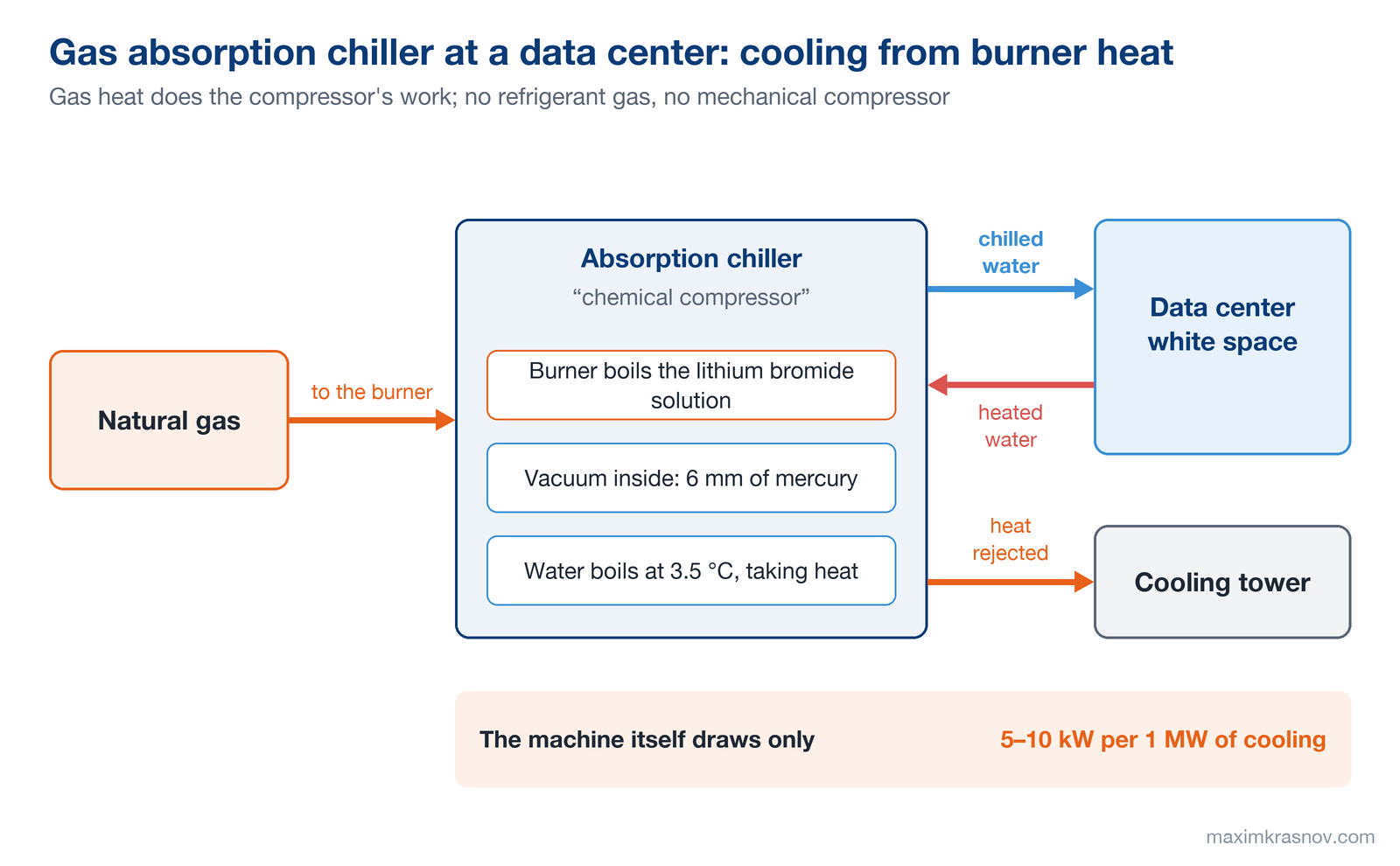
The machine itself draws 5–10 kW of electricity per 1 MW of cooling, depending on the model. A compressor scheme needs 300–350 kW for the same megawatt: for the refrigeration machine alone that is a 30–70-fold difference. The complete plant for 5,000 kW, with cooling towers, pumps and burner, has a peak of 230 kW, about 46 kW per megawatt of cooling.
The difference from the classic scheme is 1,437 kW, or 28 full 50 kW racks on the same connected capacity. My main argument to customers goes like this: a data center can be built where there is only enough electricity for the computing itself; what you need is a pipe from Gazprom and electricity for the pumps, the burner and the cooling towers.
| Metric, data center with 5,000 kW of cooling | Classic chiller scheme | Gas absorption chiller | Trigeneration (gas engine + absorption chiller) |
|---|---|---|---|
| Peak power for cooling | 1,667 kW | 230 kW | 230 kW of own generation |
| Electricity per year | 10.22 million kWh | 1.41 million kWh | 1.41 million kWh, own |
| Gas per year | — | 2.44 million m³, RUB 17.1 million | 10.8 million m³ for the whole site |
| Total cost of ownership for cooling | RUB 105.2 million/year | RUB 43.4 million/year | RUB 17.1 million/year |
| Capital cost | — | RUB 325 million | RUB 715 million |
| PUE | 1.45+ | 1.15–1.25 | depends on the scheme |
| Payback | baseline | 2.2 years | 1.9 years |
What does a gas absorption chiller cost to own, and when does it pay back?
Total cost of ownership of the gas scheme is RUB 43.4 million per year against RUB 105.2 million for the classic chiller scheme at the same 5,000 kW. The saving is RUB 61.8 million per year, and payback in our model is 2.2 years. The cost of 1 kWh of cooling is RUB 1.9 against RUB 4.6.
Gas: thermal COP (cooling produced divided by heat input) is 1.35, about 400 Nm³/h at peak, 2.44 million m³ a year for RUB 17.1 million. Electricity: 1.41 million kWh for RUB 14.1 million. Cooling tower water: 12.5 m³/h, RUB 6.2 million per year.
The grid connection saving is a separate line: RUB 67 million for 1,437 kW at RUB 47,000 per kW, and proportionally more where a kilowatt costs up to RUB 100,000. Cooling is not "buy it and forget it"; it is the cost of ownership over the life of the facility, and that is what you have to calculate.
What PUE does an absorption scheme give in a data center?
PUE (Power Usage Effectiveness: total data center energy divided by IT equipment energy) for a gas absorption chiller is 1.15–1.25 in our calculation. For the classic chiller scheme it is 1.45 and above. The industry average PUE is 1.6–1.8.
We did not calculate PUE separately for trigeneration in our model: it depends on the energy center design, so I compare it on total cost of ownership.
In July 2026 Johnson Controls published a reference design for AI data centers with absorption chillers running on waste heat from on-site generation: up to 44% less electricity for cooling, up to 97 MW of additional capacity on a 1 GW site, PUE from 1.23. The manufacturer notes that these are modeled results. In 2025 Vertiv and Tecogen announced a partnership on gas-fired chillers for data centers that have hit their power limit.
How is trigeneration different from a gas absorption chiller?
Trigeneration (producing electricity, heat and cooling from one fuel) goes further: a gas engine generator set powers the IT load, and its heat is turned into cooling. One megawatt of gas yields roughly 500 kW of electricity and 500 kW of heat, which is usually dumped through radiators. We take the 90–95 °C hot water and feed it to the absorption chiller, and fuel utilization rises to 85% instead of 35–40%.
On a 5,000 kW site, own electricity costs RUB 3.45 per kWh against RUB 10 from the grid. Energy costs for the whole facility are RUB 133.5 million per year against RUB 443.5 million, a saving of RUB 310.0 million per year. Capital cost is RUB 715 million, payback in the model 1.9 years; the internal rate of return for a specific site comes from the feasibility study.
A separate question is which absorption chiller to pair with the gas engine. On hot water the absorption chiller's COP is 0.75–0.85, on direct gas firing about 1.4. If you order the gas engine without a hot water heat recovery module and feed the 400 °C exhaust gas straight into the machine, the same heat gives twice as much cooling; we delivered such a project in Kazakhstan. It is more complex: if there is a lot of exhaust and little cooling demand, part of the exhaust is bypassed.
The classic international example is the Green Data Center of Syracuse University and IBM: 12 Capstone microturbines, 50% less energy, running since 2009. The absorption chillers there are Thermax, two double-effect units of 150 tons of refrigeration each.
Our trigeneration projects are Teplichnoye (832 kW), MolPromKuban and Syry Kubani (3 MW). The closest to data centers is the Central Customs Administration in Moscow: Capstone microturbines and two Thermax absorption chillers, part of the cooling goes to the server rooms, and the system has been running since around 2014. We have one confirmed direct-fired gas chiller project: Rublyovo-Arkhangelskoye JSC, two Thermax TCH G2 E3 machines, 2025.
How do you provide redundancy for absorption chillers in a Tier IV data center?
Tier IV (the highest data center reliability level under the Uptime Institute standard) does not prescribe a formula like "N+1" or "2N". It requires four properties: any component can be maintained without shutdown, the site withstands any single failure, redundant equipment is separated into different rooms, and cooling continues without interruption when power is lost. An absorption scheme meets these requirements if its three weak points are covered.
The first is the heat source. A failure of the gas engine, the boiler house or the gas supply knocks out all absorption chillers at once; that is the main single point of failure. The second is restart: after a stop, an absorption chiller takes 15–30 minutes or longer to reach operating conditions, an electric chiller 3–10 minutes, so the thermal storage has to be several times larger. The third is cooling towers: a single-effect absorption chiller rejects roughly twice as much heat to the tower as an electric chiller of the same capacity, and the towers and pumps also need redundancy.
The main scheme I recommend is a hybrid. Absorption chillers on gas engine heat run at base load and deliver the savings, and electric chillers are sized to carry the full load on their own if the heat source is lost. Different technologies fail for different reasons: a gas outage does not touch the electric machines, a grid outage does not touch absorption chillers running on the gas engine. The drawback is the capital cost of a double fleet of machines.
If electricity is scarce and a hybrid is impossible, what remains is 2N on absorption chillers: two groups of machines at 100% each in separate rooms and two independent heat sources (two groups of gas engines, a gas engine plus a boiler house, or for direct-fired machines two gas supplies or backup fuel). N+1 on the machines alone is not enough for Tier IV: it does not cover a failure of the shared heat source, header or pipe.
Any scheme needs two independent chilled water loops for the full load, thermal storage to ride through an absorption chiller restart, and pumps and controls on UPS. We show the customer a table for every component: after any single failure, N remains.
When does a gas absorption chiller pay off, and when does it not?
A gas absorption chiller pays off when the grid cannot supply capacity or a kilowatt of connection is expensive, and there is gas on site. And above all, before the grid connection is paid for.
The scheme loses its point if gas costs more than RUB 11 per m³ or electricity less than RUB 5 per kWh. At the base tariff of RUB 10 per kWh the margin is twofold, but in regions with cheap generation I check this first. If connected capacity has already been bought for the full load, the main argument is gone.
The plant room follows boiler house rules and must be heated: the machine is charged with water, so the temperature has to stay above +5 °C. The cooling tower rejects 2.3–2.5 times more heat than the cooling capacity, the area for cooling towers is 2.3–2.5 times larger than for an electric scheme, and 12.5 m³/h of water is needed.
Related: what an absorption chiller is and when it beats a compressor chiller, trigeneration: when it pays off. All articles are in the Data center cooling section.
Key takeaways
On a 5,000 kW data center, a gas absorption chiller frees 1,437 kW of connected capacity: RUB 67 million on the grid connection and 28 racks of 50 kW. Total cost of ownership for cooling is RUB 43.4 million per year against RUB 105.2 million for the classic scheme, payback is 2.2 years, PUE 1.15–1.25. Trigeneration gives more, RUB 310.0 million of savings per year for the site, but needs RUB 715 million up front and two service contracts.
For Tier IV I would build a hybrid: absorption chillers at base load, electric chillers as full backup, and thermal storage to cover the long restart of the absorption machine. If there is no gas, gas costs more than RUB 11 per m³, or the capacity has already been paid for, it is more honest to choose another scheme.
FAQ
How much electricity does the absorption chiller itself use?
5–10 kW per 1 MW of cooling, depending on the model. A compressor machine uses 300–350 kW for the same megawatt. The complete 5,000 kW plant, with cooling towers, pumps and burner, has a peak of 230 kW.
Is a gas absorption chiller safe inside a data center building?
The working fluids are demineralized water and lithium bromide, and inside there is a vacuum, not pressure. If the shell is breached, air goes in and nothing comes out. The plant room is designed under boiler house rules with gas detection.
Can an absorption chiller run on the heat from the servers themselves?
No. Return water from servers is at 30–45 °C, and the machine needs heat from 80 °C.
How much water does a 5,000 kW absorption scheme need?
12.5 m³/h, which is RUB 6.2 million per year. Without water treatment the cooling tower fouls, and the savings go on maintenance.
What happens to cooling if the gas engine in a trigeneration scheme stops?
The grid connection stays as backup, and the absorption chiller is fed from the boiler house. For Tier IV that is not enough: you need a second independent heat source or electric chillers that carry the full load on their own.
Sources
-
Cold Energy calculation for the webinar of 6 August 2026, tariff RUB 10 per kWh: data center with 5,000 kW of cooling, 8,760 hours a year, average load 70%, gas at RUB 7 per m³, grid connection at RUB 47,000 per kW, N+1 redundancy in all options.
-
Uptime Institute, Tier Standard: Topology — requirements for Tier IV data centers.
-
Johnson Controls, Absorption Chiller Reference Design Guide, 28 July 2026: press release.
-
Vertiv and Tecogen, partnership on gas-fired chillers for power-constrained data centers, 3 March 2025: Vertiv press release.
-
Syracuse University and IBM, Green Data Center: 12 Capstone microturbines and two double-effect Thermax absorption chillers of 150 tons of refrigeration each, 50% less energy, running since 2009 (NYSERDA case study).
Need a cooling solution for your site? Get a consultation