
How to Choose an Industrial Cooling Tower: Open, Closed or Hybrid

founder and CEO of Cold Energy (NCT)
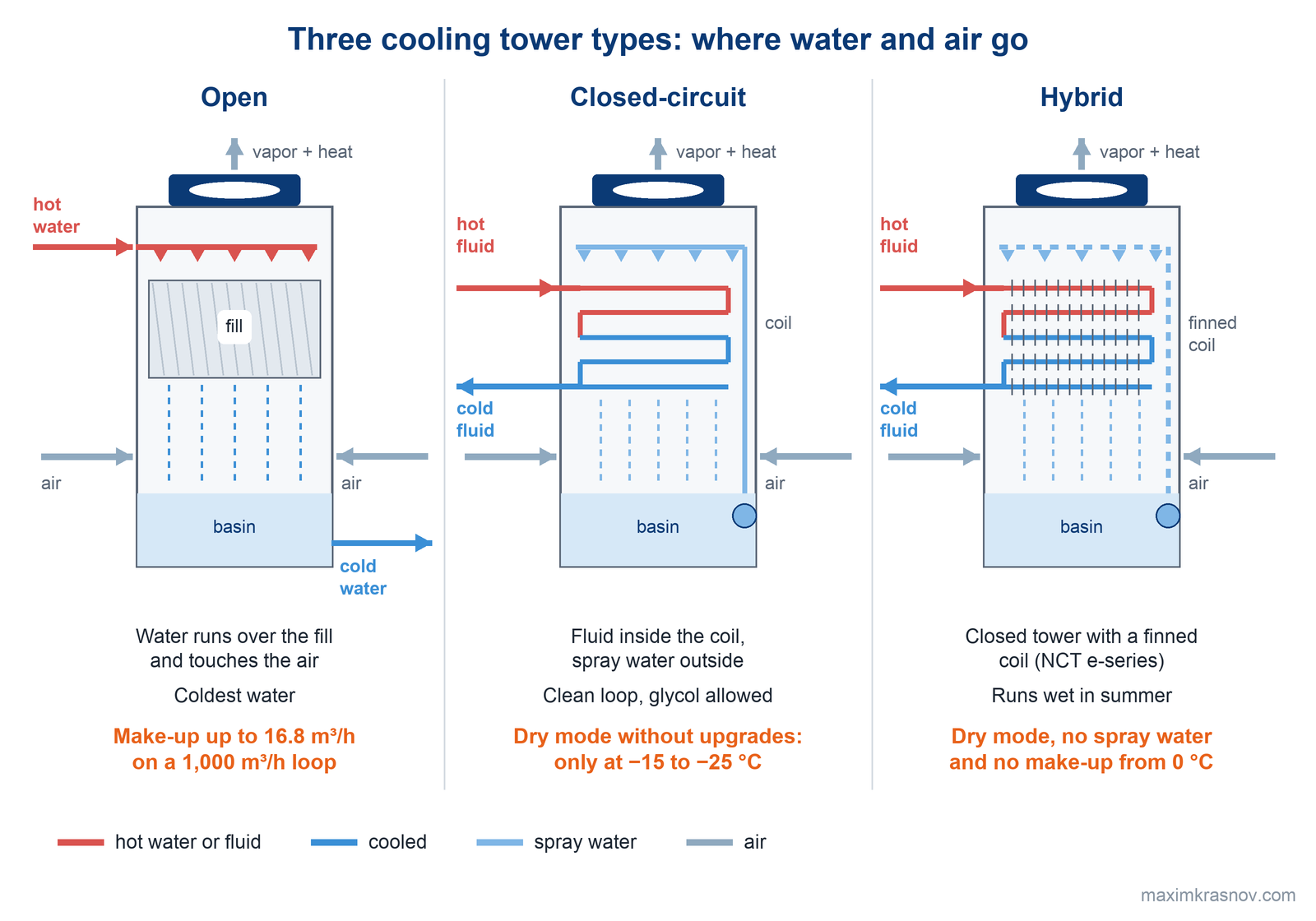
An industrial cooling tower is chosen by three questions: what water temperature you need in summer, whether outdoor air may enter the process loop, and whether there is water on site. An open tower gives the coldest water, but on a 1,000 m³/h loop it takes up to 16.8 m³/h of make-up. A closed tower keeps the loop clean, and a hybrid tower with a finned coil runs without water in the cold season.
This article is for plant directors and chief engineers. We manufacture open and closed cooling towers, dry coolers and chillers, so, frankly, I do not mind which you choose. What matters is this: a mistake in the type of unit cannot be fixed later by picking a different model.
What is the difference between open, closed and hybrid cooling towers?
An open cooling tower is an evaporative cooler in which process water runs down the fill in direct contact with air. Part of the water evaporates and carries off heat, so an open tower gives the coldest water from the most compact unit.
A closed-circuit cooling tower is a unit in which the cooled fluid flows inside a coil while the outside of the coil is sprayed with its own water from the basin. The two circuits never mix: air does not touch the process water, and the loop can carry glycol.
A hybrid cooling tower is a closed tower that runs wet in summer and, in cold weather, switches off the spray and cools the fluid with air alone. In the NCT range these are the e-series: the "e" stands for a finned coil, and per the catalog such a tower runs without spray water from 0 °C. A closed tower with a plain coil and no modifications goes into dry mode only at −15 to −25 °C.
A common compromise is an open tower plus a plate heat exchanger. The process gets clean water, but 2–4 °C warmer, and the heat exchanger fouls with dirt from the open loop. It makes sense for very large flows or when an open tower is already installed.
What water temperature can a cooling tower deliver in summer?
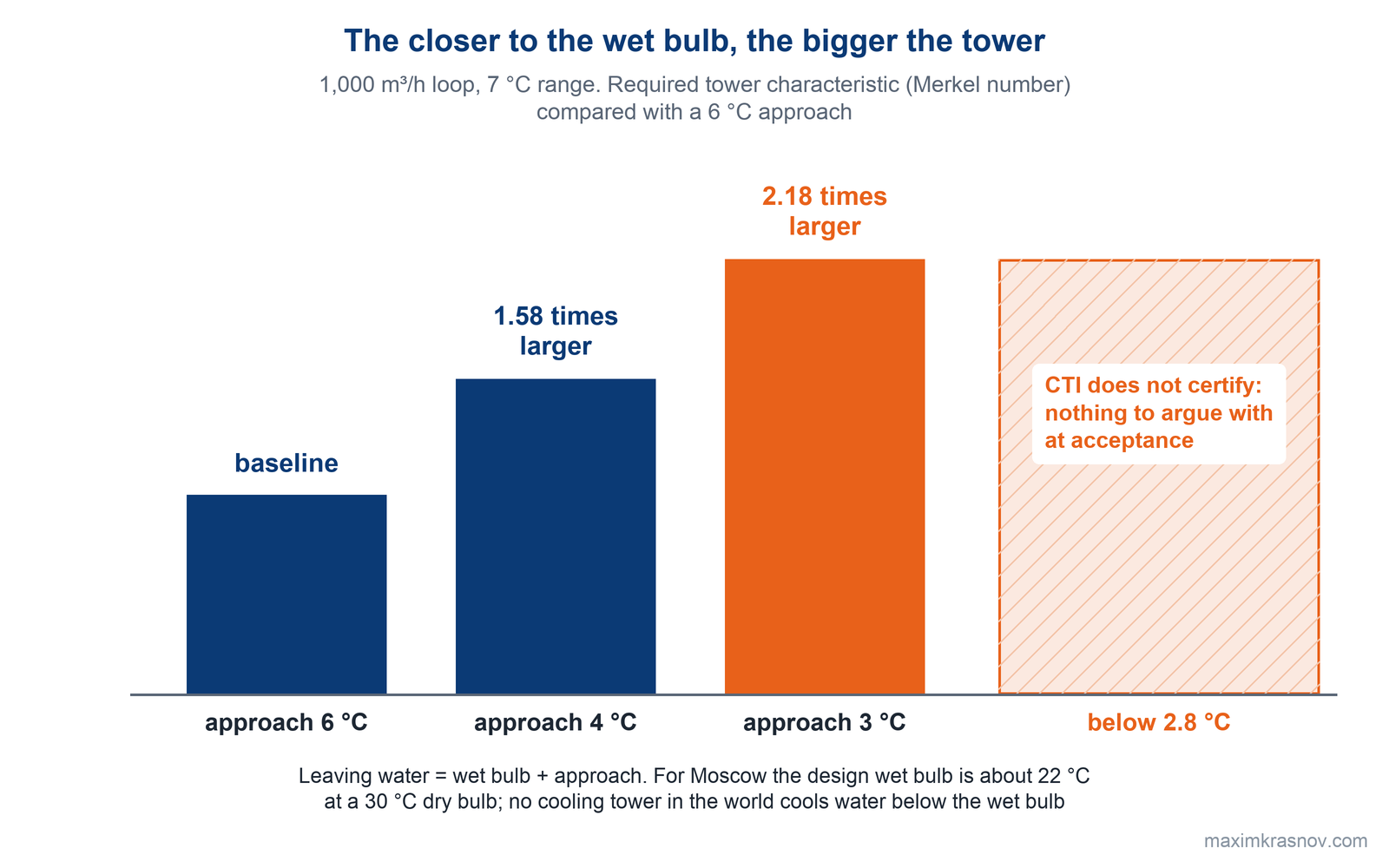
Any evaporative cooling tower cools water to the wet-bulb temperature plus the approach. The wet bulb is what a thermometer wrapped in wet cloth reads in the wind; no cooling tower in the world takes water below it. For Moscow the design wet bulb is about 22 °C at a 30 °C dry bulb, and in practice a tower delivers the wet bulb plus 3–4 degrees.
The approach has the biggest effect on unit size. On a 1,000 m³/h loop with a 7 °C range, going from a 6 °C approach to 4 °C requires a 1.58 times larger tower characteristic (Merkel number), and to 3 °C, 2.18 times larger. Below 2.8 °C the Cooling Technology Institute (CTI) does not certify thermal performance at all, so at acceptance there will be nothing to argue with.
A reader of my channel recently asked: "The tower was designed for +27 °C, but in summer it gives +30 °C, is it defective?" Almost always this is a selection error: someone took an "average summer" wet bulb, and on hot humid hours the tower will not deliver its +27 °C. The design wet bulb is taken for the site's city from SP 131.13330.2025 (Russian building climatology code), and the probability level is agreed in writing.
If you need 7–15 °C water, that is a chiller's job, and the cooling tower removes heat from its condenser. It is sized for the condensing heat: a chiller with 1,000 kW of cooling and 200 kW of compressors sends 1,200 kW to the tower.
When does a plant need a closed cooling tower instead of an open one?
A closed tower is needed when the process loop must stay clean: pharmaceuticals, electronics, glass furnaces, chiller and absorption chiller condensers. It is also needed if the loop carries glycol, if housing nearby imposes strict limits on drift and plume, and if consumers sit 10–15 m above the tower. In that last case an open system creates vacuum in the return line, air in the pipes and drain-down of the system when the pump stops.
An open tower remains the right choice for metals, machine building and food production, where the loop can be "dirty" and make-up water is available. Dust and fluff from the air settle in the water, so filtration and water treatment are mandatory.
The cost of a mistake is clear at a site we service: two absorption chillers with open cooling towers. Dirty water clogged the filters so fast that operators cut the condenser pump flow below design, just to avoid cleaning filters every 30 minutes, and the machines lost cooling capacity. The client began to regret not installing a closed tower. Many regret it, but in a tender they are not ready to pay more.
Closed does not mean no water and no chemicals: the spray water evaporates just the same, the approach is larger than with an open tower, and scale on the coil directly cuts capacity.
How much water does a cooling tower need, and what if water is scarce?
An open tower evaporates about 1% of the flow for every 7 °C of range (ASHRAE Handbook, chapter 40), and at the summer peak up to 0.18% of the flow per 1 °C. On a 1,000 m³/h loop cooled 35 → 28 °C that is 8,141 kW of heat, 12.6 m³/h of evaporation and 16.8 m³/h of make-up at four cycles of concentration.
Over a year on a real load profile the same loop takes about 69 thousand m³ of make-up, while the summer peak applied to the whole year would give 134 thousand m³. A nearly twofold difference decides whether the water utility's limit is enough. How to calculate and reduce make-up is covered in how much water a cooling tower uses.
A closed tower uses as much water for spraying in summer. Savings come only from hybrid operation: the e-series runs dry in the shoulder seasons and winter and takes no make-up. If there is no water on site at all, or no right to draw it, an evaporative tower does not fit: then you compare a cooling tower and a dry cooler, including an adiabatic one.
How do climate and winter change the choice of cooling tower?
The temperature at which a closed tower can cope without spray water depends more on the winter load than on the model.
A worked example for a tower with an 8,150 kW summer load (fluid 35 → 28 °C, assumed dry-mode heat transfer coefficient 200 kW/°C):
| Winter load, share of summer | Load, kW | Switches to dry mode below, °C |
|---|---|---|
| 30% | 2,445 | +19.3 |
| 50% | 4,075 | +11.1 |
| 70% | 5,705 | +3.0 |
| 100% | 8,150 | −9.3 |
If production runs at half capacity in winter, the tower stops using water already from +11 °C; at full load, only in frost. So the data sheet should give the load by season, not a single summer point.
In a cold climate the fan type also matters. In series with a centrifugal fan at the bottom (VR, HR), the wheel and motor sit in a dry compartment, so the wheel does not ice up. VR towers run in winter in Murmansk, Vorkuta and Ulan-Ude.
Winter also means free cooling. At a powder metallurgy plant we installed a Thermax absorption chiller and three NCT cooling towers for 4.6 MW of cooling with +7/+12 °C water. In summer the towers reject the machine's heat; in the cold season the machine is off, and two towers cool water from +12 to +7 °C through heat exchangers directly for production.
How do the site and noise limit the choice?
The site limits a cooling tower in two ways: the air it needs and the noise it makes. A tower next to a wall or in a pit breathes its own warm exhaust, and according to published data such recirculation of just 1.1 °C takes away up to 19% of capacity.
The minimum clearance from a solid wall is calculated from the air velocity entering the gap: no more than 1.5 m/s, or 2 m/s for centrifugal fans with a diffuser. For a module moving 40 m³/s of air, that is 2.5 m from the wall with an axial fan and 1.9 m with a centrifugal one. The Stanford guide gives at least 9 m to leave a margin for wind.
Noise is checked against the night limit: near homes it is 45 dBA under SanPiN 1.2.3685-21 (Russian sanitary hygiene standards). A tower rated at 68 dBA at 10 m meets it only at 141 m, and with the fan at 70% speed at night, already from 58 m. Silencers go into the selection from the start: after installation they are almost impossible to add.
For a roof, give the structural engineer not the dry weight from the catalog but the emergency weight: for the VR-2-3 tower that is 8,010 kg against 4,010 kg dry.
What does a cooling tower cost to operate?
Operating cost is set by fan electricity, water with its treatment, and the condition of the galvanized steel. The cheapest tower in a tender often ends up the most expensive.
A centrifugal fan draws 20–30% more at peak than an axial one, but with variable-speed control the annual average is almost equal. VA towers with a single large-diameter axial fan are the most power-efficient in our range. A variable-frequency drive pays off on any series: at 60 kW of installed power, 8,000 operating hours and an average air demand of 60%, it saves about 174 thousand kWh per year, which is RUB 1.74 million at RUB 10 per kWh.
Water treatment is mandatory both for an open tower and for the spray circuit of a closed one. New galvanizing must run for the first 8 weeks at pH 7.0–8.0 and calcium hardness of 100–300 mg/L to form a protective film. A typical program from an outside water treatment contractor holds pH 8.5–9.0 and in one or two seasons eats a coating designed to last many years. Without water treatment, scale, biology and corrosion kill even a good tower within a couple of years.
How to choose a cooling tower: options compared
| Criterion | Open | Open + heat exchanger | Closed-circuit | Hybrid (closed e-series) |
|---|---|---|---|---|
| Water in July | Coldest | 2–4 °C warmer than open | Close to open, depends on selection | Same as closed |
| Process loop cleanliness | Contact with air | Clean, heat exchanger fouls | Clean | Clean |
| Glycol in the loop | Not possible | Only in the secondary loop | Possible | Possible |
| Make-up | Evaporation + blowdown | Same as open | Spray water only | Like closed in summer, no water from 0 °C in winter |
| Winter | Anti-icing measures | Same + heat exchanger protection | Glycol or dry mode | Dry mode, no plume |
| Footprint | Smallest | Larger: three components | Small | Small |
| Water treatment | Mandatory | Mandatory | Mandatory for spray water | Mandatory for spray water |
| Typical site | Metals, machine building, food plants | Existing open tower + new clean consumer | Pharma, electronics, glass, chillers, absorption chillers | Same, plus housing nearby and water shortage |
Key takeaways
1. The tower type is chosen by three questions: the summer water temperature you need, whether process water may contact air, and whether there is make-up water. The model comes later.
2. A cooling tower will not cool water below the wet bulb. CTI does not certify an approach below 2.8 °C, and going from 6 °C to 3 °C raises the required tower characteristic 2.18 times.
3. A closed tower pays back its premium where dirty water hits expensive equipment: chiller and absorption chiller condensers, furnaces, pharma.
4. A hybrid closed tower saves water only in the cold season, and the dry-mode threshold depends on the winter load.
FAQ
What water temperature will a cooling tower deliver in a Moscow summer?
An evaporative tower delivers the wet bulb plus the approach. With a design wet bulb of about 22 °C, the real water is 25–28 °C depending on unit size. NCT catalogs state cooling to +23 to +24 °C in summer; the exact figure comes from a selection for your duty.
Does a closed cooling tower need water treatment?
Yes. The spray water evaporates just as in an open tower, salts deposit on the coil, and a hot-dip galvanized coil without passivation develops white rust. You need blowdown, chemical dosing and a passivation regime for the first 8 weeks.
Can you control a closed tower's capacity by switching the spray off?
No. Dry mode is seasonal, not a control method: alternate wetting and drying of the coil builds scale, and capacity jumps. Capacity is controlled with the fans, and in frost during dry mode the basin is drained.
Sources
-
ASHRAE Handbook — HVAC Systems and Equipment, 2024, chapter 40 "Cooling Towers": evaporation of about 1% of flow per 7 °C of range.
-
Cooling Technology Institute, STD-201RS: limits of thermal performance certification, approach of at least 2.8 °C.
-
SP 131.13330.2025 (Russian building climatology code).
-
SanPiN 1.2.3685-21, table 5.35: noise limits in areas next to residential buildings.
-
Stanford University, HVAC Water Chillers and Cooling Towers: cooling tower clearance from buildings.
-
NCT cooling tower catalogs and selections, 2026; experience and calculations of Cold Energy.
More on cooling towers in the Cooling towers section.
Need a cooling solution for your site? Get a consultation