
Chiller Free Cooling: When the Compressor Stops and What It Saves
founder and CEO of Cold Energy (NCT)
Free cooling is a mode in which a chiller system cools water with outdoor air through a dry cooler or a cooling tower while the compressor is off. In central Russia that is about 4,500 hours a year. On a 1,000 kW year-round load with 12/18 °C water, free cooling saves up to 1.78 million kWh, about RUB 17.8 million per year at RUB 10 per kWh.
For half the year in Russia, cooling can be taken from outdoors. It sounds obvious, yet most plants run refrigeration machines all year, even when it is below zero outside. At the same time, free cooling does not pay off everywhere: it adds a heat exchanger, valves, glycol and controls, and on a site without winter load that money will not come back.
This article is for those who need cooling all year: data centers, process lines, server rooms. Free cooling without a calculation is one of the 13 mistakes I go through in How to choose an industrial chiller; other material is in the Chillers section.
How does chiller free cooling work?
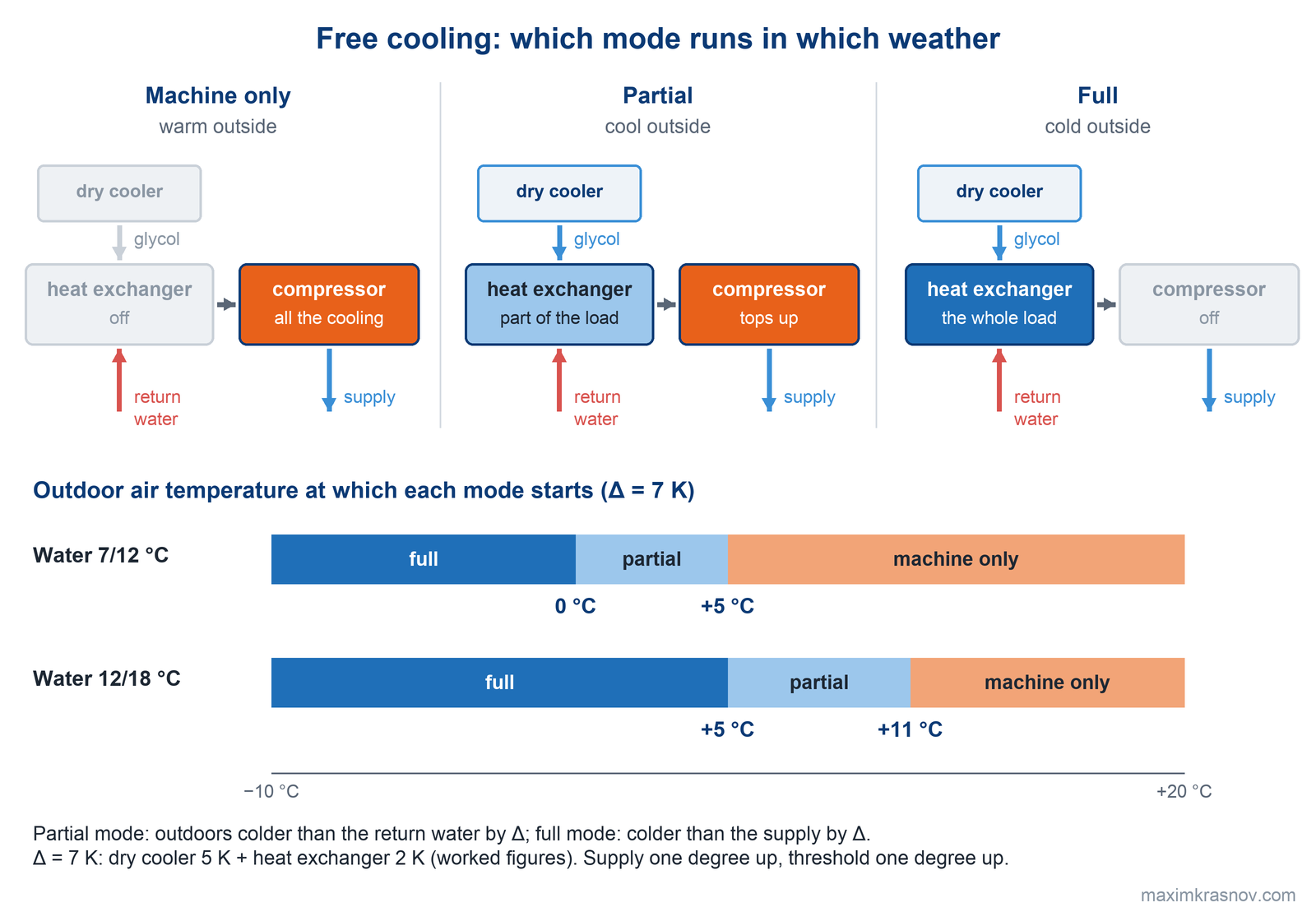
Free cooling works like this: when it is colder outside than the water the consumer needs, the water cools down in the outdoor unit without a compressor, and the machine covers only the rest of the load or stands by. It is not a separate machine but a heat exchanger, a glycol loop and motorized valves. Three schemes appear in projects.
| A. Integrated free cooling or a heat exchanger before the evaporator | B. Cooling tower and plate heat exchanger | C. Condenser dry cooler switched to a heat exchanger | |
|---|---|---|---|
| Works from | dry bulb | wet bulb | dry bulb |
| Water outdoors | no, glycol | yes, the tower needs a winter mode | no, glycol |
| What is added to the project | free-cooling section or heat exchanger, valve on the glycol | heat exchanger, valves, winter piping for the tower | two three-way valves, chilled-water heat exchanger |
Scheme A is a packaged unit with integrated free cooling. Above the setpoint the compressors run. When the outdoor air is colder than the glycol, a three-way valve routes the flow through the free-cooling section, and in frost the section takes the whole load. For NCT chillers of the NCSA series with a remote condenser, free cooling is listed in the catalog.
Scheme B is a water-cooled chiller with a cooling tower. In winter the tower cools the water to a temperature at which the consumer loop can be cooled through a plate heat exchanger, bypassing the machine.
Scheme C is a water-cooled chiller with a dry cooler (dry fluid cooler). In summer the dry cooler rejects condenser heat; in winter three-way valves switch it to the chilled-water heat exchanger: one unit does two jobs.
At what outdoor temperature does free cooling start?
Free cooling starts when the outdoor temperature is below the water temperature by the sum of the approaches in the heat exchangers. Partial mode begins when it is colder outside than the return water minus Δ; full mode, when it is colder than the supply water minus Δ. Here Δ is the approach of the dry cooler or cooling tower plus that of the intermediate heat exchanger.
Example. Chilled water 7/12 °C, dry cooler approach 5 K, heat exchanger 2 K, total Δ = 7 K (worked figures; real ones come from unit selections). Partial free cooling starts below 12 − 7 = 5 °C, full below 7 − 7 = 0 °C.
With a 12/18 °C regime, typical for modern data centers, the thresholds rise by 6 K: partial mode below 11 °C, full below 5 °C. Hence the main rule: chilled water temperature is the main lever of free cooling. Every degree the supply goes up shifts the threshold by a degree and adds hours without the compressor.
How many hours a year can a chiller run without the compressor?
Free cooling hours are counted from the site's climate: how many hours a year it is colder outside than the start thresholds. In Moscow the wet bulb stays below 5 °C for 4,696 hours a year, in St. Petersburg for 4,756, which is 54% of the year. Below 0 °C: 3,207 and 2,874 hours.
| Wet bulb below | Moscow, h/year | St. Petersburg, h/year |
|---|---|---|
| 0 °C | 3,207 (37%) | 2,874 (33%) |
| 5 °C | 4,696 (54%) | 4,756 (54%) |
| 10 °C | 5,971 (68%) | 6,086 (70%) |
| 15 °C | 7,591 (87%) | 7,746 (88%) |
This is our estimate from the ERA5 reanalysis for 2015–2024, 87,672 hours; for Pulkovo the series practically matched ASHRAE Climatic Design Conditions 2021. A cooling tower scheme works from the wet bulb, so the hours come straight from the table. A dry cooler works from the dry bulb, which is never lower than the wet bulb, so for schemes A and C the table is an upper estimate.
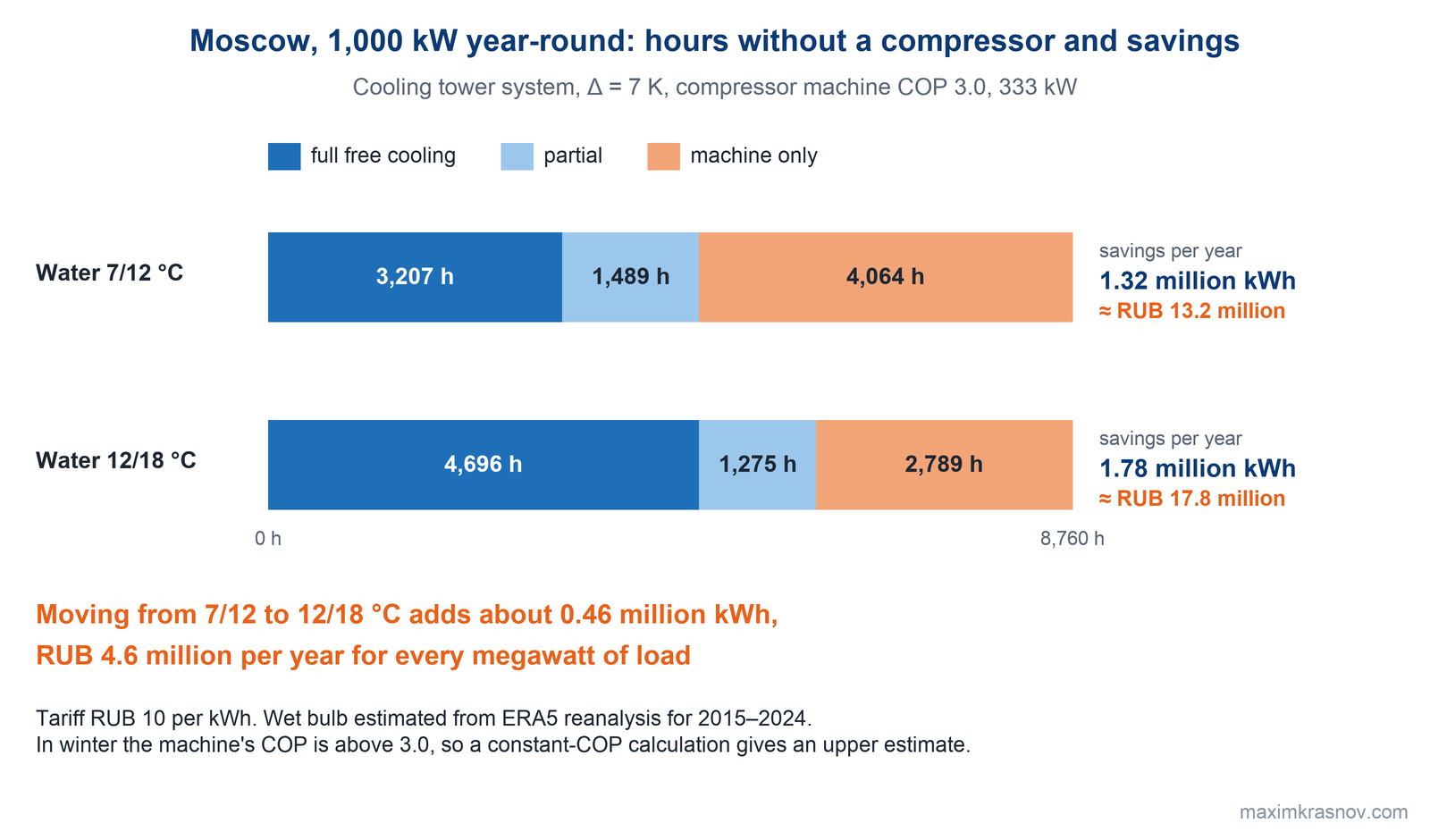
For Moscow and a cooling tower scheme at Δ = 7 K on a 7/12 °C regime, full free cooling runs 3,207 hours, partial 1,489, machine only 4,064 hours. On a 12/18 °C regime, full mode runs 4,696 hours, and the machine runs alone for no more than 2,789 hours a year. For data centers we plan on 4,500 hours of free cooling in central Russia, about 3,000 in the south and about 6,000 in the north.
How much does free cooling save on a 1,000 kW load?
On a 1,000 kW year-round load in Moscow, free cooling with a 12/18 °C regime saves about 1.78 million kWh a year out of 2.92 million, which is 61% of compressor electricity. At RUB 10 per kWh that is about RUB 17.8 million a year.
The calculation from our design guide for engineers: cooling tower scheme, Δ = 7 K, compressor machine with COP 3.0 drawing 333 kW.
1. Full free cooling: 4,696 h × 333 kW = 1.56 million kWh, compressors off.
2. Partial mode: 1,275 h, free cooling removes on average half the load: 1,275 × 167 = 0.21 million kWh.
3. Total: about 1.78 million kWh per year.
4. The same site on a 7/12 °C regime: 3,207 × 333 + 1,489 × 167 = 1.32 million kWh, about RUB 13.2 million.
5. Moving from 7/12 to 12/18 °C adds about 0.46 million kWh, RUB 4.6 million a year for every megawatt of load.
From the savings you subtract what the system itself adds. If the heat exchanger and glycol add 5 kW to the pumps all year, that is 0.044 million kWh, less than 3% of the savings; plus fans in winter mode. In winter the machine's COP is above 3.0, so a constant-COP calculation gives an upper estimate.
In a 5,000 kW data center, packaged units with free cooling give about 4,500 hours of free cooling a year, and seasonal COP rises from 3.0 to 5.5. Electricity use is 1.8 times lower than with a system without free cooling, minus RUB 46 million a year. A comparison with other systems is in Data center cooling: five options for 5,000 kW.
Integrated free cooling, dry cooler or cooling tower: which to choose?
The free cooling scheme is chosen by whether there is water on site and which machine is already installed. A packaged unit with integrated free cooling is chosen when there is no water and you need fast commissioning and modular expansion. A cooling tower with a plate heat exchanger works from the wet bulb and gives more hours, but needs water treatment and a winter mode for the tower.
A dry cooler in free cooling mode uses little energy. To produce 1,000 kW of cooling a chiller needs about 300 kW of electricity; a dry cooler, where only the fans turn, about 30 kW, 10 times less.
An example from one of our sites. At a powder metallurgy plant, on a chromium production line, 4.6 MW of cooling with +7/+12 °C water is needed. In summer a Thermax absorption chiller runs, and three NCT cooling towers cool its loop from +32 to +25 °C. In winter the machine rests: two cooling towers cool water from +12 to +7 °C and send it through heat exchangers directly to production.
When does free cooling not pay off?
Free cooling does not pay off where there is no load in the cold hours. Comfort air conditioning that is off in winter has almost no cold hours with load, and free cooling will add more to pumps and valves than it saves.
Payback is calculated in two variants: the machine runs all year, or the machine runs in summer and a dry cooler does the cooling in winter. We aim for a payback of 2–3 years. Clients also come to us with free cooling already installed, and we calculate 20 years: neither the chiller nor the free cooling itself will last that long. If the option costs, say, RUB 15 million and saves a million a year, it will pay off in 15 years at best.
The second source of losses is controls. In St. Petersburg it can be minus 2, then the sun comes out and it is plus 3, and the system keeps switching free cooling on and off. Transitions are made with hysteresis (a dead band) and a minimum time in each mode; schemes on three-way mixing valves run unstably in the shoulder seasons. A default changeover setpoint eats up to a third of the free hours.
And the third: free cooling saves kilowatt-hours but does not cut the peak. In summer all compressors run, and the grid connection is paid for by that peak. If the constraint is power capacity, the answer is something other than free cooling; how to calculate it is in Chiller total cost of ownership.
Does adiabatic cooling save anything in summer?
In Moscow and St. Petersburg, adiabatic condenser cooling (spraying water into the air in front of the heat exchanger) gives not annual savings but capacity and reliability in the hottest hours. According to NCT data it lowers the inlet air temperature by 5–15 °C depending on the climate.
A calculation for a NASA43 chiller in Moscow: minus 5 K at the inlet lowers condensing by about 5 K and compressor power by about 16%, that is by 7.7 kW. There are about 88 hours a year with a dry bulb above 28 °C, so the savings are about 0.7 thousand kWh. But a machine with a standard range up to +35 °C stays in its operating envelope at the absolute maximum of 38 °C and does not trip on high pressure.
Key takeaways
1. Free cooling is cooling water with outdoor air without a compressor; in central Russia that is about 4,500 hours a year.
2. The free cooling threshold is the water temperature minus the approaches in the units: on a 7/12 °C regime full mode starts below 0 °C, on 12/18 °C below 5 °C.
3. On a 1,000 kW year-round load in Moscow, free cooling saves up to 1.78 million kWh a year, about RUB 17.8 million at RUB 10 per kWh.
4. Moving from a 7/12 to a 12/18 °C regime adds about 0.46 million kWh of savings a year for every megawatt of load.
5. Without winter load, free cooling does not pay off, and it does not reduce peak power or the grid connection charge.
FAQ
Does free cooling need glycol?
In dry cooler schemes the outdoor loop runs only on glycol: water in it would freeze in winter. In a cooling tower scheme the water stays outdoors, and the tower needs a winter mode with ice protection. Glycol concentration is calculated for the lowest loop temperature.
Can free cooling be added to an existing chiller?
It is easier to build it into the design together with the machine: the heat exchanger, motorized valves and glycol change the system. On a water-cooled chiller with a dry cooler, free cooling is added with two three-way valves and a chilled-water heat exchanger. In any case payback is calculated from the site's hours and load.
How many free cooling hours are there in St. Petersburg?
By our estimate from the ERA5 reanalysis for 2015–2024, the wet bulb in St. Petersburg is below 5 °C for 4,756 hours a year and below 0 °C for 2,874 hours. For a dry cooler, which works from the dry bulb, there are fewer hours: they are counted from the site's hourly series.
Does free cooling reduce peak electrical demand?
No. The peak falls in summer heat, when free cooling is not running and the compressors carry the whole load. Free cooling reduces annual kilowatt-hours, while the grid connection capacity is sized by the summer peak.
Sources
-
SP 131.13330 (Russian building climatology code).
-
ASHRAE Climatic Design Conditions, 2021 edition.
-
Open-Meteo, historical weather data based on the ERA5 reanalysis: hourly series 2015–2024 for Moscow and St. Petersburg.
-
NCT catalogs and technical-commercial proposals, 2026: free cooling, adiabatic cooling.
-
Experience and calculations of Cold Energy: webinars "13 critical mistakes when choosing a chiller" (February 2026) and on data center cooling (6 August 2026), tariff RUB 10 per kWh.
Need a cooling solution for your site? Get a consultation