
Trigeneration: Power, Heat and Cooling from Gas — When It Pays Off
founder and CEO of Cold Energy (NCT)
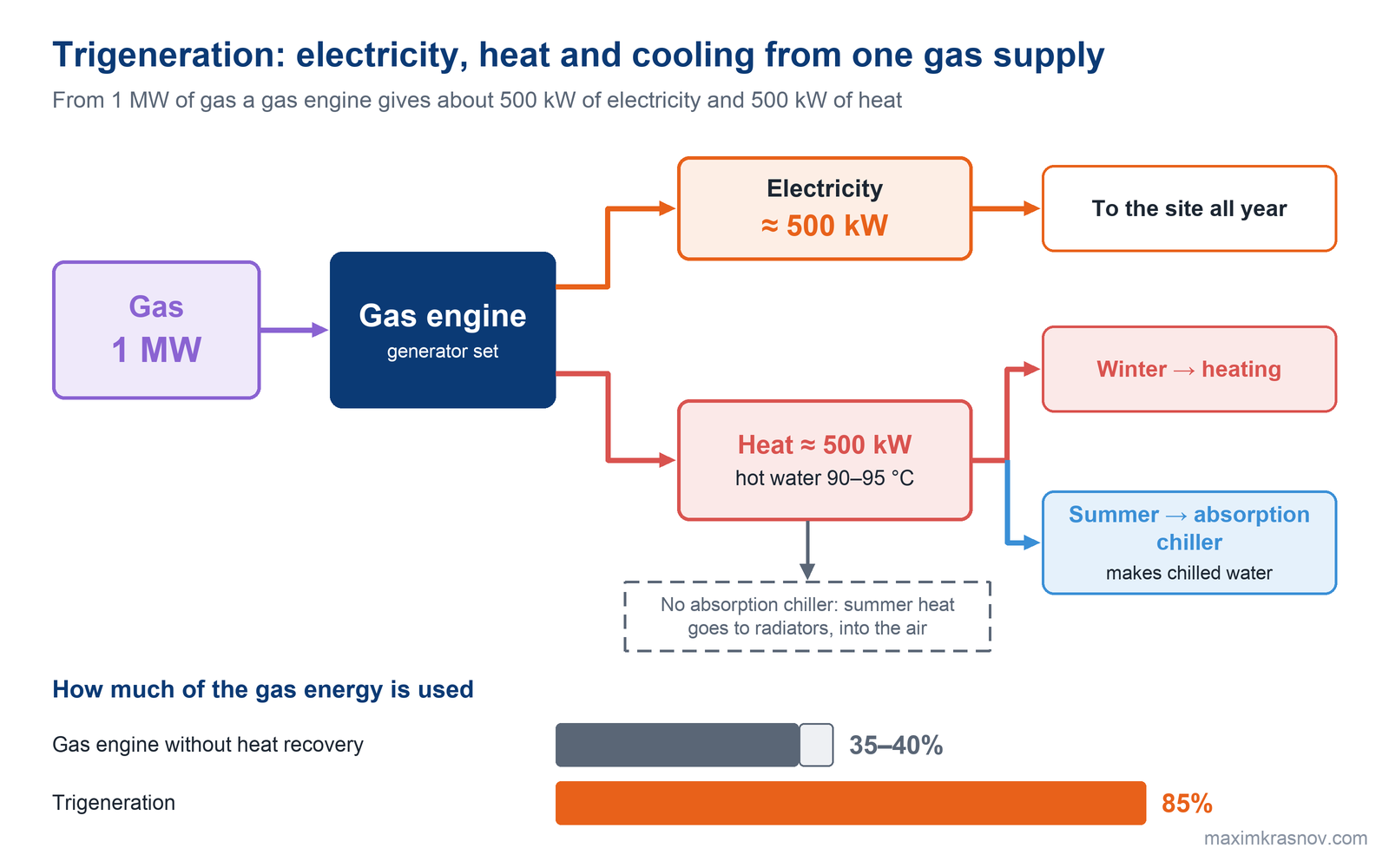
Trigeneration is producing electricity, heat and cooling from one gas supply. A gas engine generator set makes electricity; its heat goes to space heating in winter and to an absorption chiller for cooling in summer. Fuel utilization is 85% instead of 35–40%. In our model of a site with 5,000 kW of cooling, own electricity costs RUB 3.45 per kWh against RUB 10 from the grid, and payback is 1.9 years.
The scheme is for sites that have gas and need three things at once: electricity, heat and cooling. That means plants, business centers, greenhouses and data centers, especially when the grid cannot supply the capacity. In such a scheme Cold Energy is responsible for the cooling side: Thermax absorption chillers, cooling towers, pump stations, water treatment and controls.
How is trigeneration different from cogeneration?
Cogeneration is electricity and heat from one unit. Trigeneration adds a third product, cooling: an absorption chiller turns part of the cogeneration unit's heat into chilled water. Without an absorption chiller, the gas engine's heat has nowhere to go in summer and is released into the atmosphere.
One megawatt of gas gives the gas engine roughly 500 kW of electricity and 500 kW of heat. In a conventional scheme that heat is dumped through radiators on the container roof: you pay for the gas and throw away half the result. Trigeneration takes the 90–95 °C hot water and delivers it to a consumer all year round, so fuel utilization is 85%, not 35–40%.
The US Department of Energy, in its fact sheet on absorption chillers for combined heat and power, writes that they are often driven by heat recovered from engines, microturbines and gas turbines, and that they pay off best where cooling or air conditioning is needed all year.
How is a gas engine plus absorption chiller scheme built?
A gas engine has two heat sources: engine jacket hot water and exhaust gas. Each source gets its own absorption chiller, and the difference in cooling between them is almost twofold.
| Gas engine heat | Machine | Cooling COP | What matters in the design |
|---|---|---|---|
| Hot water at 90–95 °C | single-effect hot water machine | 0.7–0.85 | water flow and temperature difference, engine operating schedule |
| Exhaust at 275–600 °C | exhaust-fired machine | per data sheet, 1.3–1.4 for double-effect | engine back pressure, diverter damper |
| Exhaust at 400 °C without hot water heat recovery | flue gas-fired machine | twice as much cooling from the same heat | gas bypass when little cooling is needed |
The classic scheme: a gas engine with a heat recovery module delivers hot water, the water goes to the absorption chiller, and the chiller makes cooling. But heat recovery can be made twice as effective: order the gas engine without the hot water heat recovery module and feed the 400 °C flue gas straight into the machine. We delivered such a project in Kazakhstan. To be honest, it is more complex work: sometimes there is a lot of exhaust and little cooling demand, and part of the gas has to be bypassed.
The key calculation for an exhaust-fired machine is back pressure. The absorption chiller's own gas-side resistance is 200–250 mm of water column, and the ducts, bends, damper and silencer add to it. The total must not exceed the engine's allowable back pressure, otherwise the engine loses power. The three-way diverter damper must go to bypass when the machine stops or power is lost.
Exhaust temperature depends on engine load: the lower the load, the higher the temperature. So the machine is selected for the actual engine schedule at 100, 75 and 50% load, not for a single data sheet point.
How does the trigeneration balance change between summer and winter?
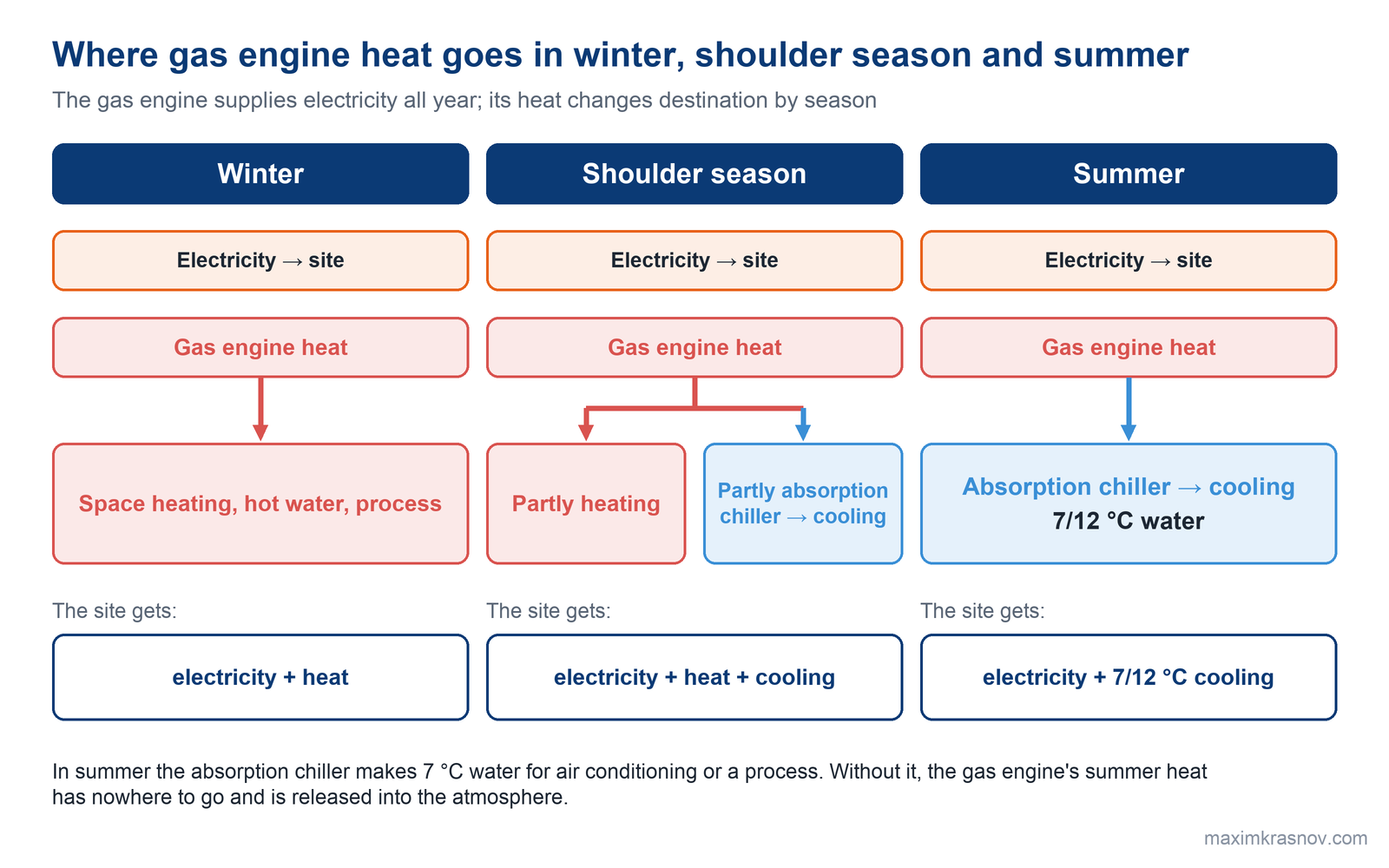
The gas engine delivers electricity all year, while its heat changes destination with the season. In winter the hot water goes to space heating, in summer to the absorption chiller, which makes 7 °C water for air conditioning or a process. In the shoulder season the heat is split between heating and cooling.
| Season | Where the gas engine's heat goes | What the site gets |
|---|---|---|
| Winter | space heating, domestic hot water, process | electricity + heat |
| Shoulder season | partly heating, partly the absorption chiller | electricity + heat + cooling |
| Summer | absorption chiller | electricity + 7/12 °C cooling |
How much heat cooling needs is shown by our end-to-end calculation: a 1,000 kW absorption chiller on 90/79 °C engine jacket hot water. The machine needs 1,430 kW of heat, which is 112 m³/h of hot water. Using the ratio of 500 kW of electricity to 500 kW of heat, that is the engine heat of roughly 1.4 MW of electrical capacity; this is an estimate, and the exact figure comes from the gas engine data sheet.
The cooling plant's electricity in this example is about 66 kW without cooling tower fans. A plant on an electric chiller with COP 5 would take about 245 kW, 3.5–4 times more. On the other hand, the cooling tower in the absorption scheme is almost twice as large: it rejects 2,430 kW, the consumer's heat plus all the engine heat that came into the machine.
The right division of roles: the absorption chiller carries the base load at constant flow, the electric chiller takes the peak and backup. A machine sized for the peak on one cooling figure without a load profile ends up running at 20% capacity.
When does trigeneration pay off?
Trigeneration pays off when four conditions come together:
1. The site has gas and a gas allowance. Without technical conditions from the gas utility it is too early to model the scheme.
2. Electricity is expensive or unavailable. A grid connection costs about RUB 47,000 per kW, and a site to which the grid cannot supply capacity does not get started at all.
3. Heat and cooling are needed most of the year. If heat is needed only in winter and cooling only for two summer months, the engine will be working for the radiators.
4. The load runs long: for an absorption chiller, 3,000–4,000 hours a year or more.
For a site with 5,000 kW of cooling we modeled the scheme at RUB 10 per kWh, gas at RUB 7 per m³, 8,760 hours a year and an average load of 70%.
| Metric, site with 5,000 kW of cooling | Value |
|---|---|
| Electricity generation | 35.1 million kWh a year for the whole site |
| Gas | 10.8 million m³, RUB 75.5 million per year |
| Gas engine service | RUB 1.3 per kWh, RUB 45.6 million per year |
| Own electricity | RUB 3.45 per kWh against RUB 10 from the grid |
| Site energy costs | RUB 133.5 million per year against RUB 443.5 million |
| Saving | RUB 310.0 million per year |
| Capital cost | RUB 715 million |
| Payback in the model | 1.9 years |
The internal rate of return for a specific site comes from the feasibility study, not from a generic model. At the previous tariff of RUB 7.5 the same model gave a payback of 3.0 years: the more expensive grid electricity is, the faster your own pays back.
To be honest about the drawbacks: capital cost is several times higher than the classic scheme. There are two service contracts, not one: the gas engine is serviced separately, by engine hours. A gas allowance is not available everywhere.
What happens to cooling if the gas engine stops?
If the gas engine stops, the site switches to the grid connection, and the absorption chiller is fed with heat from a boiler house. So the grid connection and a backup heat source stay in a trigeneration scheme.
There are two nuances. After a stop, an absorption chiller takes about 30 minutes to reach operating conditions; an electric chiller is faster. A continuous process or server rooms need thermal storage or a backup chiller alongside. In addition, during a power outage longer than 3 minutes the absorption chiller needs a dilution cycle, otherwise the solution may crystallize, so its control panel is fed from a UPS or a backup supply.
Where does trigeneration with absorption chillers already run?
Thermax absorption chillers we have supplied run on heat from on-site generation at plants, greenhouses, retail and office buildings. A few sites:
-
Teplichnoye JSC, Sverdlovsk region: trigeneration with 832 kW of cooling; two Thermax LT 12 C hot water machines cool the packing area, with outlet water down to 3.5 °C.
-
Syry Kubani, Vyselki: 3 MW trigeneration, ice water and air conditioning.
-
MolPromKuban: trigeneration at a dairy plant.
-
Central Customs Administration, Moscow: Capstone microturbines generate electricity and hot water, two Thermax absorption chillers turn it into cooling, and part goes to the server rooms. The project dates from around 2014 and is still running.
-
Galereya shopping center, Saratov: two Thermax 5G 6L C machines on hot water from trigeneration, air conditioning.
-
Belorusneft, Davydovka and Osobino sites: Thermax LT 14 C and LT 10 C machines on hot water from gas engines.
-
Moscow Region Government House, Krasnogorsk: three Thermax LT 42 T machines on hot water from a 12 MW energy center, central air conditioning.
Of international practice, the closest to me is the Green Data Center of Syracuse University and IBM in the US: 12 Capstone microturbines, 50% less energy, running since 2009. The absorption chillers there are also Thermax, two double-effect units of 150 tons of refrigeration each.
Is trigeneration a fit for a data center?
It is, and for a data center it is one of the strongest schemes: it needs electricity and cooling at the same time and all year. The gas engine powers the IT load, its heat covers cooling through an absorption chiller, and the grid stays as backup. The main gain is not the tariff but removing the capacity limit.
For server rooms redundancy matters: a gas engine failure knocks out both electricity and heat for the absorption chiller at once, so a second independent heat source or electric chillers for the full load are needed. The detailed calculation of the gas scheme and Tier IV redundancy is in the article on absorption chillers for data centers, and the comparison with other options is in the review of five data center cooling options.
Key takeaways
1. Trigeneration is a gas engine plus an absorption chiller: electricity all year, heat in winter, cooling in summer, all from one gas supply. Fuel utilization is 85% instead of 35–40%.
2. On gas engine hot water, a single-effect absorption chiller gives a cooling COP of 0.7–0.85. 400 °C exhaust fed straight into the machine gives twice as much cooling from the same heat, but needs a back pressure calculation and a gas bypass.
3. On a site with 5,000 kW of cooling at RUB 10 per kWh, own electricity costs RUB 3.45, the saving is RUB 310.0 million per year, capital cost RUB 715 million, and payback in the model 1.9 years.
4. Trigeneration pays off when there is a gas allowance, electricity is expensive or unavailable, and heat and cooling are needed most of the year.
5. Drawbacks: capital cost several times higher than the classic scheme, two service contracts, a backup heat source and a chiller for continuous loads.
FAQ
Which absorption chiller should be paired with a gas engine?
For 90–95 °C engine jacket hot water, a single-effect hot water machine. If the engine exhaust is free, an exhaust-fired machine will give more cooling from the same heat. The choice is made from the gas engine data sheet: exhaust flow and temperature at 100, 75 and 50% load and the allowable back pressure.
How much cooling does a gas engine give per 1 MW of gas?
An estimate from our ratios: from 1 MW of gas a gas engine gives about 500 kW of heat as hot water. A single-effect absorption chiller with a COP of 0.75–0.85 turns it into roughly 375–425 kW of cooling. The exact figure only comes from the engine data sheet and the machine selection.
Does trigeneration need a cooling tower?
Yes. The absorption chiller rejects to the cooling tower both the consumer's heat and all the engine heat that came into it: about 2.45 kW per 1 kW of cooling for a single-effect machine. The area for cooling towers is 2.3–2.5 times larger than for a compressor scheme.
How is trigeneration different from a direct-fired gas absorption chiller?
A gas absorption chiller burns gas in its own burner and gives only cooling (heat in winter), and the site buys electricity from the grid. Trigeneration first makes electricity from gas in the gas engine and only then sends the heat to the absorption chiller. I explain how the machines themselves work in the article what is an absorption chiller.
Sources
-
U.S. Department of Energy, Combined Heat and Power Technology Fact Sheet Series: Absorption Chillers for CHP Systems, DOE/EE-1608, May 2017: PDF.
-
Syracuse University and IBM, Green Data Center: 12 Capstone microturbines and two double-effect Thermax absorption chillers of 150 tons of refrigeration each (NYSERDA case study).
-
Cold Energy calculation for a site with 5,000 kW of cooling, tariff RUB 10 per kWh, gas at RUB 7 per m³, 8,760 hours a year, average load 70%.
-
Cold Energy experience: supply and commissioning of Thermax absorption chillers at trigeneration sites; end-to-end calculation of a 1,000 kW absorption chiller on gas engine hot water.
More material is in the Absorption chillers and trigeneration section.
Need a cooling solution for your site? Get a consultation