
Evaporative Condenser: 15–30% Less Compressor Power in Summer

founder and CEO of Cold Energy (NCT)
An evaporative condenser is a unit in which refrigerant vapor condenses inside a coil sprayed with water. It works from the wet-bulb temperature and in summer keeps condensing 5–10 K lower than an air-cooled condenser. At 3% of compressor power per kelvin (manufacturers quote 1.8–4.0%), that is 15–30% of electricity in hot weather on a plant with 250 kW or more of condensing heat.
This article is for plant directors and chief engineers running an ammonia or HFC refrigeration plant: food processing, deep-freeze storage, chemicals. The choice of condenser shows up in the electricity bill in summer and in water handling in winter. Below: how to calculate the gain, how much water it takes, and where an evaporative condenser should not be installed.
What is an evaporative condenser and how is it different from a cooling tower?
An evaporative condenser (EC) is a stage of the refrigeration cycle, not a water loop. Hot refrigerant vapor from the compressors enters the top header of the coil; outside, the coil is sprayed with water from the basin and swept by a fan. The water evaporates and carries the heat away, and liquid refrigerant drains by gravity into the receiver.
The line between it and a cooling tower is simple. If heat is removed directly from the refrigerant — ammonia, HFCs, propane, butane, CO₂ — it is an evaporative condenser. If the chiller's condenser holds water or glycol and that fluid has to be cooled, it is a closed-circuit cooling tower or a dry cooler. How a cooling tower differs from a dry cooler is covered in cooling tower or dry cooler.
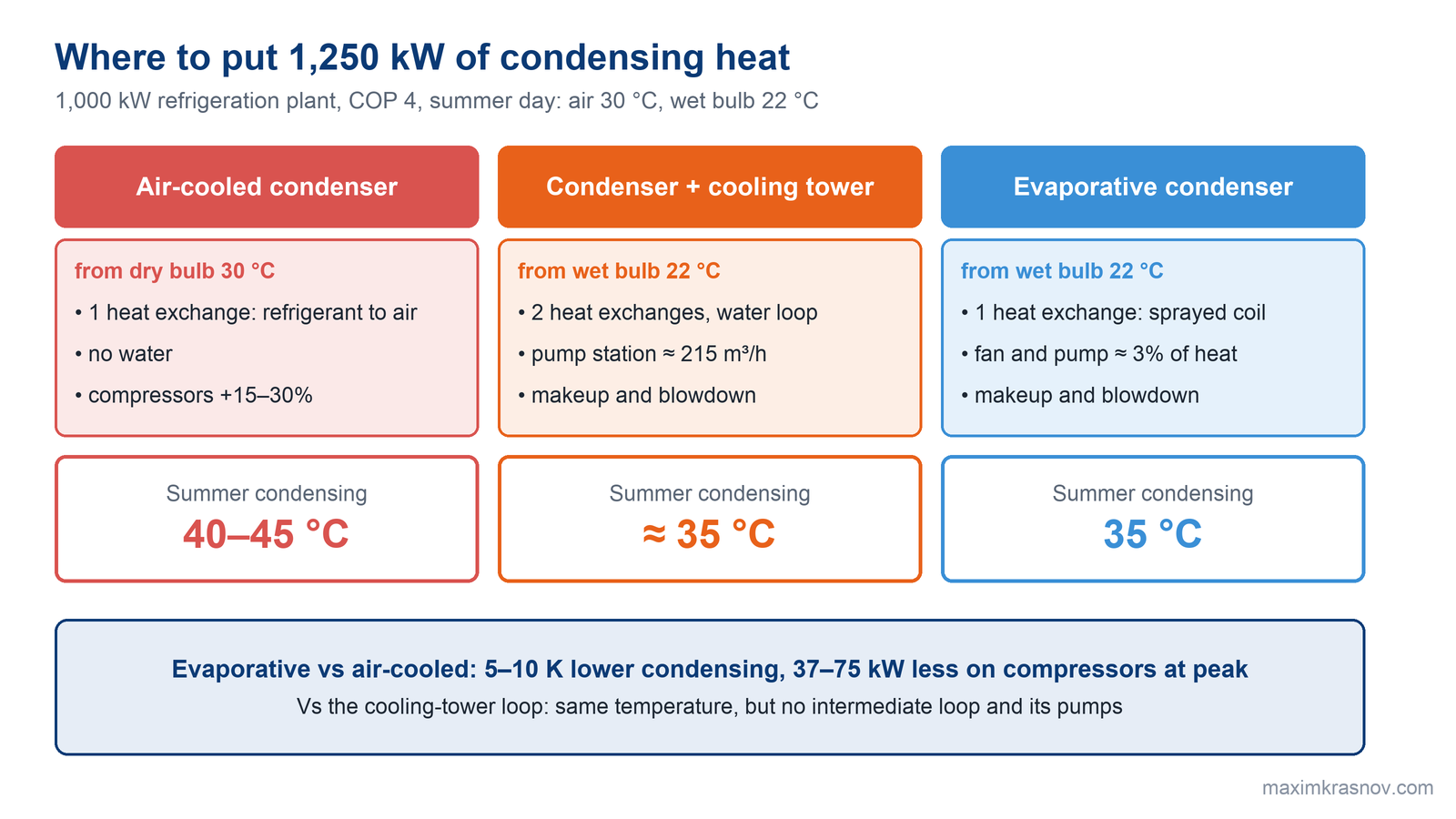
An EC has one heat exchange instead of two: refrigerant to the wetted wall to air. A shell-and-tube condenser plus cooling tower has two, with an intermediate water loop and pumps between them.
Why does an evaporative condenser condense at a lower temperature?
An evaporative condenser cools from the wet-bulb temperature, an air-cooled condenser from the dry bulb. The dry bulb is what an ordinary thermometer shows outdoors; the wet bulb is the limit to which air can be cooled by evaporating water. On a hot day in central Russia the gap is 7–10 K: for Moscow, ASHRAE design data (0.4% annual frequency) give 29.9 °C and 22.1 °C.
The NCT catalog rating point: ammonia R717, condensing at 35 °C with a 22 °C wet bulb and 31 °C air. An air-cooled condenser condenses 10–15 K above the air, so at +30 °C outdoors it runs at 40–45 °C.
By our data, an EC holds 35 °C at +31 °C outdoors and 40 °C at +35 °C. In the same heat an air-cooled condenser climbs 5–8 K above its design temperature and loses 10–18% of capacity. Those are exactly the hours when cooling is needed most.
How much electricity does an evaporative condenser save?
On a plant with 1,000 kW of cooling, an EC instead of an air-cooled condenser takes 37–75 kW off the compressors in a hot hour. The calculation is illustrative, on typical numbers, to show the order of magnitude:
| Step | Formula and assumption | Result |
|---|---|---|
| Compressors | Q₀ 1,000 kW, COP 4: 1,000 / 4 | 250 kW |
| Heat to the condenser | 1,000 × (1 + 1/4) | 1,250 kW |
| Condensing difference | air-cooled 40–45 °C − EC 35 °C | 5–10 K |
| Increase in compressor power | 3% per 1 K (manufacturers quote 1.8–4.0%) | 15–30% |
| Extra kilowatts with air-cooled | 250 × 0.15…0.30 | 37–75 kW |
| Per year, lower bound | 37.5 kW × 3,000 h | ≈ 112,000 kWh |
| Money, lower bound | 112,500 kWh × RUB 10 | ≈ RUB 1.1 million per year |
The annual figure is an upper estimate: the 3,000 hours are counted with the summer difference, while in spring and autumn it is smaller. An exact calculation uses the hourly climate of the site and the load profile. Water, water treatment and the difference in fan power are subtracted from the gain: both units have fans, and the exact kilowatts come from the selection.
The peak 37–75 kW matter on their own too. When a plant is short of permitted grid capacity, they come off the connection limit on the hottest day. Other ways to free up power on cooling are covered in not enough grid power at the plant.
Evaporative condenser or shell-and-tube condenser with a cooling tower?
In condensing temperature, an EC and a water-cooled layout with an open cooling tower are close: both work from the wet bulb and give about 35 °C. The EC wins on the layout, not on degrees.
1. No intermediate loop. No shell-and-tube condenser, no circulating-water pump station and no piping between them. For 1,250 kW of heat at a 5 K range, such a loop would pump about 215 m³/h of water.
2. The EC spray pump is small. In a real selection for 1,630 kW of heat it is 4 kW, the fan 45 kW, together 3% of the heat rejected.
3. Fewer units on site. One machine instead of a condenser, a cooling tower and a pump station.
The price of this gain is pressure. In an ammonia EC coil it is 5–20 bar versus 1–4 bar in a closed-circuit cooling tower. An ammonia plant is a hazardous production facility, pressure equipment falls under TR CU 032/2013 (EAEU technical regulation on pressure equipment safety), and EC piping is a refrigerant line with a receiver, traps and a purger.
How much water does an evaporative condenser use?
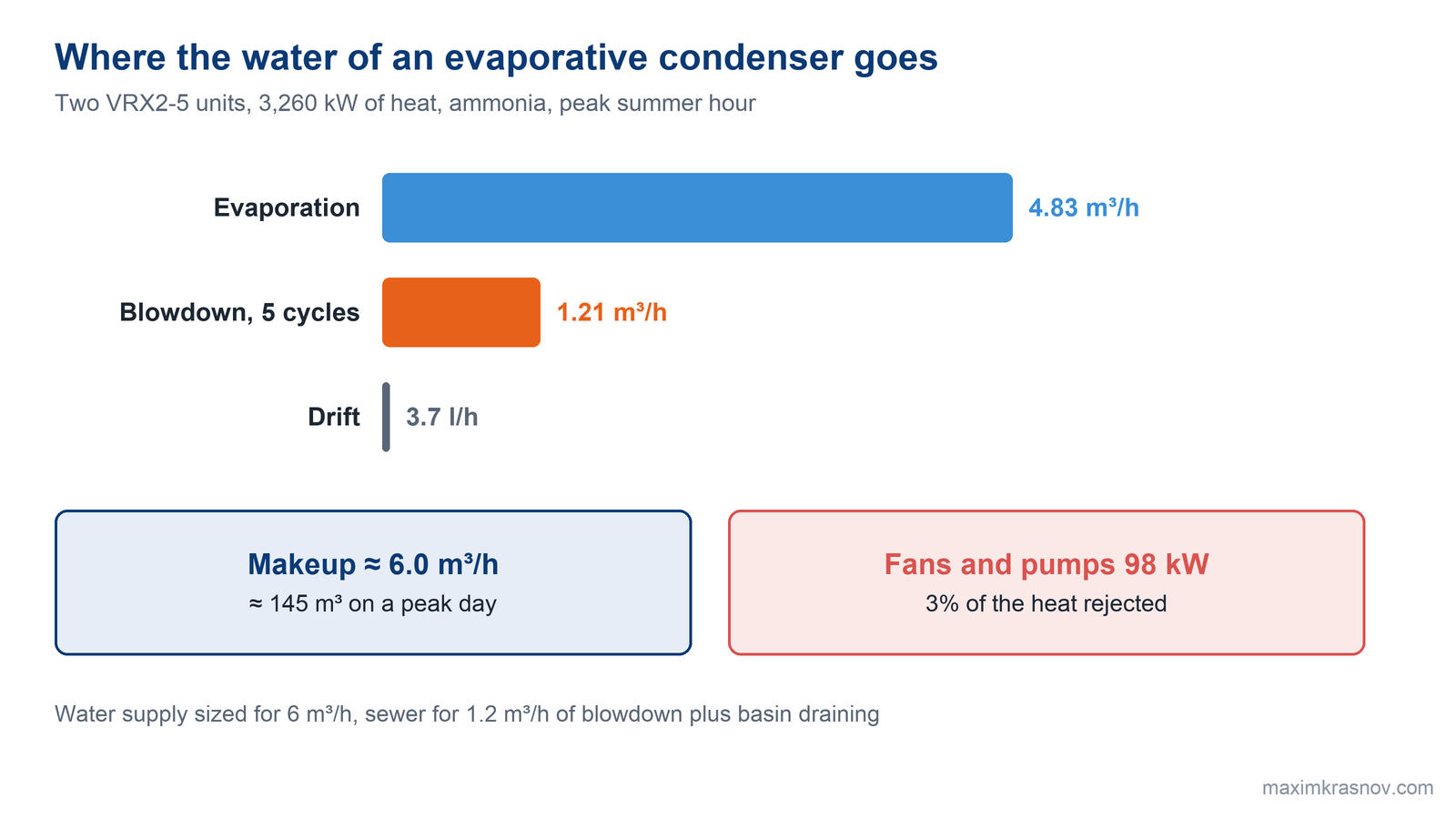
An evaporative condenser uses water like a cooling tower of the same capacity: evaporation, blowdown and drift. The figures come from a real NCT selection for a deep-freeze potato plant under construction in the Voronezh region. The ammonia plant there has 2,512 kW of cooling with three evaporating levels: −33, −7 and −1 °C. Two VRX2-5 ECs were selected for 35 °C condensing at a 22 °C wet bulb.
| Quantity | Calculation | Result |
|---|---|---|
| Condensing heat | 2 × 1,630 kW | 3,260 kW |
| Ratio to cooling | 3,260 / 2,512 | 1.30 |
| Evaporation | 2 × 0.67 kg/s × 3.6 | 4.83 m³/h |
| Blowdown at 5 cycles of concentration | 4.83 / (5 − 1) | 1.21 m³/h |
| Drift at 0.002% of 186.5 m³/h spray flow | 186.5 × 0.00002 | 3.7 l/h |
| Makeup in the peak hour | 4.83 + 1.21 + 0.004 | ≈ 6.0 m³/h |
| Makeup on the peak day | 6.0 × 24 | ≈ 145 m³ |
| Fans and pumps | 2 × (45 + 4) kW | 98 kW, 3% of heat |
Water supply and treatment at this plant are sized for 6 m³/h, the sewer for 1.2 m³/h of blowdown plus basin draining. Drift from units with drift eliminators is negligible. Without eliminators (0.10–0.20% of spray flow) it would be 0.19–0.37 m³/h, up to a third of the blowdown.
If the site has no water or water is very expensive, look at dry units. How to compare water and electricity in one bill is covered in water or electricity.
How does an evaporative condenser work in winter?
In winter an EC has two jobs: keep the spray water from freezing and keep condensing pressure from dropping too low. There are three layouts for the water.
| Layout | How it works | When it fits |
|---|---|---|
| Wet operation with a basin heater | spraying all winter, an electric heater in the basin holds +4 °C at −18 °C outdoors | mild winters |
| Dry operation | only the fans run, the basin is empty | small winter load, hard frost |
| Remote sump tank | the basin is dry, water and pumps sit in a heated room | year-round operation in frost |
At this plant a remote sump tank was chosen: the pumps, two duty and one standby, sit inside the building, and water from the basins drains back. Below −5 °C spraying is switched off and the condensers run dry. Winters there reach −30 °C, and the plant runs 365 days a year.
Finned NCT versions (the letter e in the series name) run without spraying from 0 °C down: less makeup water and less pump energy over the year. Winter condensing pressure is held by the fans: variable-speed drives no lower than 30% speed and no more than 6 starts per hour. The spray pump is not switched off for control — otherwise scale builds up on the coil.
When do you not need an evaporative condenser?
You do not need an evaporative condenser if the condensing heat is below 250 kW: that is where the NCT range starts. Below it, a water-cooled condenser with a closed-circuit cooling tower or an air-cooled condenser is the better buy. Three more cases where I would look the other way:
-
No water, or no sewer for the blowdown. Then an air-cooled condenser or a dry cooler, and accept a higher summer condensing temperature up front.
-
No team to manage the water. SanPiN 3.3686-21 (Russian sanitary rules on infectious disease prevention) lists evaporative condensers among systems with mandatory Legionella control: sampling points, automatic blowdown, biocide, no dead legs.
-
The customer asks for high condensing. We once received a request for an EC at 47 °C. Before selecting, we ask why: at that temperature the unit loses its main point, which is holding 35 °C at a 22 °C wet bulb.
What should you check in a design with an evaporative condenser?
On real projects the expensive mistakes sit not in the unit but around it. Five points I would check before ordering:
1. Select on heat, not on cooling. Condensing heat = Q₀ × (1 + 1/COP) plus oil heat and superheat. Selecting "for 1,000 kW of cooling" at COP 4 gives a unit 20% smaller than needed.
2. Vapor superheat at the inlet. Above 90 °C a desuperheater is needed, otherwise the superheat is not removed and steaming increases.
3. Drain line and receiver. The receiver goes below the condensers, with a drop of at least 1.5 m for ammonia and 3.7 m for HFCs. Liquid trapped in the coil takes the lower rows out of service, and condensing pressure rises in summer.
4. Ammonia charge before sizing the relief valves. At the same plant the ammonia inventory was revised from 6,600 to 7,860 kg, and the safety relief valves had to be recalculated.
5. Operating weight. The VRX2-5 ships at 9,246 kg and weighs 11,838 kg in operation. The roof is designed for the second figure.
How to read a supplier's quote so these points do not get lost is covered in reading a quote for a chiller. All articles on cooling energy are in the energy efficiency section.
Where do NCT evaporative condensers operate?
NCT evaporative condensers operate at a cold store on Sakhalin, have been selected for a food plant under construction, and run at many other sites. The range is 250 to 3,500 kW per unit at the rating point. The units run on ammonia, propane, butane, CO₂ and the refrigerants R22, R134a, R290, R407C, R410A and R507A.
VRX coils undergo a 24-hour hydraulic test before shipping, and the sections arrive charged with nitrogen. Production is in Russia, so spare parts and repairs do not wait 10–12 weeks for delivery from Europe or China. We receive requests for equivalents of imported units of 640 and 1,240 kW.
Key takeaways
1. An evaporative condenser works from the wet bulb and in summer keeps condensing 5–10 K lower than an air-cooled one: at 3% per kelvin, that is 15–30% of compressor power.
2. On a plant with 1,000 kW of cooling, the difference versus an air-cooled condenser is 37–75 kW in a hot hour and about RUB 1.1 million per year at the lower bound, at RUB 10 per kWh.
3. Against a condenser-plus-cooling-tower layout, the EC wins on the layout: no intermediate loop and its pumps, while the fan and spray pump take about 3% of the heat rejected.
4. An EC uses water like a cooling tower: two units rejecting 3,260 kW take about 6 m³/h of makeup and 145 m³ on a peak day.
5. Below 250 kW of heat, without water and without a water treatment team, an evaporative condenser is not worth installing.
FAQ
Can an evaporative condenser be fed with steam condensate without water treatment?
Only if the condensate meets the manufacturer's limits for zinc: fully softened water is not fed onto a galvanized coil. For zinc, keep pH 6.5–9.0, conductivity up to 2,400 µS/cm, chlorides up to 250 mg/l and hardness no lower than 30 mg/l as CaCO₃. For the first weeks new zinc is passivated at pH 7.0–8.0, otherwise white rust builds up.
Are evaporative condensers made for HFC refrigeration plants?
Yes. NCT ECs are selected for R22, R134a, R407C, R410A and R507A, for propane and butane, while CO₂ and blends are calculated case by case. On HFCs an EC usually replaces an air-cooled condenser that cannot keep up in summer: the cycle is the same, condensing is lower. Non-condensable gases on HFC systems are removed through the receiver as a service procedure.
Is a correction needed if the condenser stands next to a wall or in a group?
Yes. A unit next to a wall or in a group partly breathes its own humid discharge, so the design wet bulb is raised and the unit is reselected; a typical example is from 21 to 22 °C. According to published data, 1.1 K of recirculation can cost an evaporative unit up to 19% of its capacity. Air velocity in the gap between the wall and the louvers is kept at no more than 1.5 m/s, and a group of four or more sections is sent to the manufacturer for review.
Sources
-
SP 131.13330.2025 (Russian building climatology code).
-
SanPiN 3.3686-21 (Russian sanitary and epidemiological requirements for the prevention of infectious diseases), chapter XLII.
-
TR CU 032/2013 (EAEU technical regulation "On the safety of equipment operating under excess pressure").
-
ASHRAE Handbook — Fundamentals: climatic design data, wet bulb.
-
Cold Energy experience and calculations: engineering guide "NCT Dry Coolers and Condensers" (October 2026), guide "NCT Chillers", NCT evaporative condenser catalog and questionnaire, selection for the ammonia plant of a food processing plant.
Need a cooling solution for your site? Get a consultation