
What Is a Dry Cooler? How It Works and Why It Loses Capacity in Summer

founder and CEO of Cold Energy (NCT)
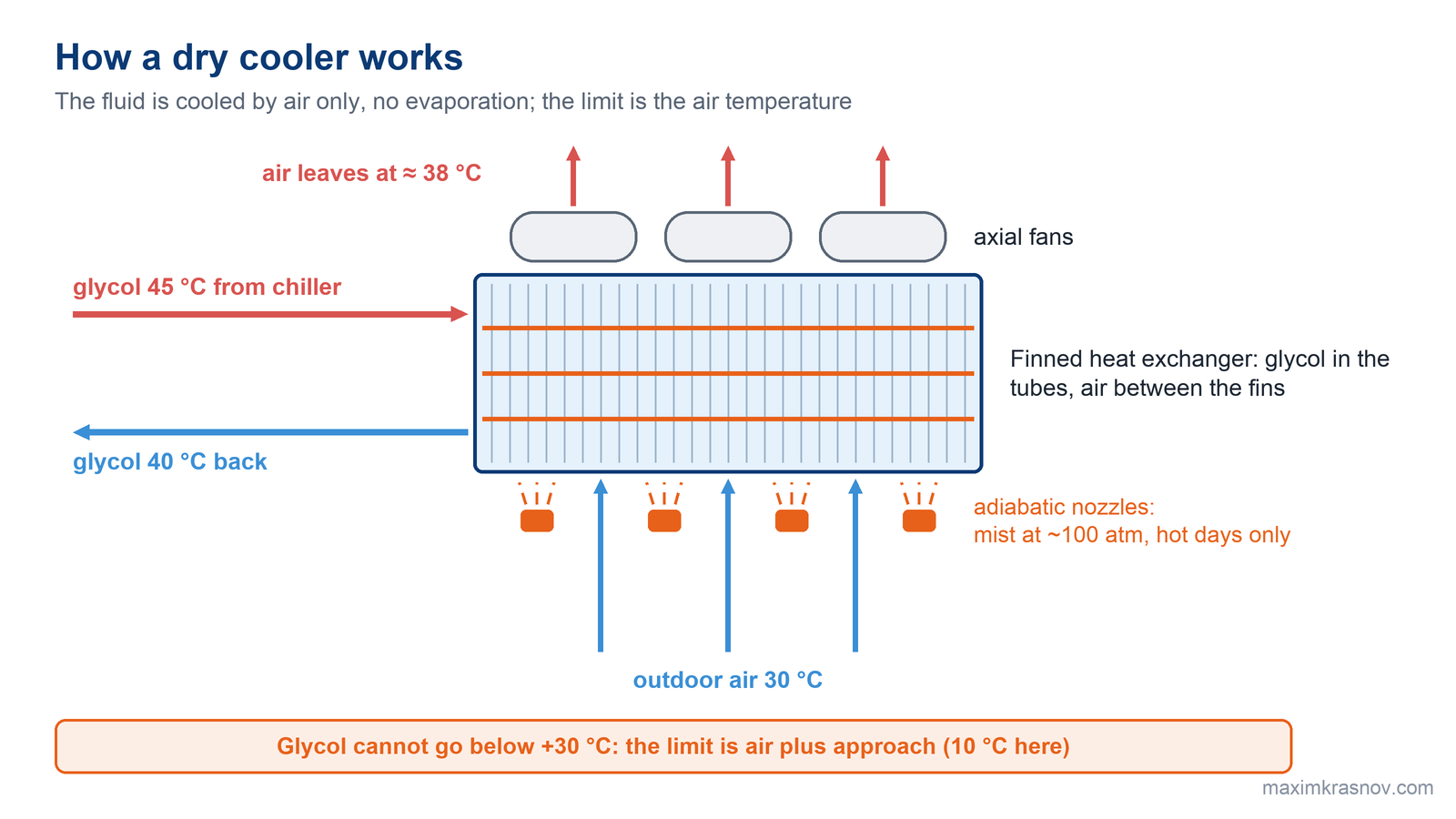
A dry cooler is a closed-loop fluid cooler: a finned heat exchanger with fans in which glycol or water is cooled by outdoor air alone, with no evaporation. That is why in summer it runs into the air temperature: an economical unit returns fluid 5.6–11 °C warmer than outdoor air, which at +30 °C means 36–41 °C. In exchange it needs no make-up water, no blowdown and no water treatment.
This article is for plant directors and chief engineers who are putting a dry cooler on a chiller, a process or a free cooling system. Dry coolers are one of NCT's best-selling products, and most of the complaints about them I have seen are not manufacturing defects but design decisions: the unit was sized for a mild summer, placed in a corner of the roof or filled with water. For a comparison with evaporative cooling on water and electricity, see cooling tower vs dry cooler.
What is a dry cooler and how is it built?
A dry cooler, also called a dry cooling tower, is built much like a car radiator. Hot fluid flows through tubes, fins increase the surface, axial fans blow outdoor air across it, and heat leaves only by warming the air. The fluid does not change phase, and there is no water on the outside.
NCT DC dry coolers are made from 300 kW in three configurations:
-
horizontal: the heat exchanger lies flat with fans on top; installed on the ground or on a roof;
-
vertical: air flows horizontally; for narrow passages and spaces between buildings;
-
V-shaped: two heat exchangers at an angle, more surface per meter of length.
The casing is galvanized steel with a polymer coating and a 10-year warranty against perforation corrosion. The fans run at outdoor air temperatures from −35 to +55 °C, and the heat exchanger accepts fluid from −35 to +80 °C.
When is a dry cooler the right choice?
A dry cooler wins where the fluid can be kept 3–5 °C or more above outdoor air temperature. The NCT catalog lists five such cases:
1. The required fluid temperature is 3–5 °C or more above outdoor air.
2. The loop must stay clean: the fluid cannot be in contact with the atmosphere.
3. The loop carries ethylene glycol or propylene glycol solution, not water.
4. The site has no make-up water and an open recirculating loop is not possible.
5. The fluid is hot, 60–70 °C: the temperature difference is large and the unit comes out compact.
Our dry coolers run at a power plant in Yakutia, on a drilling platform off Sakhalin, at a government facility on Novaya Zemlya, at a liquid pesticide plant in Tatarstan, at a glass factory in the Vologda region, at a data center in the Moscow region and at many other sites. On glycol, a dry cooler works where water outdoors would not survive the winter.
Why does a dry cooler lose capacity in summer?
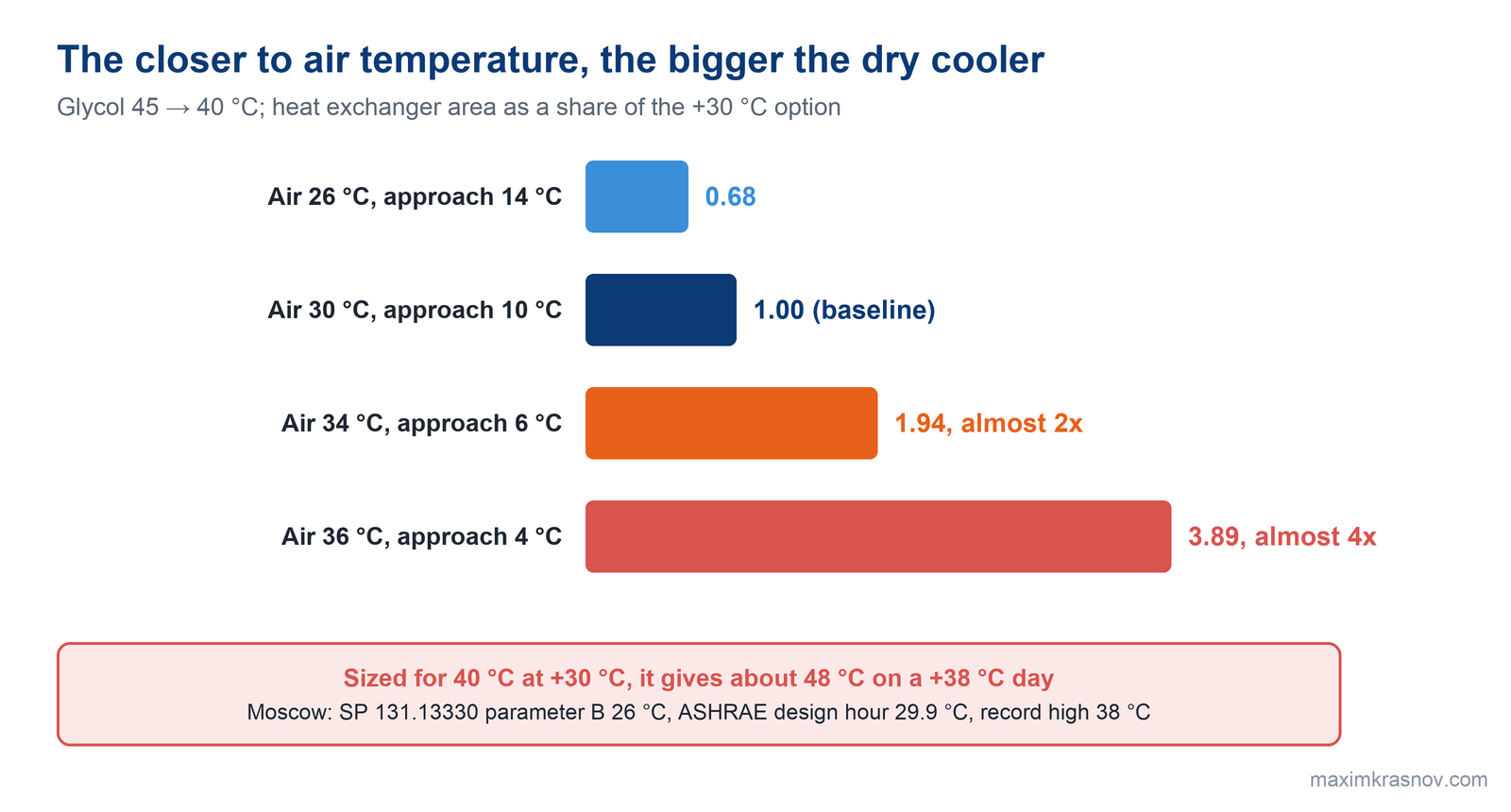
A dry cooler cannot cool the fluid below the temperature of the air passing through it. The difference between the leaving fluid and the entering air is called the approach. The smaller it is, the faster the required heat exchanger area grows: as the temperature difference tends to zero, the area tends to infinity.
An example from our design guide: glycol 45 → 40 °C, the air warms up by 8 °C in the unit.
| Entering air, °C | Approach, °C | Heat exchanger area, share of the 30 °C option |
|---|---|---|
| 26 | 14 | 0.68 |
| 30 | 10 | 1.00 |
| 34 | 6 | 1.94 |
| 36 | 4 | 3.89 |
Cutting the approach from 10 to 6 °C takes almost twice the heat exchanger, down to 4 °C almost four times. A dry cooler that runs "two degrees above outdoor air" is either huge or does not hold its setpoint.
Hence the main decision: which air temperature to size for. For Moscow, parameter B under SP 131.13330 (Russian building climatology code) is 26 °C, the ASHRAE design hour (0.4% annual frequency) is 29.9 °C, and the record high is 38 °C. The gap between 26 and 30 °C is a third of the area. In heat above the design point the fluid warms together with the air: a unit sized for 40 °C at +30 °C will deliver glycol at about 48 °C at +38 °C. For a process that is not allowed to stop, the design temperature is set by the process engineer, and it is often the record high.
What does adiabatic precooling add, and why 100 atmospheres?
An adiabatic dry cooler is the same dry unit with nozzles in front of the heat exchanger: in hot weather water is sprayed as mist, evaporates in the airstream and cools the entering air. The fluid in the tubes still never touches the water. At one customer's plant we set the nozzle pressure at about 100 atmospheres: at +35 °C and 30% relative humidity the air cools by about 10 °C.
The pressure is there for droplet size. Fine mist evaporates before it reaches the heat exchanger, while a large droplet lands on the fins, leaves salt and scale behind, and within a season or two the fins are clogged. That is why a garden hose on a hot day is a poor substitute for adiabatic precooling.
In NCT proposals the air cools by 5–15 °C, the upper figure for the dry south. The limit is the difference between dry-bulb and wet-bulb temperature: in the Moscow design hour 29.9 − 22.1 = 7.8 °C, realistically about 5 °C.
Adiabatic precooling uses little water and only in peak hours. A calculation for Moscow at 1,300 kW:
-
cooling the air by 5 °C takes about 1.2 m³/h of water;
-
Moscow has about 88 hours a year above +28 °C, so the annual total is no more than 106 m³;
-
an evaporative cooling tower of the same capacity evaporates up to 2.0 m³/h for thousands of hours a year;
-
glycol reaches the chiller condenser about 5 °C colder, and 300 kW of compressors draw 45 kW less in a hot hour.
For continuous processes I recommend sizing the dry heat exchanger for the design temperature without spray and treating adiabatic precooling as a margin. If the site loses its water supply, a unit sized tight around adiabatic precooling will lose it in exactly the hottest hour. In winter the nozzle line is drained. The water-for-electricity trade-off is covered in water vs electricity.
How does a dry cooler work with a chiller in summer and winter?
In summer a dry cooler rejects the condensing heat of a water-cooled chiller: the chiller sits indoors, and there is no water or water treatment outside. A dry cooler is connected in one of two ways:
-
glycol straight through the condenser: one loop and the lowest condensing temperature;
-
through a plate heat exchanger: glycol stays in the outdoor loop only, but the intermediate heat exchanger adds 2–4 °C to the fluid at the condenser. At 3% of compressor power per degree, that is 6–12% extra compressor energy in a hot hour.
The second option makes sense with a long pipe run, where glycol is not allowed in the condenser, or when the same heat exchanger is needed for free cooling in winter.
In winter a dry cooler provides cooling without a compressor: this is free cooling. With a 7/12 °C chilled water schedule and a combined approach of the dry cooler and heat exchanger of 7 °C, partial free cooling starts below +5 °C and full free cooling below 0 °C; with a 12/18 °C schedule, below +11 and +5 °C. One dry cooler serves the condenser in summer and the chilled water heat exchanger in winter. How many hours a year this gives is covered in chiller free cooling.
Where should a dry cooler go so it does not breathe its own exhaust?
A dry cooler cools with the air it actually gets, not the air given in SP 131.13330. Next to a blank wall or behind a tall screen the hot discharge comes back to the inlet, and almost every degree of that preheat goes straight into the fluid temperature.
An example from the design guide: a dry cooler on a chiller condenser, 1,000 kW of cooling, 250 kW of compressors. Recirculation on a cramped roof raised the inlet air by 3 °C, and the condensing temperature rose by the same 3 °C. At 3% of compressor power per degree that is 22.5 kW, or 112,500 kWh a year over 5,000 hours, about RUB 1.1 million at RUB 10 per kWh.
The placement rules are simple:
-
at least 1.2 m from a wall and between neighboring units;
-
screens no higher than the unit itself, fan tops no lower than adjacent walls and parapets;
-
a group goes in a row, with the discharge above the parapet;
-
support height allows for the local snow cover, otherwise in winter the unit gets buried in snow and the air goes round in a loop.
Recirculation also hits the fans: air leaving the heat exchanger of an NCT dry cooler hotter than +55 °C puts them out of service.
How much power do the fans draw, and how can you cut it?
Fans are the main consumer within the dry cooler itself, and on a year-round load variable frequency drives cut about 60% of their energy. Fan power grows with the cube of speed: at 60% speed a fan draws 0.6³ = 21.6% of its power.
A calculation for a notional dry cooler with 16 kW of fans, an average airflow demand of 60% and 8,000 operating hours a year:
| Control method | Average power | Energy per year |
|---|---|---|
| On/off staging, fans switched one by one | 9.6 kW | about 77,000 kWh |
| Variable frequency drive, all fans at 60% speed | 3.8 kW including losses | about 30,000 kWh |
| Difference | 5.8 kW | about 46,000 kWh, RUB 0.46 million |
Dry coolers already in service can be upgraded by replacing the fans with EC (electronically commutated) motors with built-in speed control: NCT offers this replacement as a retrofit for installed units.
Which dry cooler mistakes cost the most?
The most expensive mistakes are built in at the design stage and show up at the first frost or the first heat wave.
| Mistake | What it leads to | How to do it right |
|---|---|---|
| A dry cooler on a process that needs fluid almost at air temperature in summer | At +30 °C the unit delivers 36–41 °C and production stops | A closed-circuit cooling tower or a chiller for trim cooling |
| Water instead of glycol | If circulation stops in frost or power is lost, the heat exchanger freezes within hours | Glycol sized for the site's winter minimum |
| Topping up a glycol loop with water | A 10 m³ loop at 40% becomes 33.3% after adding 2 m³ of water, and freeze protection rises by several degrees | Top up only with premixed solution |
| Climate data from SP 131.13330 without a site correction | A unit on a roof next to a wall breathes its own exhaust and loses capacity in hot weather | Clearances and a site correction in the design |
| Hot fluid without checking leaving air temperature | Air above +55 °C puts the fans out of service | Check that point in the selection |
| Adiabatic precooling used to cover a shortfall in area | Water is cut off and on a hot day the unit misses its setpoint | Size for the dry design temperature, treat adiabatic precooling as a margin |
Glycol concentration is chosen for the coldest temperature the loop will see plus a 3–5 °C margin. 40% ethylene glycol freezes at about −23 °C, while the coldest five-day period in Moscow under SP 131.13330 is −26 °C. For a dry cooler that runs free cooling all winter, 40% is not enough: it needs a stronger solution, and the unit and pumps are recalculated for it. Concentration is checked with a refractometer at commissioning and every autumn.
Key takeaways
1. A dry cooler is a dry fluid cooler: it returns fluid 5.6–11 °C warmer than outdoor air, 36–41 °C at +30 °C, and no amount of extra area will cool it below the air.
2. Every degree closer to the air costs more: a 6 °C approach instead of 10 °C takes almost twice the heat exchanger, 4 °C almost four times.
3. Adiabatic precooling with mist at about 100 atmospheres cools the entering air by 5–15 °C depending on climate and uses water only in hot hours: in Moscow no more than 106 m³ a year for 1,300 kW.
4. A cramped roof costs money: +3 °C of recirculation on a 1,000 kW chiller means about 112,500 kWh of extra electricity a year.
FAQ
What is the difference between a dry cooler and a chiller?
A dry cooler only rejects heat to outdoor air and cannot cool fluid below the air temperature. A chiller is a refrigeration machine with a compressor: it makes 7/12 °C water in any weather. They often work together: the dry cooler takes heat from the chiller condenser in summer and provides cooling without a compressor in winter.
Are a dry cooling tower and a dry cooler the same thing?
Yes, a dry cooling tower is another name for the same dry fluid cooler. It does not evaporate water, so it needs no make-up water, blowdown or water treatment. An evaporative cooling tower cools to the wet-bulb temperature, which in summer is 7–10 °C colder.
Can you fill a dry cooler with water instead of glycol?
In practice, no. If circulation stops in frost or power is lost, a water-filled heat exchanger freezes within hours. Water is acceptable only with an emergency drain, backup power for the pump and heating.
How much water does an adiabatic dry cooler use?
Only for evaporation and only in hot hours. For 1,300 kW in Moscow that is about 1.2 m³/h in a peak hour and no more than 106 m³ a year if the spray switches on above +28 °C. The exact consumption and the water quality requirements for the nozzles come from a selection for your site.
What capacities do industrial dry coolers come in?
NCT DC dry coolers start at 300 kW, including adiabatic versions. Larger capacities are built up from modules, and a new one can be added to a running installation.
Sources
-
ASHRAE Handbook — HVAC Systems and Equipment and ASHRAE Climatic Design Conditions: design dry-bulb and wet-bulb temperatures for Moscow.
-
SP 131.13330 (Russian building climatology code).
-
Cooling Best Practices, "Evaluating Process Cooling Supply Temperatures": approach of an economical dry cooler 5.6–11 °C.
-
NCT catalogs and technical-commercial proposals, 2026: DC dry coolers, adiabatic version.
-
Experience and calculations of Cold Energy.
More on the topic in the Cooling towers section.
Need a cooling solution for your site? Get a consultation