
Wet-Bulb Temperature: The Hard Limit of Cooling Tower Performance

founder and CEO of Cold Energy (NCT)
Wet-bulb temperature is the lowest temperature air can reach by evaporating water into it, and no cooling tower can bring water below it. For Moscow the design wet-bulb is about 22 °C, and in real operation a tower delivers 3–4 degrees above it, i.e. 25–26 °C. Every degree of error in the wet-bulb adds about 0.7 °C to the cold water.
This article is for the plant director and chief engineer ordering a cooling tower, an evaporative condenser or a dry cooler. The wet-bulb is chosen once, in the design basis, and the consequences show up every summer: either as a complaint against a tower that works perfectly, or as extra cells and money spent on a margin that will never be needed.
What is wet-bulb temperature in simple terms?
A wet-bulb thermometer is an ordinary thermometer wrapped in a wet cloth and exposed to moving air. Water evaporates from the cloth and cools it, so it reads lower than the ambient thermometer. The drier the air, the stronger the evaporation and the lower the reading.
Engineers call the ambient temperature the dry-bulb, and the reading with the wet cloth the wet-bulb. On a hot day in central Russia the difference between them reaches 7–10 degrees. For Moscow, ASHRAE data at the 0.4% level give a design dry-bulb of 29.9 °C and a wet-bulb of 22.1 °C: a difference of 7.8 degrees.
This difference decides what a unit can deliver in summer. A unit that cools by evaporation works from the wet-bulb. A unit that simply blows air over tubes works from the dry-bulb and in summer always lags by those 7–10 degrees.
Why can't a cooling tower cool water below the wet-bulb?
A cooling tower cools water by evaporation, without a compressor, and this kind of cooling has a physical limit: the wet-bulb of the entering air. The water can approach it but cannot cross it. The difference between the cold water and the wet-bulb is called the approach.
A subscriber to my channel sent a question: the tower was designed for +27 °C leaving water, but in summer it gives +30 °C — is it defective? Almost always, no. The design wet-bulb was taken "as a summer average", and in the hottest and most humid hours the tower cannot deliver its +27 °C. Adjustment will not fix this; only a different tower will.
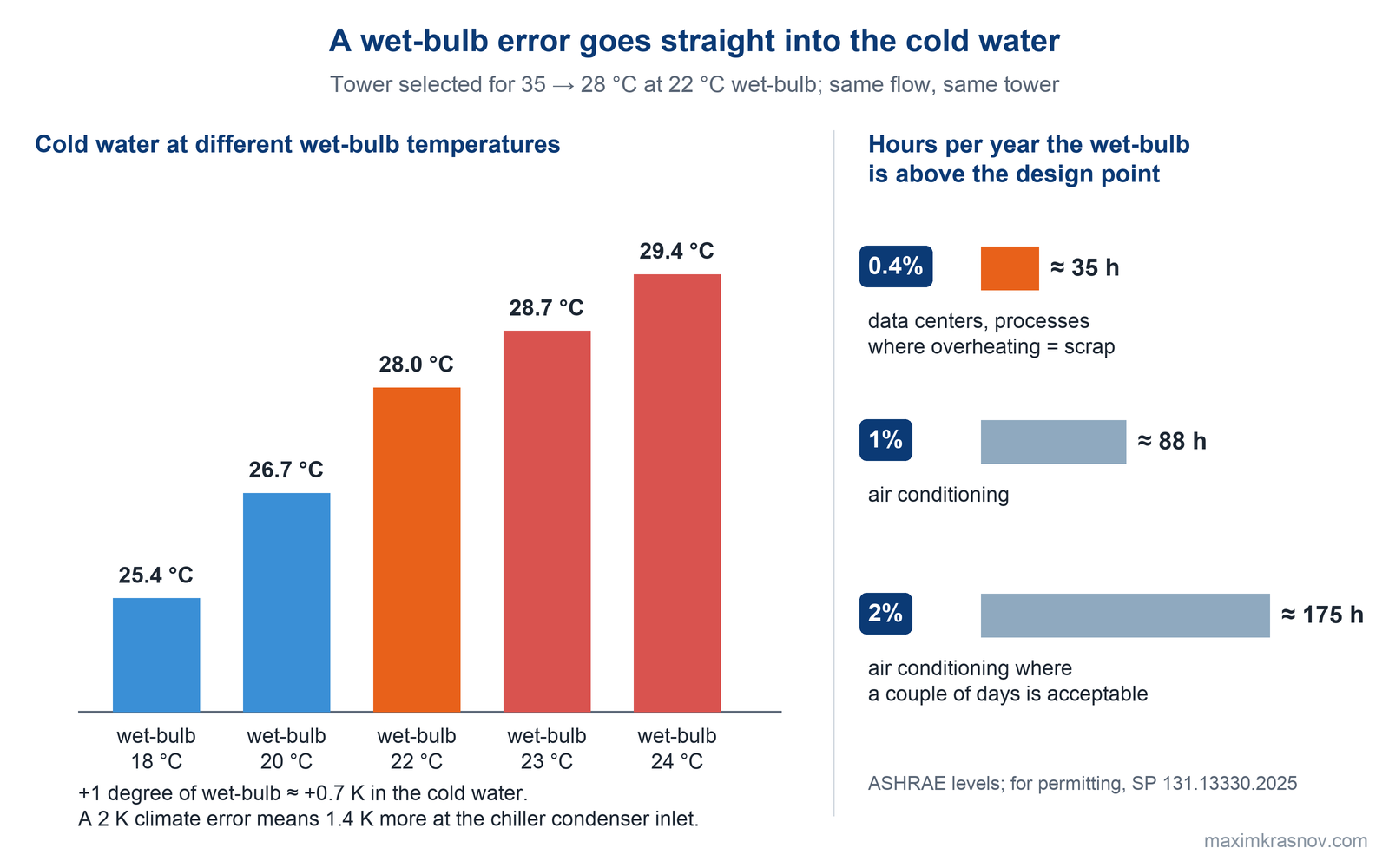
How sensitive the water is to weather shows on a tower selected for 35 → 28 °C at a 22 °C wet-bulb. The flow and the tower itself stay the same; only the weather changes:
| Wet-bulb, °C | Cold water, °C | Approach, °C |
|---|---|---|
| 18 | 25.4 | 7.4 |
| 20 | 26.7 | 6.7 |
| 22 (design) | 28.0 | 6.0 |
| 23 | 28.7 | 5.7 |
| 24 | 29.4 | 5.4 |
Every degree of wet-bulb above design adds about 0.7 °C to the cold water. A 2-degree error in choosing the climate gives 1.4 °C extra at the chiller condenser inlet exactly in the hours when the plant is already at its limit.
How do you calculate wet-bulb temperature?
The wet-bulb is calculated from air temperature and relative humidity, either by psychrometric calculation or from a psychrometric (h–d) chart. The Russian code SP 131.13330.2025 "Building Climatology" has no ready-made wet-bulb column; it gives temperature and humidity for the warm season, and the wet-bulb is derived from them.
The calculation takes three steps:
1. From temperature and humidity, find the water vapor pressure.
2. From that, find the moisture content of the air and its enthalpy (heat content, kJ/kg).
3. The wet-bulb is the temperature at which saturated air has the same enthalpy.
Example: 29 °C and 55% humidity give an enthalpy of 64.5 kJ/kg and a wet-bulb of 22.0 °C.
| Air temperature, °C | Humidity, % | Enthalpy, kJ/kg | Wet-bulb, °C |
|---|---|---|---|
| 26 | 60 | 58.4 | 20.3 |
| 28 | 50 | 58.4 | 20.3 |
| 29 | 55 | 64.5 | 22.0 |
The first two rows show the main point: 26 °C at 60% and 28 °C at 50% give the same wet-bulb. A cooling tower "sees" the enthalpy of the air, not the ambient temperature, so the hottest day on the wall thermometer is not necessarily the hardest day for the tower. For central Russia the design wet-bulb is about 21–23 °C, a handy range for checking someone else's calculation.
What wet-bulb design level should you choose?
An ASHRAE level is the share of hours per year when the wet-bulb is above design: 0.4% means about 35 hours beyond the design point, 1% about 88 hours, 2% about 175 hours. The Russian "supply probability" (obespechennost) is counted the other way round, as the share of hours when the design value is not exceeded. The stricter the level, the less often the tower runs beyond design, and the larger it is.
This is the owner's decision together with the designer, and it has to be written into the specification. I ask the customer one question: what happens to your production in the hours when the weather is worse than design?
-
Processes where one extra degree stops the line or causes scrap, and data centers: the strictest level, 0.4% by ASHRAE or the highest supply probability under SP 131.
-
Air conditioning, where a temperature rise is acceptable a couple of days a year: 1% or 2%.
-
Seasonal production with peak load outside summer, such as the autumn campaign of a sugar plant: the design point is taken for the peak period, not for July.
In the technical data sheets for NCT cooling towers that we issue with each selection, the wet-bulb is stated together with its supply probability, 0.98 by default. Selection is done by software, not by a person with a calculator, so the tower's performance is guaranteed for the recorded point. If your process needs a different level, it is stated in the questionnaire. If the weather data are old or the weather station is far from the site, international practice adds about 0.6 °C to the 0.4% wet-bulb.
What happens if you get the wet-bulb wrong?
A wet-bulb error costs either a complaint against a working tower or extra steel. An example from our practice is a starch plant in Gulkevichi, Krasnodar Krai. The old towers there were rated for 40 → 28 °C but actually delivered 32–35 °C, and in summer the vacuum evaporators of the maltodextrin line either lost capacity or burned extra gas.
We selected two NCT VR4 open cooling towers of 700 m³/h each for a heat load of about 10 MW, based on the design wet-bulb for Krasnodar Krai rather than the average summer air temperature. That substitution is exactly what let the previous supplier down. The 40 → 28 °C mode now holds all year round, and the plant itself recorded savings of 90 m³ of natural gas per tonne of product and a payback of under one year.
| Error in the design basis | What it leads to | How to do it right |
|---|---|---|
| A "typical central Russia" wet-bulb, with no city and no design level | In summer the water is 1–2 °C warmer than design, a complaint against a working tower | Wet-bulb per SP 131.13330.2025 for the site's city, design level agreed in writing |
| Average summer air temperature instead of wet-bulb | The tower is too small for hot, humid hours | Design wet-bulb for the warm season |
| 2 °C approach "to be safe" | Point outside CTI certification, tower almost twice as large | Approach of at least 2.8 °C, decision based on the sensitivity table |
| Only the summer mode is described | In winter the chiller trips on low pressure | Summer, part-load and winter modes in the questionnaire |
The opposite error is a 2 °C approach "with margin". The Cooling Technology Institute (CTI), which certifies cooling tower thermal performance, works with wet-bulb temperatures of 10–32.2 °C and approaches of at least 2.8 °C. Nobody will independently verify a point below that, and a tower sized for it comes out almost twice as large. How the approach turns into unit size I covered in the article how to choose an industrial cooling tower.
Which thermometer do dry coolers, evaporative condensers and chillers work from?
Evaporative units — open and closed cooling towers, evaporative condensers — work from the wet-bulb. Dry units — the dry cooler and the chiller's air-cooled condenser — work from the dry-bulb. That is why in the same summer hour they deliver very different temperatures.
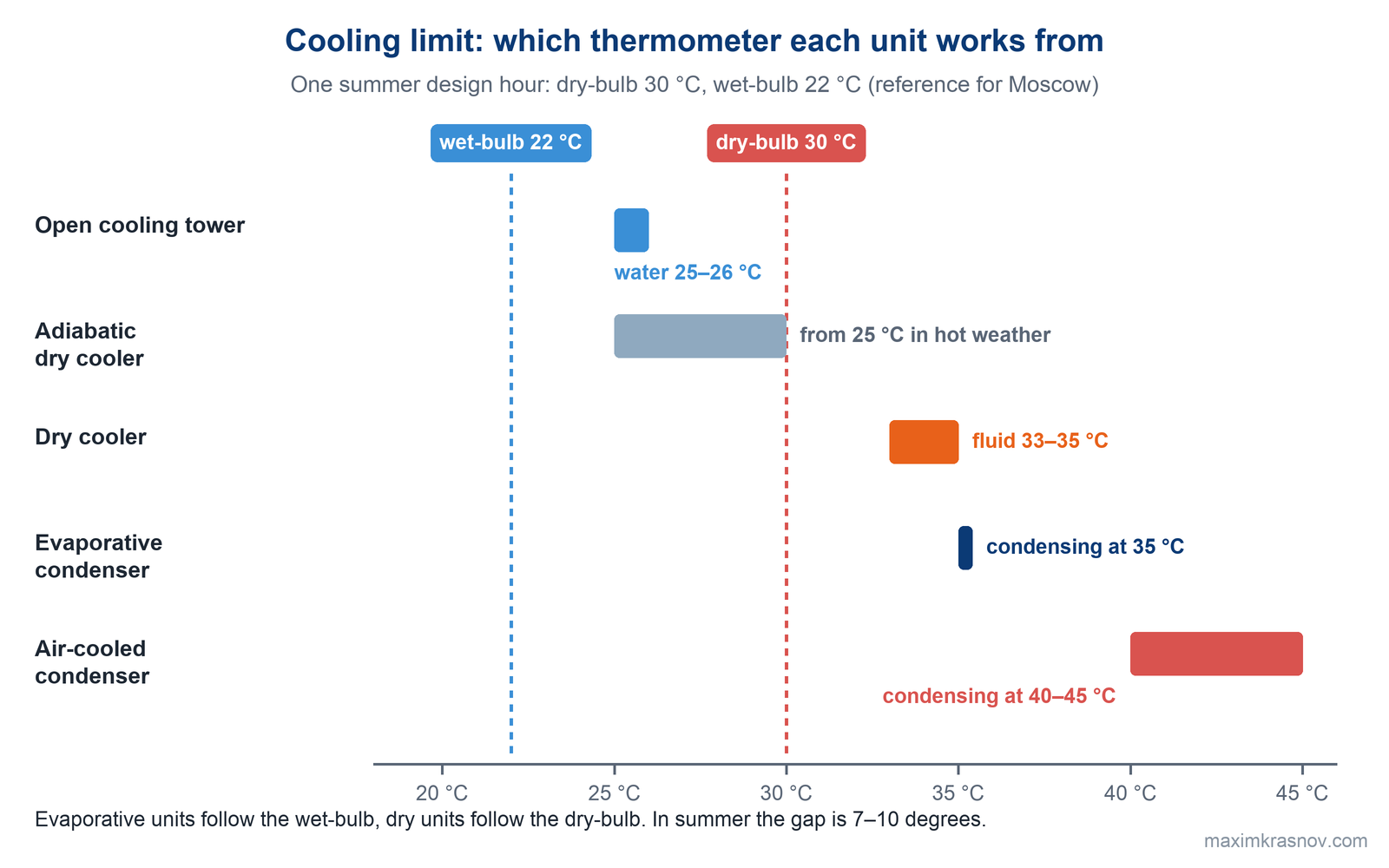
| Unit | Which thermometer | Result at 30 °C dry-bulb and 22 °C wet-bulb |
|---|---|---|
| Open cooling tower | Wet-bulb | Water 25–26 °C |
| Adiabatic dry cooler | Between dry-bulb and wet-bulb in hot weather | About 25 °C, limit 22 °C |
| Dry cooler | Dry-bulb | Fluid no colder than 33–35 °C |
| Evaporative condenser | Wet-bulb | Condensing at 35 °C |
| Chiller air-cooled condenser | Dry-bulb | Condensing at 40–45 °C |
Hence my selection rule. A cooling tower, if the water may be warmer than the wet-bulb plus 4 degrees: machine condensers, recirculating water for furnaces and presses, heat exchangers, liquid cooling of servers. A chiller, if you need 7–15 °C water or a temperature that stays rock-steady in any weather. A comparison of dry and evaporative cooling in rubles and cubic meters is in the article cooling tower vs dry cooler.
How many hours a year does the wet-bulb allow cooling without a compressor?
In winter the wet-bulb works for the owner: in Moscow it is below 5 °C for about 4,696 hours a year, in St. Petersburg about 4,756, which is 54% of the year. This is our estimate from the ERA5 climate reanalysis for 2015–2024; for Pulkovo it matched ASHRAE data almost exactly.
| Wet-bulb below | Moscow, hours per year | St. Petersburg, hours per year |
|---|---|---|
| 0 °C | 3,207 (37%) | 2,874 (33%) |
| 5 °C | 4,696 (54%) | 4,756 (54%) |
| 10 °C | 5,971 (68%) | 6,086 (70%) |
| 15 °C | 7,591 (87%) | 7,746 (88%) |
At a powder metallurgy plant we did exactly that: in summer a Thermax absorption chiller provides 4.6 MW of cooling, and three NCT cooling towers cool its water from +32 to +25 °C. In winter the machine is off, two towers cool the water from +12 to +7 °C on their own and deliver the cooling to production through heat exchangers. How to count such hours for a chiller I covered in the article on chiller free cooling. For a dry cooler these figures are an upper estimate: it works from the dry-bulb, and the dry-bulb is never lower than the wet-bulb.
Key takeaways
1. The wet-bulb is the physical limit of evaporative cooling: in real operation a cooling tower delivers 3–4 degrees above it, which for Moscow means 25–26 °C in summer.
2. Every degree of wet-bulb above design adds about 0.7 °C to the cold water, so an "average summer" wet-bulb almost always ends in a complaint against a working tower.
3. The design level is the owner's decision: 0.4% by ASHRAE leaves about 35 hours a year beyond the design point, 2% about 175 hours.
4. Evaporative units work from the wet-bulb, dry coolers and air-cooled condensers from the dry-bulb; in summer the gap is 7–10 degrees.
5. In winter the wet-bulb in Moscow and St. Petersburg is below 5 °C for more than half the year, and a cooling tower can provide cooling without a compressor.
More on selecting and operating cooling towers in the Cooling towers section.
Sources
-
SP 131.13330.2025 "Building Climatology" (Russian building climatology code; in force since 09.09.2025, replacing SP 131.13330.2020).
-
ASHRAE Handbook — Fundamentals 2025, chapter 14 "Climatic Design Information": design wet-bulb for the 0.4%, 1% and 2% levels.
-
Cooling Technology Institute, standard STD-201RS: limits of cooling tower thermal performance certification.
-
Stanford University, HVAC Water Chillers and Cooling Towers: wet-bulb correction for old weather data.
-
ERA5 climate reanalysis (Open-Meteo), Moscow and St. Petersburg, 2015–2024.
-
Cold Energy (NCT) experience and calculations: engineering guides "NCT cooling towers", "NCT chillers", "NCT dry coolers and condensers" (October 2026), site case studies, channel post of October 9, 2026.
Need a cooling solution for your site? Get a consultation