
Cooling tower water treatment: what to agree before purchase

founder and CEO of Cold Energy (NCT)
Before buying a cooling tower, agree the water quality requirements based on a water analysis, the treatment system scope and who will operate it. Conductivity of 1600 µS/cm in the basin and 400 µS/cm in the make-up water indicates approximately 4 cycles of concentration, but whether that operating condition is acceptable requires a separate assessment. A treatment panel controls blowdown and chemical dosing according to its configuration; choosing the operating limits requires water analysis.
If someone proposes leaving chemical water treatment out of the supply or buying it after startup, first establish who will be responsible for water quality. Treatment protects the fill and heat exchanger against blockage, deposits, corrosion and biological fouling. Payback depends on the water and equipment: the same payback period cannot be promised for different plants.
In our experience, failure to follow water handling procedures led to tube replacement in an absorption chiller. Below, I explain what to check before ordering and what operating records to require. The overall water balance is covered in the article on cooling tower water consumption.
Why is water analysis needed before selecting a cooling tower?
Water analysis is needed before selecting materials and treatment equipment: acceptable operating conditions depend on the dissolved salts, contaminants and metals throughout the circuit. Descriptions such as "mains water" or "good borehole water" are not enough for selection. As some water evaporates, dissolved salts remain in circulation.
For selection, we request the make-up water source and its water quality data: pH, conductivity or dissolved solids, total and calcium hardness, alkalinity, chlorides, sulfates, silica, iron and manganese, ammonia, suspended solids and organic matter. We also establish who manages treatment, whether the composition changes seasonally and where blowdown discharge is permitted.
A closed-circuit cooling tower has two distinct circuits: the fluid inside the coil and the external spray water. It is the spray water that evaporates; a closed process circuit does not remove the need to monitor spray water chemistry. A dry cooler operates differently: its fluid has no contact with outdoor air, and dry cooling requires no make-up water. If the dry cooler has a spray system, assess that water system separately.
What do cycles of concentration show, and what limits them?
Cycles of concentration are the ratio of dissolved salt concentration in the recirculating water to that in the make-up water; the conductivity ratio provides an operating estimate. Four cycles means roughly four times the salt concentration, not four passes through the cooling tower. Check whether the conditions allow a conductivity-based estimate.
An example from our selection method: 1600 ÷ 400 = 4. Conductivity is measured in microsiemens per centimeter, µS/cm. Compare readings with the same temperature compensation. Chemical dosing and changes in water composition can affect the estimate, so laboratory analysis remains necessary.
For make-up water with an initial dissolved solids concentration of 300 mg/L, a simple model with no salt precipitation gives the following results:
| Cycles of concentration | Calculated dissolved solids in recirculating water | What the engineer must confirm |
|---|---|---|
| 2 | 600 mg/L | Whether the composition is acceptable for the circuit materials |
| 3 | 900 mg/L | Which constituents first limit concentration |
| 4 | 1200 mg/L | The blowdown setpoint and treatment program |
| 6 | 1800 mg/L | Whether this operating condition is possible with this particular water |
The table does not establish that operation at 6 cycles is acceptable. Chlorides, silica, calcium and alkalinity may set the limit. Two water supplies with the same total dissolved solids are not necessarily equivalent for a particular heat exchanger.
The DOE FEMP cooling tower management guidance recommends determining allowable cycles and the corresponding conductivity with a water treatment specialist. Agree the controller setpoint on the basis of the initial water analysis.
How do blowdown, chemicals and mechanical cleaning differ?
Blowdown removes some recirculating water containing accumulated salts; chemicals control deposits, corrosion and biological fouling; mechanical cleaning removes suspended solids. A discharge valve does not replace chemical dosing or suspended solids removal.
Blowdown is the controlled discharge of some water, replaced by fresh make-up. An inhibitor is a chemical that slows an unwanted process, such as scale formation or corrosion; a biocide controls biological fouling. Select the chemicals and doses to suit the water analysis and equipment compatibility.
Sand, mill scale and dust must be removed separately: chemicals do not replace mechanical cleaning. On a dusty site, agree the suspended solids removal method, cleaning locations and maintenance access in advance. A standard dosing panel does not perform this function.
A design may include side-stream filtration, which treats part of the circulating flow. Our water treatment panel does not contain such a filter. We are not presenting side-stream filtration here as a standard product we supply: if it is needed, specify the equipment and responsible contractor separately.
What does a water treatment panel include?
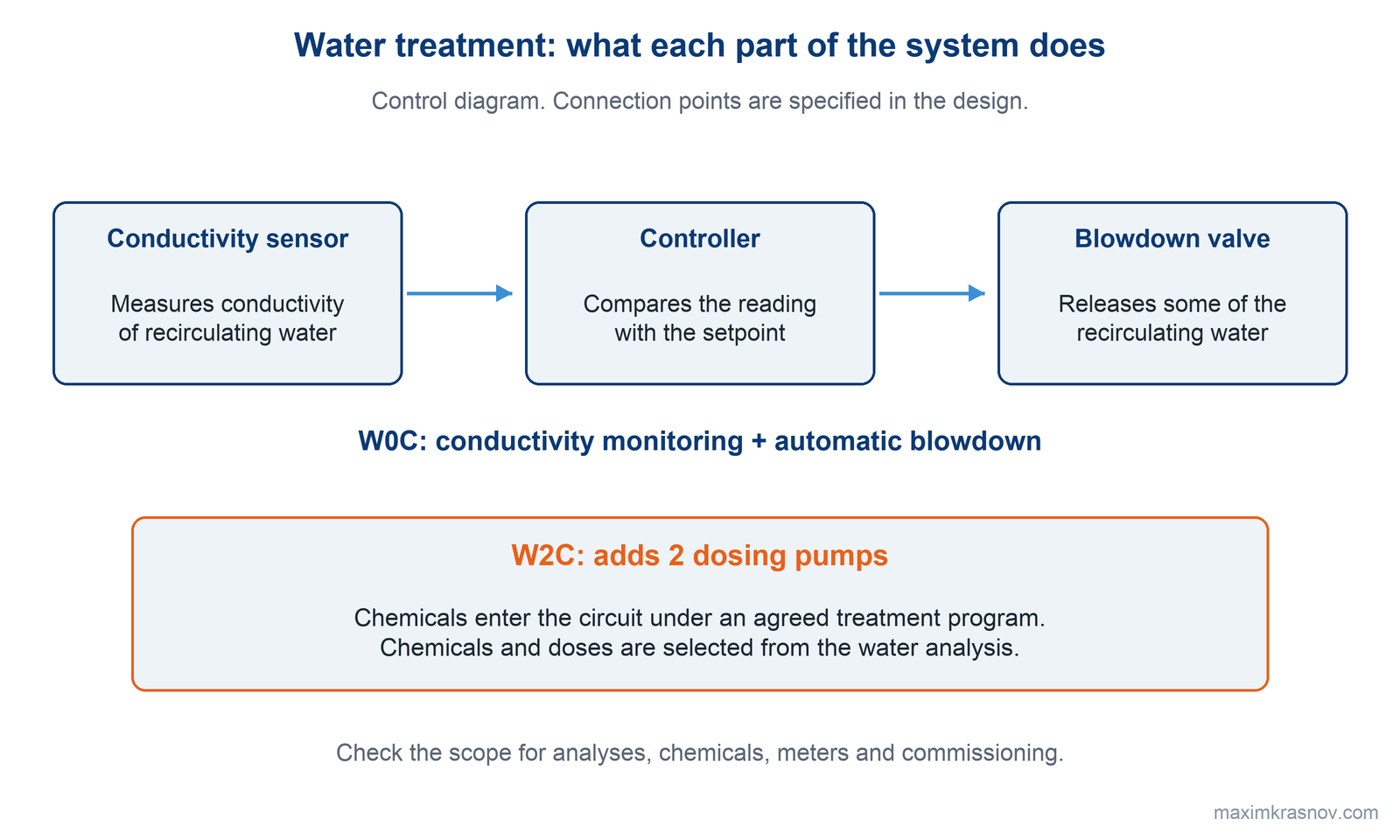
In our range, W0C monitors conductivity and controls blowdown, while W2C adds 2 dosing pumps. These are different configurations, although both may be described as "water treatment." Check each function and the scope of supply in the quotation.
| NCT configuration | What it does | What the name does not establish |
|---|---|---|
| W0C | Conductivity monitoring and automatic blowdown | This configuration has no dosing pumps |
| W2C | Monitoring and blowdown, plus two chemical dosing pumps | Check whether water analysis, chemicals and commissioning are included |
| W3C | An extended dosing program and make-up water metering | The configuration and program depend on the water; this is not a necessary upgrade for every plant |
Why did the tubes fail when the metal grade met the specification?
In our case, tube damage resulted from acid in the shared water circuit, followed by failure to follow the chiller's shutdown preservation instructions. The stainless steel tubes in an absorption chiller were damaged after approximately 12 months. The customer suspected that the metal did not meet the specification, but analysis confirmed the specified grade. I described this case on my channel in September 2026.
The investigation established that acid had entered the shared water circuit after a third-party heat exchanger was cleaned. The chiller was then drained for winter, contrary to the instructions for that particular machine. As water evaporated from the remaining liquid, the acid concentration increased, eventually causing through-wall tube damage.
This case is not a reason to prohibit draining all equipment. Follow the preservation instructions for the specific machine, and check shared circuits for the effects of chemical cleaning. Before cleaning, agree a procedure; afterwards, record the water composition.
How can costs be compared without promising a payback period?
Compare the full scope of work and subsequent operation: the panel, analyses, chemicals, commissioning and maintenance. Assess these costs against the condition of the fill and heat exchanger and the cost of replacing them if they become blocked. Without the site's operating history, neither savings nor a payback period can be stated.
Use the guide to reading a cooling equipment quotation to check completeness: a component shown on a diagram is not necessarily included in the price. This applies to valves, meters and dosing pumps alike.
What should the owner agree before ordering and check at startup?
Before ordering, agree water quality requirements, the scope of supply and responsibilities; at startup, check settings and hand over operating instructions. Work through the following steps and assign responsibility for each deliverable.
1. Gather the input data. Obtain make-up and recirculating water analyses with sampling dates and locations, plus a list of circuit materials and equipment.
2. Agree the water chemistry operating program. Establish allowable values from manufacturers' documentation, design cycles of concentration, blowdown setpoints and the treatment program. New galvanized equipment requires a separate passivation procedure, forming a protective layer, in accordance with the manufacturer's instructions.
3. Define the supply scope and connections. Cover the panel, valve, sensors, pumps, meters, chemicals, connection points, power supply and discharge routing. For each item, identify who supplies it and who installs it.
4. Check startup and maintenance arrangements. Include setup for the actual water, instructions, verification measurements, cleaning procedures and chemical replenishment.
5. Assign operating responsibility. Make an employee responsible for maintaining a readings log and following procedures when limits are exceeded and after chemical cleaning. Where a separate water treatment specialist is involved, coordinate the operating program with the cooling supplier.
Key takeaways
1. Select cooling tower water treatment based on the composition of make-up and recirculating water, equipment materials and operating conditions. Naming the water source does not replace analysis.
2. Basin conductivity of 1600 µS/cm with make-up conductivity of 400 µS/cm indicates approximately 4 cycles of concentration. Confirm separately whether this is acceptable for the specific circuit.
3. W0C provides monitoring and blowdown; W2C adds two dosing pumps. Check the supply scope for analysis, chemicals, meters and commissioning.
4. Water treatment costs include the panel, analyses, chemicals, commissioning and maintenance. Estimate savings on replacing blocked fill and heat exchangers from the site's operating history; without it, a payback period cannot be determined.
Find more articles on equipment selection and operation in the Cooling towers section.
FAQ
Why can make-up water with zero hardness still be unsuitable?
Zero hardness does not mean zero dissolved salts: ion-exchange softening replaces calcium and magnesium with sodium, without reducing total dissolved solids to zero. A service report recorded 819 ppm (parts per million) at zero hardness, against the equipment's specified maximum of 600 ppm. This was a limit for the inspected unit, not a universal standard; adding a chemical does not remove dissolved salts.
Is the panel manufactured to a GOST standard or technical specifications?
The equipment is manufactured to TU (Russian technical specifications). A recorded response to a customer's enquiry identified a declaration of conformity with a Customs Union technical regulation for the water treatment equipment. Request the current document for the offered product together with its technical passport; the word "GOST" (Russian state standard) alone is not evidence of certification.
Sources
-
DOE FEMP — Best Management Practice #10: Cooling Tower Management: cycles of concentration, conductivity monitoring and selection of acceptable operating conditions with a specialist.
-
ASHRAE Handbook — HVAC Systems and Equipment, Cooling Towers chapter: evaporation, impurity concentration and control of biological fouling, deposits and corrosion.
-
Cold Energy's experience and calculations: selection of NCT water treatment systems, investigation of heat exchanger tube damage and service analysis of softened water. The concentration calculations are examples, not operating instructions for specific equipment.
Need a cooling solution for your site? Get a consultation