
Imported Chiller After the Brand Exits: Repair, Upgrade or Replace

founder and CEO of Cold Energy (NCT)
You do not have to replace an imported chiller just because its manufacturer left Russia. Three numbers make the decision: the repair cost (a compressor overhaul in year 10 runs about half the price of the machine), the extra electricity of the old system compared with a modern one, and the cost of a day of downtime while you wait for a spare part. Often the best money is spent on upgrading the plant around the machine.
From 2005 I represented York International (Johnson Controls) in Russia's North-West region, and from 2008 Trane Technologies; I trained at their factories. In 2011 I founded Cold Energy, and since 2014 we have been building our own NCT chillers. So I look at the installed base of imported machines from two sides: as someone who sold them and as a manufacturer who replaces them.
This article is for the chief engineer and the owner of a site where an imported machine runs without manufacturer support. More material on chillers is in the Chillers section.
What happens to an imported chiller when the manufacturer leaves Russia?
The machine itself keeps running: the compressor and heat exchangers do not know that the local office has closed. What changes is where you get oil, filters, spare parts and engineers who know this machine. A chiller needs them for its whole service life, so when choosing a new machine I advise checking whether its compressors and heat exchangers have an official representative with a warehouse in Russia.
We first ran into departing suppliers back in 2014. The dollar doubled in price, and Western partners began restricting sales without explanation and stopped shipping equipment to Russia that had already been paid for. For the owner of an imported machine, the lesson from that story is simple: check the spare parts stock and service before a breakdown, not during one.
Large centrifugal machines are the hardest case. Nobody in Russia mass-produces centrifugal compressors today, so for such a machine the question "where do we get a compressor" has to be settled in advance.
Why does an imported chiller lose capacity if the brand is not to blame?
Most often the culprit is water, not the brand: in our experience, when equipment does not deliver its capacity, nine times out of ten the cause is water quality. One millimetre of scale on a heat exchanger means minus 30 % of capacity.
The second common cause is selection. At an oil and fat plant in the Lipetsk region, an imported chiller has been in place since 2014 and has never worked properly. The designer selected it for about 24 °C under SNiP (the Soviet-era Russian building code), but at the site 24 °C is reached as early as the beginning of May, and in peak heat it gets up to 38 °C. In summer the loop water was 10 degrees warmer than required, and the plant cut its oil output.
The third cause is a changed duty and glycol. An old chiller selected for a 7/12 °C water loop will deliver less than its rated capacity in a 5/10 °C loop. Weak glycol sharply accelerates corrosion and leads to evaporator freezing, and freezing fluid can burst a plate heat exchanger.
Until these causes are ruled out, replacing the machine can be an expensive mistake: a new chiller in the same water and with the same selection will repeat the fate of the old one.
What should you check before deciding to repair or replace?
Five things are checked before the decision, and four of them are about the site, not the brand of the machine.
1. Water and glycol: water analysis, glycol concentration, scale and deposits in the heat exchangers.
2. Actual duty: water temperatures, pump flow and head as measured, not as in the old design.
3. Operating log. Pressures, superheat, subcooling, temperatures and current recorded at commissioning are the baseline: deviations from them show heat exchanger fouling before capacity drops.
4. Spare parts: who will supply a compressor, oil and filters, in how many days and with what warranty.
5. Cost of downtime: how much the site loses per day without cooling, and whether there is a standby machine.
After these five points the "repair or replace" argument usually turns into a calculation.
When is it cheaper to repair an imported chiller?
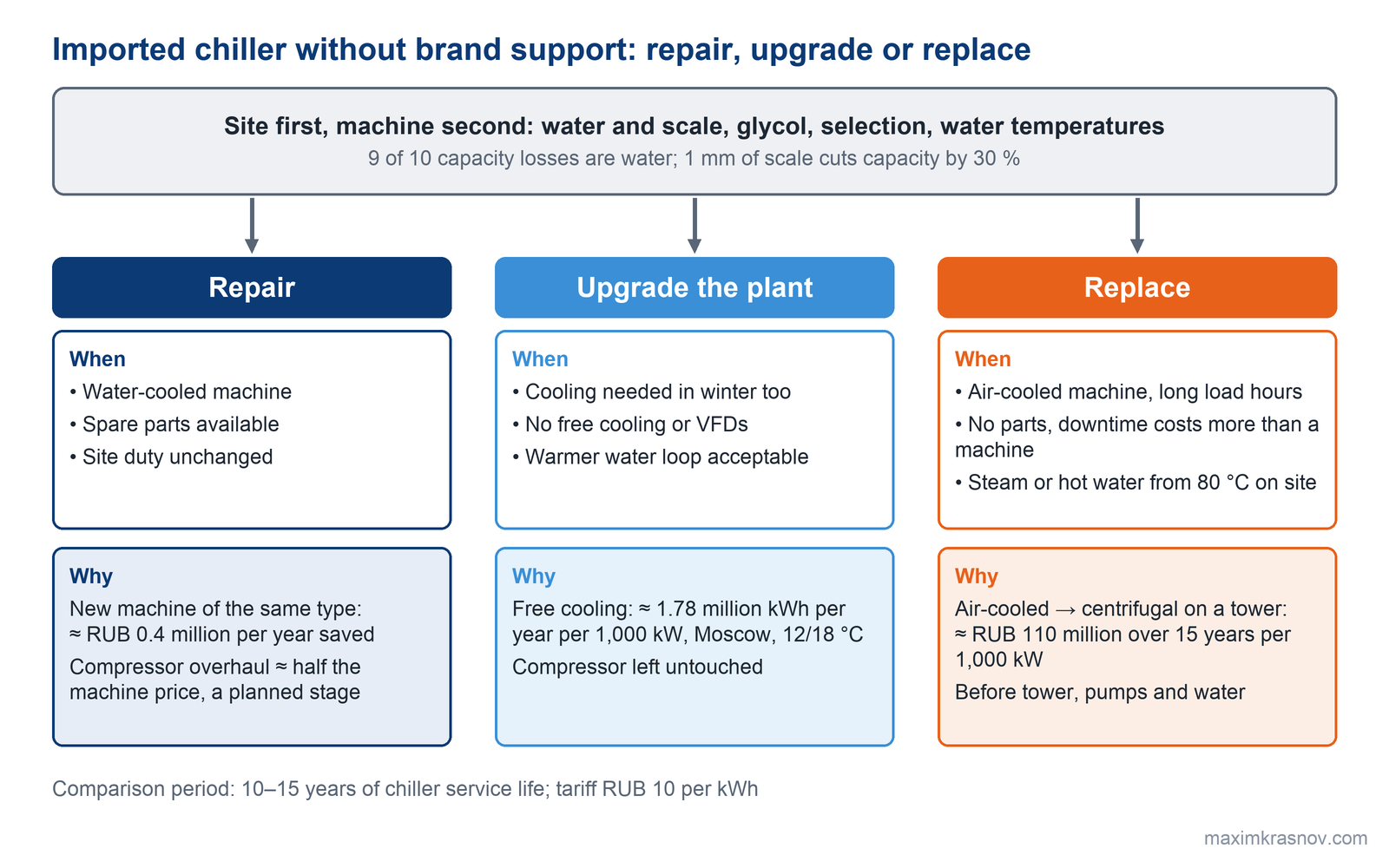
Repair pays when the machine is water-cooled, the site duty has not changed, spare parts are available and years of operation are still ahead. A chiller lasts 10–15 years, and a compressor overhaul in year ten costs about half the price of the machine. This line goes into the total cost of ownership from day one; it is not a reason to replace.
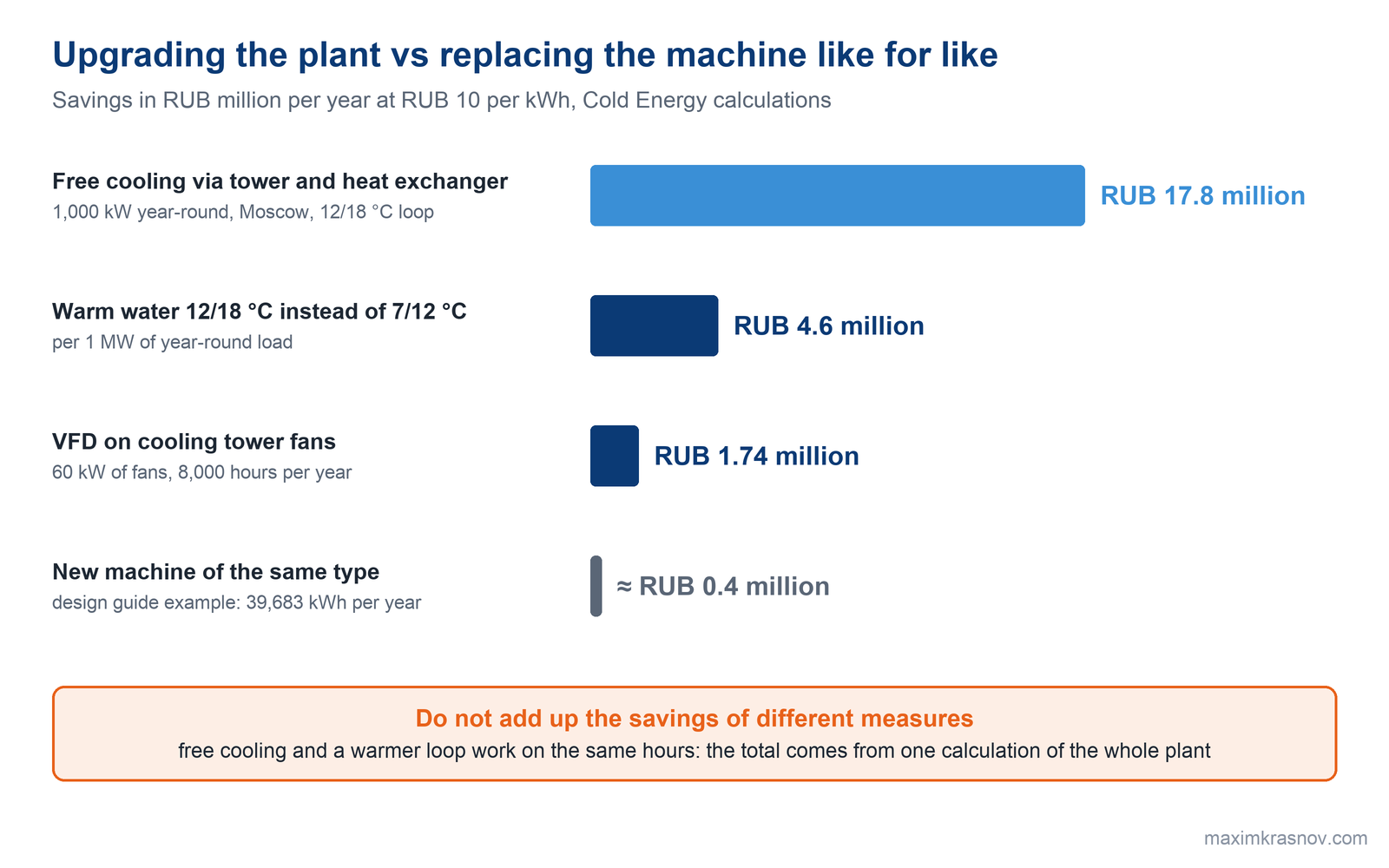
A water-cooled machine on a cooling tower condenses at about 35 °C, so a new machine of the same type will not beat it by much. In an example from our design guide for engineers, two 1,000 kW machines with different part-load efficiency differ by 39,683 kWh per year, about RUB 0.4 million at RUB 10 per kWh. Over 15 years that is about RUB 6 million, while a megawatt-class chiller costs in the order of RUB 25–30 million: electricity will not pay back such a replacement.
I broke down the full cost of owning a machine in Chiller Total Cost of Ownership.
What can be upgraded around an old chiller?
An upgrade means improving the plant around the chiller: free cooling, variable frequency drives (VFDs), a warmer water loop, water treatment and controls. The compressor is left alone, and the effect is often larger than from replacing the machine with an identical one.
| Measure | Effect in our calculations | At RUB 10 per kWh | Key condition |
|---|---|---|---|
| Free cooling via cooling tower and heat exchanger | 1.78 million kWh per year per 1,000 kW, Moscow, 12/18 °C loop | RUB 17.8 million per year | Load exists in winter |
| Warm water loop 12/18 °C instead of 7/12 °C | +0.46 million kWh per year per 1 MW | RUB 4.6 million per year | Consumer does not dehumidify air |
| VFD on cooling tower fans | 173,600 kWh per year for 60 kW of fans, 8,000 h | RUB 1.74 million per year | Not below 30 % speed |
| VFD on secondary pumps | about −30 % of pump energy | per pump meter | Differential pressure sensor on the farthest branch |
| Cooling tower blowdown by conductivity | −9.45 m³/h of water on a 1,000 m³/h loop | about RUB 3.8 million over 4,000 h at nominal water tariffs | Make-up water analysis |
Do not add up figures from different rows: free cooling and a warm loop work on the same hours. The total for your site comes from one calculation of the whole plant; eight measures with their conditions are in How to Cut Industrial Cooling Costs.
When is it time to replace an imported chiller?
Replacement pays in three cases: the machine is air-cooled and runs many hours a year; there are no spare parts and downtime costs more than a new machine; or the site has waste heat.
An air-cooled machine on a long load. At +30 °C outdoors an air-cooled packaged chiller condenses at 46 °C, a water-cooled machine on a cooling tower at about 35 °C. For 1,000 kW of cooling at 4,380 operating hours a year, the compressors of an air-cooled packaged unit with a coefficient of performance (COP: kilowatts of cooling per kilowatt of electricity) of 3 will cost RUB 219 million over 15 years, and those of a centrifugal chiller on a cooling tower with COP 6, RUB 110 million. From the difference of about RUB 110 million you subtract the cooling tower, pumps, water and water treatment.
Downtime costs more than the machine. When I worked at Trane, we did the cooling for the MEGA shopping centres. A day of downtime at a weekend there was estimated at roughly a million dollars, and the client took the most expensive machine. At a large plant one day of downtime costs more than the entire chiller plant. If a spare part for the old machine takes months to arrive and there is no standby, repair stops being the cheap option.
Waste heat. At SIBUR's Polief plant a 1,000 kW compression chiller constantly drew 300 kW, while exhaust steam was vented to the atmosphere. We installed a Thermax absorption machine running on that steam: 300 kW of electricity saved, payback in a few months.
What can replace an imported chiller, and what is still imported?
An imported machine is replaced by a Russian one of the same class, and one exists for almost every type. We assemble screw chillers and cooling towers at the Sertolovo plant. The NCT range includes air-cooled packaged units, machines for remote condensers, water-cooled scroll and screw chillers, and for large capacities, oil-free centrifugal NWCV chillers from 229 to 7,033 kW with COP 6.01–6.85 at 7 °C leaving evaporator water and 30 °C entering condenser water.
An honest caveat: nobody in Russia mass-produces centrifugal compressors, and the one in the NWCV is not Russian either. If a component is made abroad, a direct question should get a direct answer, and on request a line on its origin in the specification attached to the contract.
When you compare our machines in real operation with American and European ones, the picture is fair. In some areas they are ahead, in energy efficiency and water saving; in others we are, in corrosion protection and in tailoring to a specific site. How to check that equipment is really made in Russia is covered in Cooling Equipment Made in Russia.
A habit from my years with Western manufacturers: read the specification line by line. Even there, flow switches and vibration isolators were separate items, and without a separate line it is easy not to buy them together with the new machine.
Repair, upgrade or replace: summary table
The choice between the three paths depends on the machine's system type, spare parts availability, operating hours and the cost of downtime.
| Situation on site | Decision | Why |
|---|---|---|
| Water-cooled machine, capacity dropped, water not checked | Water and cleaning first, then decide | 1 mm of scale means minus 30 % of capacity |
| Water-cooled machine, parts available, duty unchanged | Repair | A new machine of the same type saves little: RUB 0.4 million per year in the example |
| Cooling needed in winter, plant has no free cooling | Upgrade the plant | Up to 1.78 million kWh per year per 1,000 kW in Moscow |
| Air-cooled packaged unit, long load, water and space available | Change the system | About RUB 110 million over 15 years per 1,000 kW, minus cooling tower and water |
| No parts, no standby, expensive downtime | Replace or add a standby | A day of downtime at a large plant costs more than the chiller plant |
| Steam or hot water from 80 °C available | Consider an absorption machine | At Polief, 300 kW saved, payback in a few months |
Key takeaways
1. A manufacturer leaving Russia is not in itself a reason to replace a chiller: the machine keeps working, what changes is access to spare parts and service.
2. Nine times out of ten capacity drops because of water, and 1 mm of scale on a heat exchanger takes away 30 % of capacity; a new machine in the same water will meet the same fate.
3. A compressor overhaul in year ten costs about half the price of the machine and is built into the total cost of ownership in advance.
4. Upgrading the plant around an old machine is often more profitable than replacing it: free cooling on 1,000 kW in Moscow saves about 1.78 million kWh per year.
5. Replacement is justified by an air-cooled system on a long load, no spare parts combined with expensive downtime, or waste heat on site.
FAQ
Can an imported chiller be serviced without the manufacturer's local office?
Yes, if spare parts are sorted out and there are engineers who know this machine. Before a breakdown, find out who will supply a compressor, oil and filters, and how fast. If there is no answer and downtime is expensive, you need a standby machine or a replacement plan.
How long does an industrial chiller last?
Chiller total cost of ownership is calculated over 10–15 years. Over this period you budget a compressor overhaul in year ten, about half the price of the machine, and a glycol change every 3–5 years.
Is there a Russian replacement for York and Trane centrifugal chillers?
By machine class, yes: NCT oil-free centrifugal chillers of the NWCV series are made from 229 to 7,033 kW. The centrifugal compressor itself is not yet mass-produced by anyone in Russia, and this is worth discussing openly with the supplier.
Which is better: a new air-cooled chiller or switching to water-cooled?
With a long load, water and space for a cooling tower, usually water-cooled: for 1,000 kW at 4,380 hours a year the compressor difference is about RUB 110 million over 15 years before subtracting the cooling tower and water. Replacing an air-cooled machine with an identical one is justified by reliability, not by the electricity bill.
Sources
-
ANSI/AHRI Standard 550/590 "Performance Rating of Water-Chilling and Heat Pump Water-Heating Packages Using the Vapor Compression Cycle": the IPLV part-load metric.
-
NCT chiller catalogues 2026: series, capacity ranges, COP.
-
Maxim Krasnov, Telegram channel: post on water quality in cooling equipment, 1 July 2026; post on the absorption machine at the Polief plant, 2 September 2026.
-
Cold Energy experience and calculations: design guide "NCT Chillers: a guide for engineers", webinar "13 critical mistakes in choosing a chiller" (February 2026), tariff RUB 10 per kWh.
Need a cooling solution for your site? Get a consultation