
Chiller Total Cost of Ownership: Purchase vs 15 Years of Running

founder and CEO of Cold Energy (NCT)
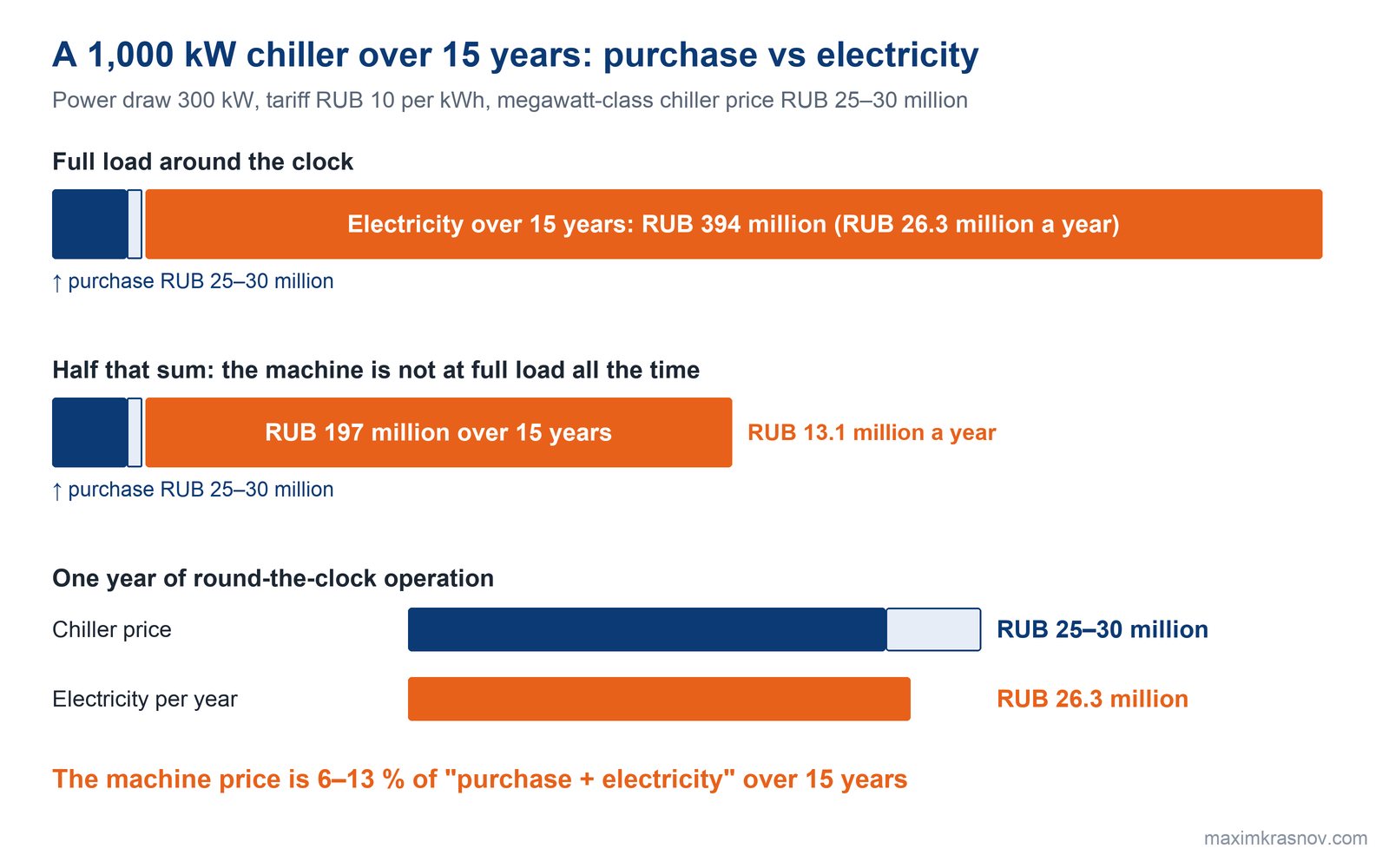
An industrial chiller costs 5–15 % of what you will spend on cooling over 15 years. The rest goes to electricity, make-up water, service and spare parts. A chiller producing 1,000 kW of cooling around the clock draws about 300 kW: RUB 26 million a year at RUB 10 per kWh and about RUB 394 million over 15 years.
Yet in Russia cooling is usually chosen on the price of the machine. That is understandable: the chiller is the largest line in the budget, so that is where people look. The US magazine FacilitiesNet estimates the initial equipment cost at 5–10 % of the life-cycle cost of a chiller plant; from our own calculations I would say up to 15 %, depending on the system.
Below is how to calculate the cost of ownership over 15 years, which budget lines get forgotten and why two machines of the same capacity can differ several times over in their electricity bills. Choosing the machine itself is covered in How to choose an industrial chiller: 13 mistakes; more is in the Chillers section.
What is chiller total cost of ownership?
Chiller total cost of ownership (TCO) is all the money the machine will take from purchase to decommissioning 10–15 years later. The price in the commercial offer is only the first line of that sum.
| Cost item | What it includes | What it depends on |
|---|---|---|
| Purchase and start-up | Machine, piping, installation, commissioning | System type, scope of supply, design |
| Electricity | Compressors, fans, pumps | Heat rejection system, part-load COP, tariff, free cooling |
| Grid connection | Fee per kilowatt of capacity | Peak demand of the plant |
| Water and chemicals | Cooling tower make-up, water treatment, chemicals | Whether the system has a wet cooling tower |
| Service and repairs | Maintenance, spare parts, compressor overhaul, glycol replacement | Components, spare parts stock, service team |
| Downtime | Lost production, facility shutdown | Redundancy, controls, protection devices |
Three lines almost never make it into this table. A compressor overhaul in year ten costs half the price of the machine. Glycol is replaced every 3–5 years. The grid connection fee is about RUB 47,000 per kilowatt, and in some regions up to RUB 100,000.
How much electricity does a chiller use in a year and in 15 years?
A chiller producing 1,000 kW of cooling and drawing 300 kW uses 300 × 8,760 = 2.63 million kWh in a year of round-the-clock operation. At RUB 10 per kWh that is RUB 26.3 million a year and RUB 394 million over 15 years.
A machine rarely runs at full load all year. If you take half of that sum, it is RUB 13.1 million a year and RUB 197 million over 15 years. In a webinar I gave the order of price of a megawatt-class chiller as RUB 25–30 million. So a machine at full load around the clock eats electricity worth close to its own price in a single year, and over 15 years its price makes up 6–13 % of "purchase plus electricity", depending on the load.
A household comparison: an A-class and an A+ class fridge differ by pennies on the bill. For an industrial chiller the same difference in class means millions of rubles a year.
How much does the heat rejection system change the 15-year bill?
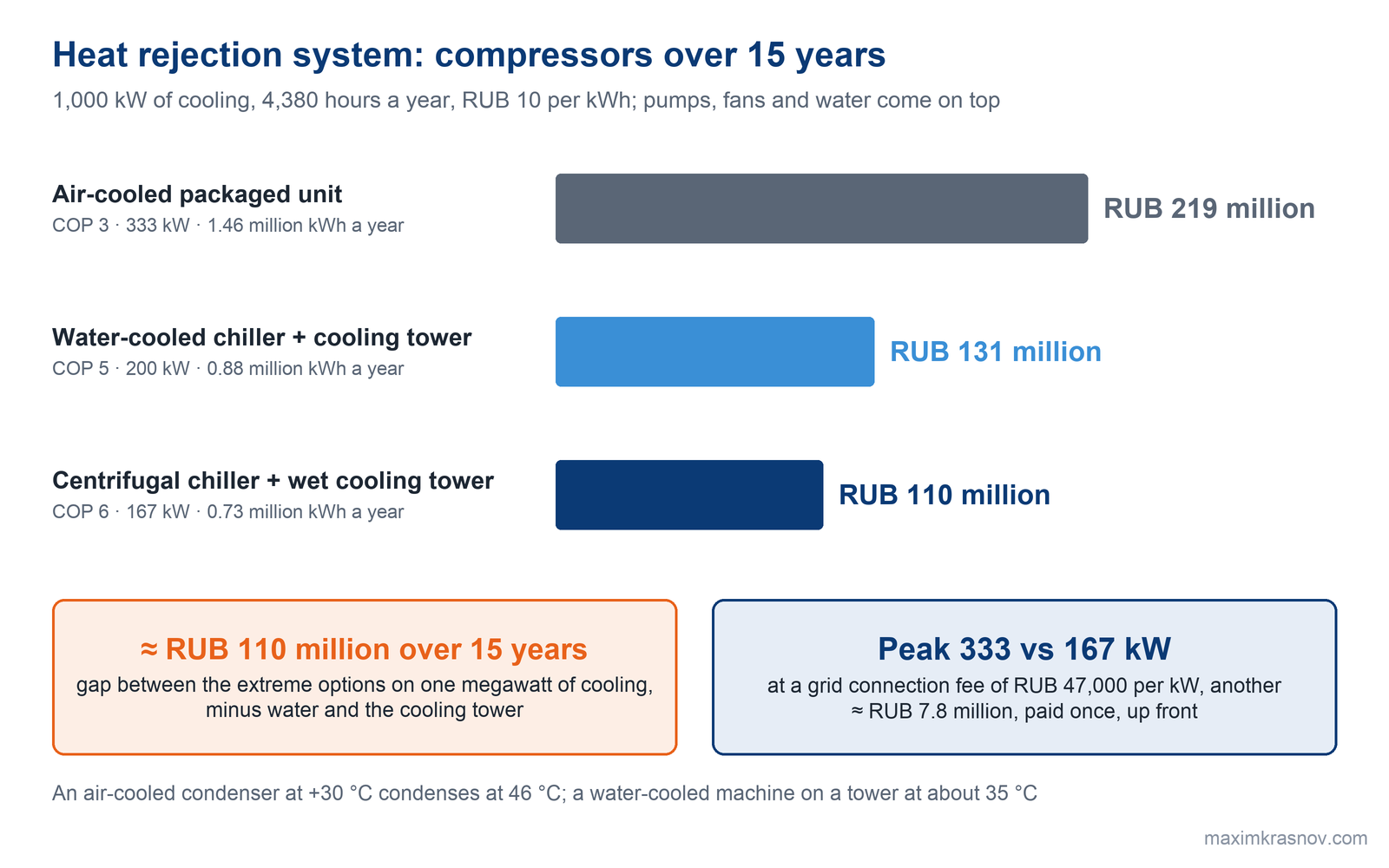
The heat rejection system changes the electricity bill more than the choice of brand. An air-cooled packaged unit with a coefficient of performance (COP: kilowatts of cooling per kilowatt of electricity) of about 3 uses 333 kW in its compressors per 1,000 kW of cooling, a water-cooled chiller with COP 5 uses 200 kW, and a centrifugal chiller on a cooling tower with COP 6 uses 167 kW.
Take 1,000 kW of cooling, operation equal to half a year at full load (4,380 hours) and a tariff of RUB 10 per kWh. The table covers compressors only: pumps and cooling tower fans, water and water treatment for the water-cooled options come on top.
| System | COP | Compressors, kW | Million kWh per year | RUB million per year | RUB million over 15 years |
|---|---|---|---|---|---|
| Air-cooled packaged unit | 3 | 333 | 1.46 | 14.6 | 219 |
| Water-cooled chiller + cooling tower | 5 | 200 | 0.88 | 8.8 | 131 |
| Centrifugal chiller + wet cooling tower | 6 | 167 | 0.73 | 7.3 | 110 |
The gap between the top and bottom rows is about RUB 110 million over 15 years per megawatt of cooling, minus the cost of water and the cooling tower. The second gap is peak demand: 333 against 167 kW. With a grid connection fee of RUB 47,000 per kilowatt, that is another RUB 7.8 million or so, paid once, up front.
The reason: an air-cooled condenser at +30 °C outdoors condenses at 46 °C, while a water-cooled machine on a cooling tower condenses at about 35 °C. According to manufacturers' data, each extra degree of condensing temperature adds 1.8–4.0 % to compressor power.
Why not compare chillers on nominal COP?
Nominal COP shows efficiency at full load, and a chiller runs at full load for only a handful of hours a year. The AHRI 550/590 standard rolls part-load performance into the IPLV figure: the machine spends 1 % of the time at 100 % load, 42 % at 75 %, 45 % at half load and 12 % at a quarter load.
An example from our design guide for engineers. Two 1,000 kW machines, 2,000 equivalent full-load hours a year. Machine A: COP 5.2, IPLV 5.6. Machine B: COP 5.0, IPLV 6.3. Machine B uses 39,683 kWh a year less, about RUB 0.4 million a year and RUB 6 million over 15 years, even though on nominal COP you would have picked machine A.
Ratings under different standards are not compared directly: the AHRI IPLV, the European ESEER and the Chinese GB-IPLV each use their own weights and temperatures. For a Russian site, the most honest approach is a calculation based on the temperature bin hours at your location.
What does chiller downtime cost?
An hour of chiller downtime costs as much as the facility loses without cooling, and in manufacturing that figure is often larger than the price of the machine. It has to be calculated before the selection; otherwise any saving on reliability looks attractive.
At an oil and fat plant in the Lipetsk region, where an imported chiller had been selected for too low an air temperature, the loop water was 10 degrees warmer than required, and in summer the plant cut its oil output. With output down 20–30 % for half a year, an additional chiller would have paid for itself in a month or two. When I worked at Trane, we did the cooling for MEGA shopping centers: a day of downtime at a weekend there was valued at about a million dollars, and the customer took the most expensive machine.
For facilities that cannot lose cooling, the answer is N+1 redundancy: if any one machine fails, the remaining ones cover the critical load. Redundant machines do not work without backup power and controls.
How does total cost of ownership change the choice of system for a data center?
In a data center the TCO difference between cooling systems runs to tens of millions of rubles a year. For a data center with 5,000 kW of cooling, packaged units with free cooling cost about RUB 150 million in capital expenditure and RUB 59.2 million a year to operate at RUB 10 per kWh. Over 15 years, operation adds up to RUB 888 million, and capital expenditure is about 14 % of the total.
The hardware in Russia and the US is similar; the difference is in how people calculate. Here the typical solution is packaged chillers with built-in free cooling, about 500 kW each, on the roof: one site in Moscow has fifty of them. In the US, instead of a scatter of machines, they build one large central chiller plant and first run dozens of options through a 15-year TCO calculation. Part of that work is already handed to AI: in 2016 Google and DeepMind put machine learning in control of data center cooling, and cooling energy fell by 40 %.
Once you calculate over 15 years, other systems come into view: several large water-cooled chillers with wet cooling towers, on-site gas generation with absorption chillers, direct-to-chip cooling without a chiller. Operating the last one costs RUB 18.9 million a year against 59.2 for packaged units, a difference of about RUB 600 million over 15 years. All five systems for one site are calculated in Data center cooling: five options for 5,000 kW.
Two more corrections for a data center. A data center runs at peak 5–7 days a year, so seasonal efficiency is what counts, not the rated point. And free cooling saves kilowatt-hours but does not reduce the summer peak that the grid connection fee is based on; how it works and when it pays off is in Chiller free cooling.
How do you calculate chiller total cost of ownership for your own site?
TCO is calculated in four steps, and for a first estimate three numbers are enough: load, operating hours and tariff.
1. Annual electricity: cooling in kW ÷ seasonal COP × operating hours. Separately, the pumps and the fans of the cooling tower or dry cooler.
2. Money over 15 years: annual kWh × tariff × 15, plus water and chemicals for wet systems.
3. Service: routine maintenance, compressor overhaul in year ten, glycol replacement every 3–5 years.
4. One-off lines: purchase, installation, design and grid connection based on the plant's peak demand.
Compare at least three systems, not three prices for one familiar system. Which one wins at your site depends on the load, the tariff and the water available; it cannot be guessed, only calculated.
Key takeaways
1. A chiller costs 5–15 % of what will be spent on cooling over 15 years; FacilitiesNet estimates the initial equipment cost at 5–10 % of the life-cycle cost of a chiller plant.
2. A 1,000 kW chiller drawing 300 kW around the clock uses 2.63 million kWh and RUB 26.3 million a year at RUB 10 per kWh.
3. For 1,000 kW of cooling and 4,380 operating hours, an air-cooled packaged unit with COP 3 spends RUB 219 million on compressors over 15 years, a centrifugal chiller on a cooling tower with COP 6 spends RUB 110 million.
4. Chillers are compared on part-load efficiency: according to AHRI 550/590 statistics, a machine spends 87 % of its time at 50–75 % load.
5. TCO includes grid connection, water, compressor overhaul, glycol and the cost of downtime, lines that are usually missing from the budget.
FAQ
Over what period should chiller TCO be calculated?
Over the full service life of the machine, usually 10–15 years. For comparing cooling systems with each other it makes sense to take 15–20 years: major decisions on cooling towers and central chiller plants outlive a single machine.
Which pays off better: an expensive efficient chiller or a cheap one?
It depends on operating hours and the tariff. A more expensive machine with better part-load COP wins in year-round process cooling and data centers. For air conditioning that runs only in summer, the electricity saving may not cover the price difference if the cheap machine is simpler and cheaper to service.
How much electricity does a 500 kW chiller use?
An air-cooled chiller producing 500 kW of cooling with COP 3 draws about 167 kW. Running around the clock, that is 1.46 million kWh and RUB 14.6 million a year at RUB 10 per kWh. The real figure is lower because the machine is not at full load all the time; it comes from operating hours and seasonal COP.
Is water part of the total cost of ownership?
Yes, if the system has a wet cooling tower. In a data center with 5,000 kW of cooling, centrifugal chillers with a wet cooling tower take about 10 m³/h of water, RUB 4.4 million a year. A water treatment unit costs around RUB 400,000, chemicals around RUB 70,000 a year.
Sources
-
Thomas Bakane, FacilitiesNet: "Chillers: Examine Life-Cycle Costs": initial equipment cost about 5–10 % of chiller plant life-cycle cost.
-
Google DeepMind, 2016: "DeepMind AI reduces Google data centre cooling bill by 40%".
-
ANSI/AHRI Standard 550/590 "Performance Rating of Water-Chilling and Heat Pump Water-Heating Packages Using the Vapor Compression Cycle": the IPLV metric.
-
NCT chiller catalogues 2026.
-
Cold Energy experience and calculations: webinars "13 critical mistakes in choosing a chiller" (February 2026) and on data center cooling (6 August 2026), tariff RUB 10 per kWh.
Need a cooling solution for your site? Get a consultation