
How to Choose an Industrial Chiller: 13 Costly Mistakes

founder and CEO of Cold Energy (NCT)
The most expensive mistakes in choosing an industrial chiller are made before the purchase: the capacity is miscalculated, the air temperature is taken from a table, the cooling type is chosen out of habit and the machines are compared on price. The stakes are high. A chiller producing 1,000 kW of cooling around the clock draws about 300 kW, which is 2.6 million kWh and RUB 26 million a year at RUB 10 per kWh.
I went through these 13 mistakes in the webinar "13 critical mistakes in choosing a chiller" in February 2026. All of them come from the practice of Cold Energy: since 2012 we have been manufacturing chillers, cooling towers, pump stations and controls. The article is written for the chief engineer, the design engineer and the buyer; more material is in the Chillers section.
How do you size a chiller correctly?
Chiller capacity is calculated from the peak and minimum load of each consumer, the water temperature regime and the site climate, not from the sum of nameplate ratings. An undersized machine runs non-stop and never reaches the set temperature. An oversized one falls into short start-stop cycles: many machines are limited to two starts per hour, and anything more frequent trips the machine on an alarm.
A reasonable margin is 10–15 %, and it is added once. If the process engineer adds 15 %, the design engineer another 10 % and the model is then rounded up, the machine ends up a third larger than needed. Summing nameplate ratings without a diversity factor (usually 60–80 %) is a common reason for a machine twice the required size.
A margin for production growth is a different matter. A machine with 20 % more capacity usually costs not 20 % but 5–7 % more. Some of our customers order a design for three machines and buy one: the pipes and valves are already on the drawing, and the second machine goes in without rebuilding the piping.
What outdoor temperature should a chiller be selected for?
A chiller with an air-cooled condenser is selected for the temperature the machine actually sees in hot weather, not for an average summer design value. An air-cooled condenser runs 10–15 degrees hotter than the air, and every extra degree of heat takes cooling capacity away from the machine.
At an oil and fat plant in the Lipetsk region, an imported chiller has been in place since 2014 and has never worked properly. The design engineer selected it for about 24 °C under SNiP (the former Russian building code), but at the site 24 °C is reached as early as the beginning of May, and in peak heat it gets up to 38 °C.
For Moscow, the warm-season "parameter B" in SP 131.13330 (Russian building climatology code) is 26 °C, the 0.4 % dry-bulb temperature per ASHRAE is 29.9 °C, and the absolute maximum is 38 °C. For a process that cannot stop, the design temperature is set by the process engineer, and it is often the absolute maximum. A chiller placed in a pit or in a corner between walls draws in its own hot air, so the enclosure must not be higher than the machine.
Which cooling type to choose: air-cooled, water-cooled or absorption?
The cooling type is chosen by three site conditions: whether water is available, where the machine will stand and whether cheap heat is available. A rooftop packaged unit is the familiar choice, but often not the most economical one.
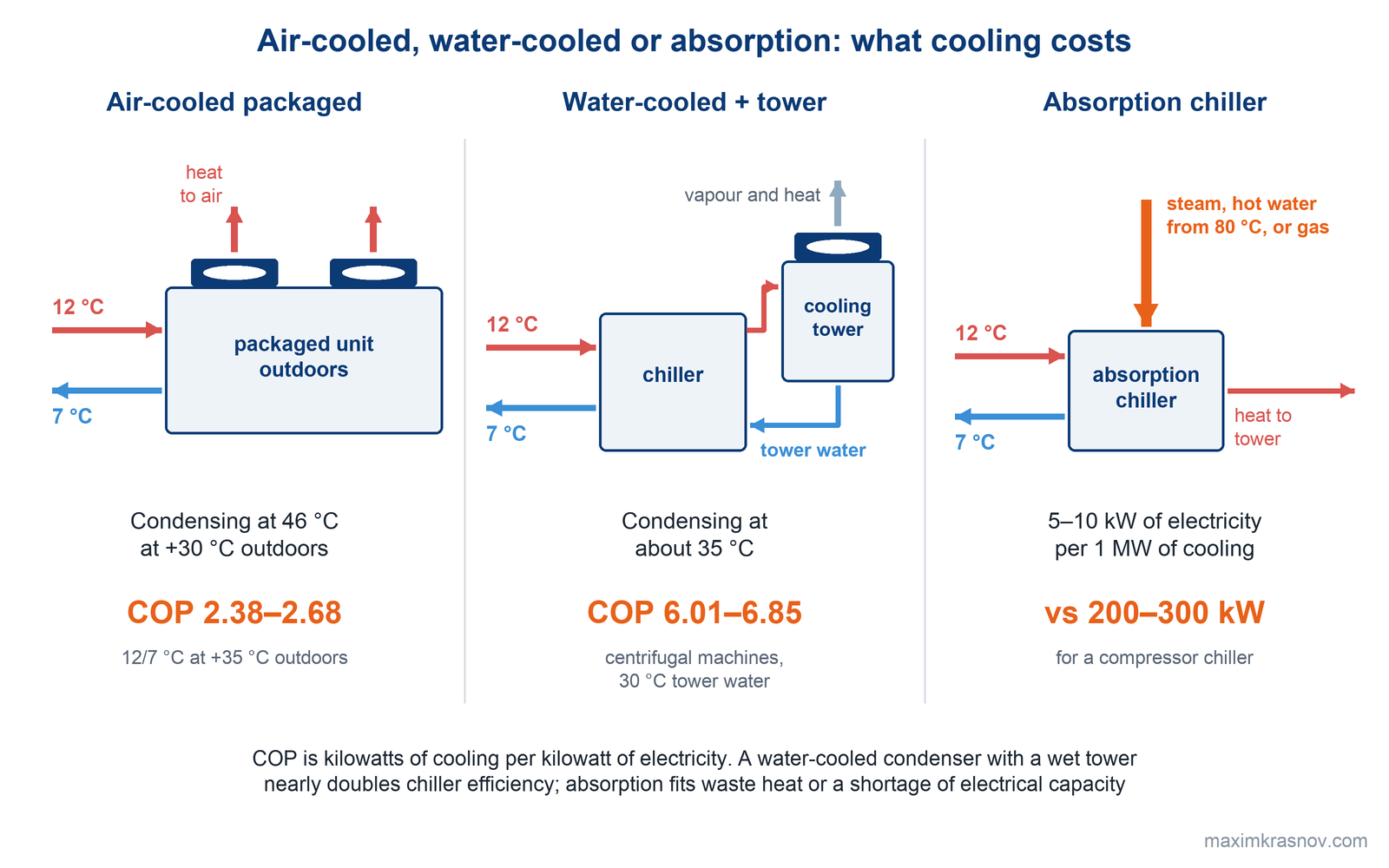
An air-cooled packaged chiller stands outdoors where air flows freely around it and needs no water. The price is efficiency: at +30 °C outdoors it condenses at 46 °C. It is not installed in a workshop without ventilation, because it will blow hot air into itself.
An indoor chiller works with an outdoor unit: a cooling tower, a dry cooler (closed-loop air cooler for liquid) or a remote condenser. A pump station and controls are added, but the solution is more reliable and more economical.
A water-cooled condenser with a wet cooling tower condenses at about 35 °C and nearly doubles chiller efficiency. According to NCT catalogues, the coefficient of performance (COP, kilowatts of cooling per kilowatt of electricity) of air-cooled packaged units at 12/7 °C and +35 °C outdoors is 2.38–2.68, while centrifugal machines on 30 °C cooling tower water reach 6.01–6.85. SIBUR asked us to convert an air-cooled machine to wet cooling: we did not get a twofold gain, but the savings were substantial.
An absorption chiller makes cooling from steam, hot water or gas and uses 5–10 kW of electricity per megawatt of cooling, against 200–300 kW for a compressor chiller. It pays off with waste heat from 80 °C or when electrical capacity is short; details are in the article Absorption chillers for data centers. With a load below 300 kW or fewer than 2,000 operating hours a year, the compressor chiller stays.
Why not save on components, controls and protection devices?
Saving on chiller components, controls and protection devices saves pennies at purchase and causes failures in operation. Every machine needs oil, filters and spare parts, so the compressors and heat exchangers must have an official representative with a warehouse in Russia. Once a customer insisted on a cheap imported machine: it arrived at our warehouse, it could not be started, and the supplier asked our service engineers to repair it. We have our own service team; the customer might not have had one.
In my experience, the controls of a chiller plant matter even more than precise component selection. Cheap machines arrive with only the sensors the compressor cannot start without, and the operations team learns about a problem when the machine has already stopped.
A flow switch is a sensor that lets the machine run only while water flows through the evaporator; it costs around RUB 20,000–30,000. Without it, when the pump stops, the machine keeps chilling standing water, the water freezes, the evaporator bursts and water gets into the refrigerant circuit. The switch is hard-wired into the machine's safety circuit, not routed through the plant controller.
Anti-vibration mounts and vibration dampers. Without them, vibration eventually breaks a copper tube. Even at the Western manufacturers where I used to work, flow switches and vibration isolators were separate line items, so look for them as separate lines in the specification.
Why order a design before buying a chiller?
A design is needed so that the machine can be installed, connected and brought to its design operating point. One customer selected a pump himself, ignored the pressure drop, saved RUB 300,000 on design and lost RUB 3 million, not counting downtime.
At one site we supplied two machines. The small one runs perfectly; the large one took a long time to sort out. The small one had a design, while the large one was connected without one, with the oil-return traps of the refrigerant line done "as it turned out". Without a design, logistics problems also surface: an opening sized to the catalogue dimensions turns out to be smaller than the machine on delivery day.
What does a chiller need to run in winter?
A chiller that has to produce cooling in frost or in the shoulder season is ordered in a low-ambient (winter) version. A standard machine trips in the cold: refrigerant accumulates in the cold condenser and the condensing pressure drops.
A large confectionery factory asked for a cheaper option and wrote into the contract that cooling was needed only in summer. In April, at +5 °C, the machine started tripping. The winter kit had been offered, but the customer chose the price.
According to the NCT catalogue, the base range of air-cooled packaged units is +10 to +35 °C outdoors, and with the full winter kit down to −30 °C. Outdoor water is protected with glycol, by draining for the winter or with electric heat tracing; with a coolant temperature below +6 °C, NCT machines run on glycol only.
Why is choosing a chiller on price the most expensive mistake?
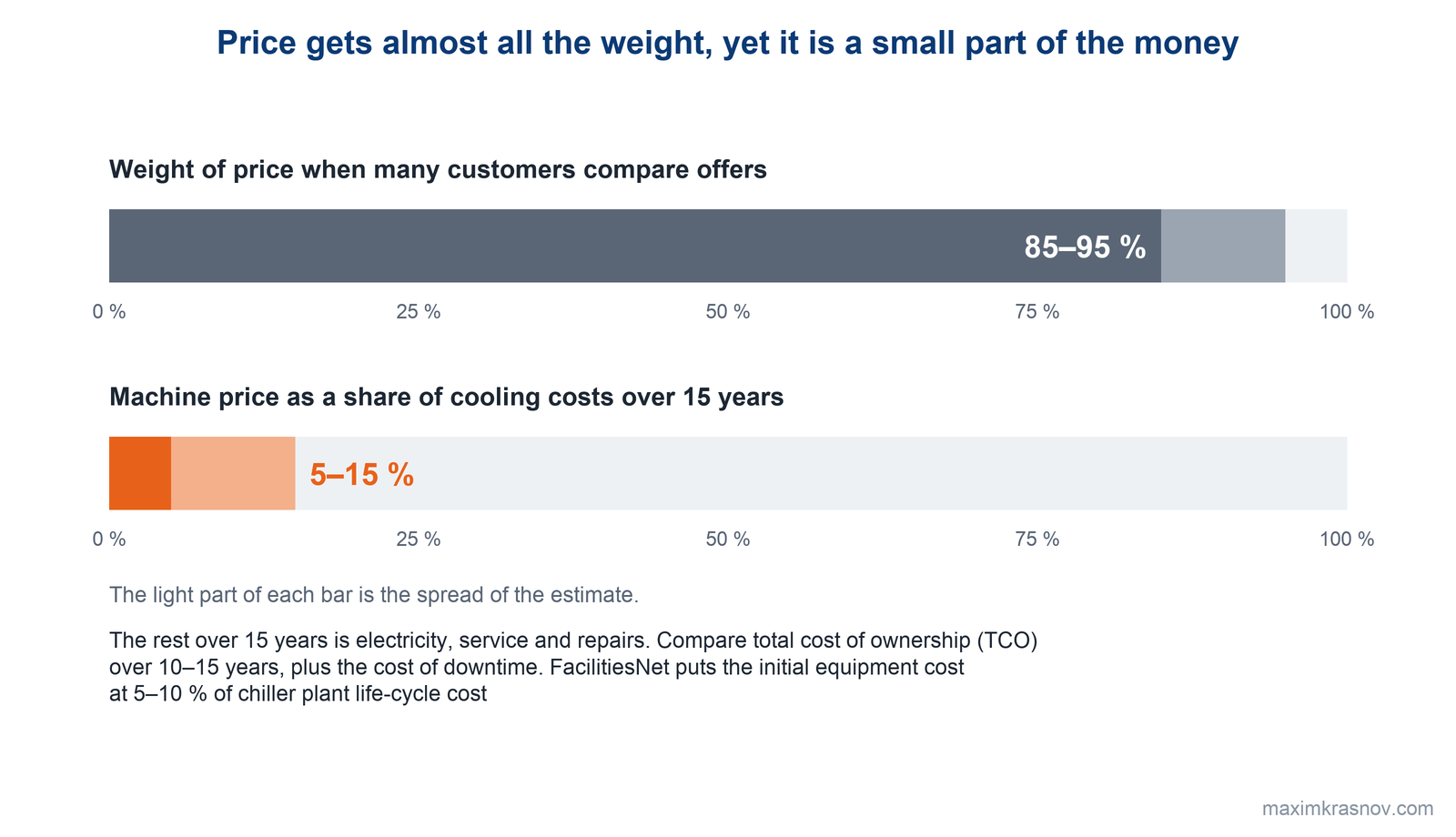
The purchase price is a small part of the money a chiller will take over its service life: the machine costs 5–15 % of what you will spend on cooling over 15 years. FacilitiesNet estimates the initial equipment cost at 5–10 % of the life-cycle cost of a chiller plant.
Many customers give price a weight of 85–95 %, so experience, service, spare parts and commissioning hardly count in the comparison. The right comparison is total cost of ownership (TCO): purchase, electricity, service and repairs over 10–15 years. How to calculate it is in the article Chiller total cost of ownership.
The cost of downtime is added to it. At the same oil and fat plant in the Lipetsk region, the loop water was 10 degrees warmer than required, and in summer the plant cut its oil output; with output down 20–30 % for half a year, an additional machine would have paid for itself in a month or two.
When does a chiller need free cooling?
Free cooling (cooling with outdoor air without running the compressor) is needed where there is load in winter too: data centers, process cooling, server rooms. A dry cooler handling 1,000 kW of cooling uses about 30 kW for its fans, against 300 kW for the compressors.
It should not be installed "just in case": the heat exchanger, valves, glycol and controls cost money. We aim for a payback of 2–3 years, and I have seen free cooling with a 20-year payback. How to calculate it is in the article Chiller free cooling; figures for a data center are in Data center cooling: five options.
13 chiller selection mistakes: summary table
| No. | Mistake | What to check in the specification and the offer |
|---|---|---|
| 1 | Wrong capacity | Peak, minimum, temperature regime; 10–15 % margin, once |
| 2 | Air temperature from a table | Design temperature and installation location |
| 3 | Cooling type chosen out of habit | Water, space, heat available on site |
| 4 | Energy efficiency not calculated | COP at the operating point, annual kWh |
| 5 | Cheap components | Component brands, spare parts stock in Russia |
| 6 | Purchase without a design | Piping design, delivery route into the building |
| 7 | No margin for growth | Space and valves for the next machines |
| 8 | Saving on controls | Variable-speed control, remote monitoring |
| 9 | No flow switch or anti-vibration mounts | Separate lines in the specification |
| 10 | No winter kit | Outdoor temperature range, glycol |
| 11 | Choice on price alone | Scored comparison against one checklist |
| 12 | TCO and downtime not calculated | 10–15-year calculation, cost of one hour of downtime |
| 13 | Free cooling without a calculation | Hours by climate, balance in kWh |
Key takeaways
1. A 1,000 kW chiller running around the clock consumes about 2.6 million kWh a year, RUB 26 million at RUB 10 per kWh, so a selection mistake costs more than a pricing mistake.
2. The 10–15 % margin is added once; a margin for growth is cheaper than it looks: a machine with 20 % more capacity costs 5–7 % more.
3. A water-cooled condenser with a wet cooling tower condenses at about 35 °C, against 46 °C for an air-cooled packaged unit.
4. Flow switches, anti-vibration mounts, controls and the winter kit cost little and protect against failures that cost tens of times more.
FAQ
How much capacity margin should a chiller have?
10–15 % for heat exchanger fouling, hot weather and pipe losses, added once and in one place. If the load is going to grow, space for another machine is designed in, rather than buying a machine twice the size.
Which is better: an air-cooled or a water-cooled chiller?
An air-cooled packaged unit is simpler and needs no water, but in summer it condenses 10–15 degrees above the air temperature. A water-cooled unit with a cooling tower is more economical, but it needs a plant room and water treatment. If both options pass on water, space and winter operation, they are compared on operating cost in rubles over 15–20 years.
Can a packaged chiller be installed indoors?
No. Without powerful ventilation a packaged unit will recirculate its own hot air and shut down. For indoor installation, choose a machine with a remote or water-cooled condenser.
What is in a chiller winter kit?
On NCT air-cooled chillers: a fan speed controller, condensing pressure and receiver pressure regulators, a receiver and control panel heating; with it, a packaged unit runs down to −30 °C. Freeze protection of the water is handled separately.
Sources
-
SP 131.13330 "Building Climatology" (Russian building code).
-
ASHRAE Climatic Design Conditions, 2021 edition.
-
Thomas Bakane, FacilitiesNet: "Chillers: Examine Life-Cycle Costs".
-
NCT chiller catalogues 2026: operating ranges, EER and COP by series.
-
Cold Energy experience and calculations; webinar "13 critical mistakes in choosing a chiller", February 2026.
Need a cooling solution for your site? Get a consultation