
Ethylene vs Propylene Glycol for Plant Cooling: Which to Choose

founder and CEO of Cold Energy (NCT)
Ethylene glycol is the choice for an industrial loop; propylene glycol is for places where the fluid may touch the product or the piping runs through occupied buildings. A 40% ethylene glycol solution leaves a chiller 94% of its water-rated capacity, propylene glycol 90%. Freeze protection costs electricity: on a 458 kW loop, 40% propylene glycol raises the pump's hydraulic power from 4.3 to 8.2 kW.
This article is for plant directors and chief engineers whose chiller, dry cooler or closed-circuit cooling tower runs outdoors in winter. The heat transfer fluid is chosen once, at the design stage, but the plant pays for that choice every operating hour: in chiller capacity, in pump electricity, and in heat exchanger repairs if nobody keeps an eye on the solution.
When does a cooling system need glycol at all?
Glycol is needed wherever the loop can freeze: a dry cooler and its piping outdoors, the internal loop of a closed-circuit cooling tower in winter, or chiller evaporator leaving water below 5 °C. Everywhere else, water is better: it is cheaper, transfers heat better and is easier to pump.
An aqueous glycol solution is water mixed with ethylene or propylene glycol plus a corrosion inhibitor package. It protects against frost but needs attention in operation: top-ups dilute it, and the glycol itself oxidizes over time and consumes its own inhibitors.
In a closed-circuit cooling tower, plain water in freezing weather is a direct risk of bursting the heat exchanger, and a frozen fluid in the heat exchanger is not a warranty case with us. That is why we ask for the "water or glycol" decision and the concentration to be written into the design, not left to the operations team.
Ethylene or propylene glycol: which is better for an industrial loop?
For an industrial loop, ethylene glycol is better if the process and sanitary requirements allow it: it takes less capacity away from the machine. Propylene glycol has low toxicity, so it is used in food and pharmaceutical production and in occupied buildings.
| Ethylene glycol (EG) | Propylene glycol (PG) | |
|---|---|---|
| Toxicity | toxic | low toxicity |
| Where it fits | industrial loop, piping does not run through residential buildings or food zones | food and pharmaceutical production, occupied buildings |
| Chiller capacity at 40% solution, relative to water | 0.94 | 0.90 |
| Pressure drop at 40% solution, relative to water | 1.51 | 1.53 |
| Freezing point, 20% by mass | −9 °C | −7 °C |
| Freezing point, 30% by mass | −16 °C | −13 °C |
| Freezing point, 40% by mass | about −23 °C | about −22 °C |
Correction factors are chiller manufacturers' data for an evaporator at 7 °C leaving temperature; on the warmer condenser loop they are smaller. Freezing points are manufacturers' data; working values come from the data sheet of the specific solution.
A 4% capacity gap at 40% solution looks small, but on a 1,000 kW machine it is 40 kW of cooling that has to be bought as extra installed capacity. If the process cannot tolerate glycol at all, glycol stays only in the outdoor loop behind an intermediate heat exchanger. The process then sees water, while the system loses 2–4 K of temperature approach, and the dry cooler is sized for that difference.
How much cooling and power does glycol cost?
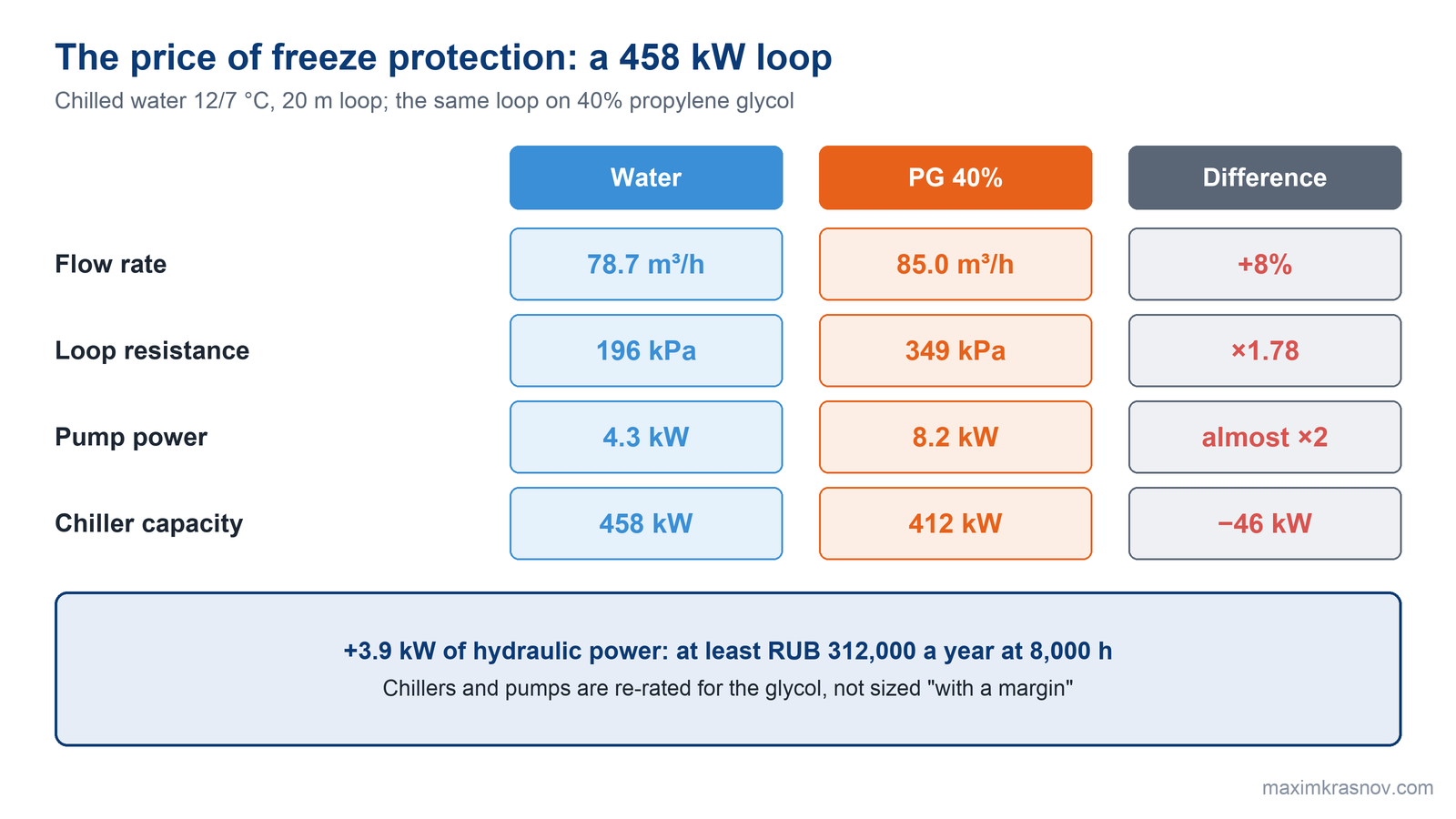
40% glycol takes 6–10% of a chiller's cooling capacity and nearly doubles the pump's hydraulic power. An example from our design engineers' guide: a 458 kW chilled water loop, water at 12/7 °C, a loop with 20 m of head loss, converted to 40% propylene glycol.
| Item | Water | 40% propylene glycol |
|---|---|---|
| Loop flow rate | 78.7 m³/h | 85.0 m³/h, +8% |
| Loop resistance | 196 kPa | 349 kPa, 1.78 times higher |
| Pump hydraulic power | 4.3 kW | 8.2 kW |
| Cooling from the same machines | 458 kW | 412 kW |
Resistance rises for two reasons at once: the solution is more viscous than water, and more of it has to be pumped because it carries heat less well. Hence the factor 1.53 × 1.08² = 1.78.
The extra hydraulic power is 3.9 kW. At 8,000 operating hours a year and RUB 10 per kWh, that is about 31,000 kWh and RUB 312,000 a year, and with pump and motor efficiency included the bill is higher. That is why chillers and pumps are re-rated for the solution rather than picked "with a margin". How to calculate the load and the machine's margin is covered in chiller capacity: how to calculate it.
What glycol concentration should I use?
Concentration is chosen for the lowest temperature the loop will ever see: the site's winter design temperature under SP 131.13330 (Russian building climatology code) plus a 3–5 K margin. Use the minimum sufficient concentration, not "fifty percent just in case": 50% instead of 40% adds almost another fifth to the pump head, a pressure drop factor of 1.81 versus 1.53 relative to water.
An example for Moscow. A dry cooler in free cooling mode (cooling with outdoor air) runs all winter. The coldest five-day period at 0.92 probability under SP 131.13330 is −26 °C, so the solution must stay liquid down to −29 to −31 °C. 40% ethylene glycol by mass freezes at about −23 °C, which is not enough. A stronger solution is needed, and the dry cooler and pumps are re-rated for that fluid.
The second question is what you are protecting against. If the loop runs in frost, the solution must stay liquid. If the loop is guaranteed to stand idle in frost, burst protection is enough: the solution turns into a flowing slush that usually does not split pipes, but it cannot be pumped. The design states what the chosen concentration protects against and gives it with its unit, by mass or by volume.
Why is a weak glycol solution more dangerous than it looks?
A weak solution is dangerous because of corrosion, not only frost: below 25–30% by volume there may not be enough inhibitor to protect the metal, and below 20–25% bacteria grow in the solution. The worst case is "a little glycol for peace of mind", 10–15%.
In service we often see loops where nobody tracked the concentration and the solution started eating the metal: at low concentration corrosion accelerates sharply. After investigating such cases, we do not allow solutions weaker than 20% because of corrosion of cast parts.
Even a correct solution ages. Glycol oxidizes into acids, pH drops, inhibitors are used up, and without monitoring the solution turns acidic within 3–5 years and attacks the metal.
Why does glycol concentration drop after filling and top-ups?
Concentration drops for two reasons: water remains in the loop after flushing, and later the loop is topped up with water instead of solution. Both losses go unnoticed until the frost arrives.
1. Leftover flushing water. In an industrial system about 10% of the volume stays as water after flushing, sometimes up to 20%. A 60 m³ loop is flushed, drained and filled with 40% solution, with 6 m³ of water left behind. The actual concentration is 40 × 54 / 60 = 36%. The temperature margin built into the design is gone on day one.
2. Topping up with water. The same loop on 40% propylene glycol, freezing at about −21 °C. Over the winter 3 m³ of solution is lost and the operator adds 3 m³ of water: concentration 38.0%, freezing at about −19.5 °C. After the third such top-up: 34.3% and about −16 °C. Without measurements nobody notices.
If concentration has dropped, part of the solution is replaced with concentrate: A = V × (D − P) / (100 − P), where V is the loop volume, P the actual concentration and D the required one. For a 60 m³ loop going from 34.3% to 40%, drain 5.2 m³ of solution, add 5.2 m³ of concentrate, circulate for 24 hours and take a check measurement.
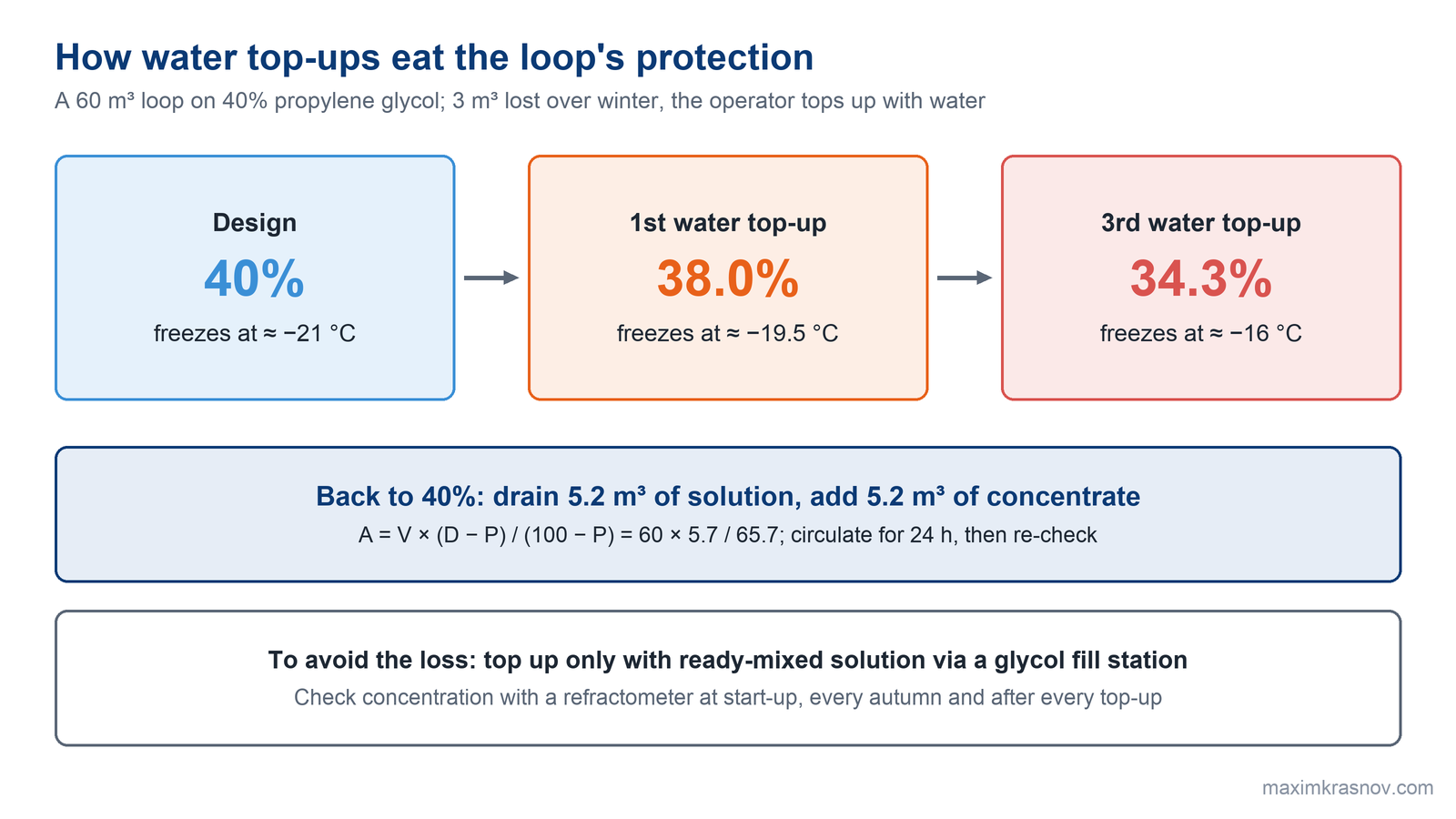
The protection against this loss is a glycol fill station: a tank with a pump and a pressure switch. When loop pressure drops, the pump feeds ready-mixed solution of the same concentration; when it recovers, the pump stops. We build NCT-SGL fill stations with 250–1,000 L tanks and 1.1–1.5 kW pumps. If top-ups become frequent, the loop has a leak: find it rather than keep topping up.
What should a glycol loop be filled with, and what must stay out of it?
Fill only with an inhibited industrial heat transfer fluid that has a data sheet, preferably a factory-premixed solution. Automotive antifreeze is not suitable: its additives are designed for other metals and duty conditions. Solutions of different brands are not mixed.
If concentrate is diluted on site, use only good-quality water: chlorides and sulfates no more than 25 mg/L each, total hardness no more than 100 mg/L as CaCO₃, preferably demineralized water. Tap water with hardness salts consumes the inhibitors and leaves deposits.
Glycol is incompatible with galvanized steel: zinc reacts with the inhibitors, a precipitate forms and protection is depleted, especially above 38 °C. A glycol tank should be polyethylene or stainless steel, not a sectional galvanized tank. The coil of an NCT closed-circuit cooling tower is galvanized on the outside, so the fluid brand for it is agreed with the factory before filling.
Never connect the water mains to a glycol loop. Make-up water is exactly the top-up that strips the protection over a season.
How do you monitor glycol in operation?
Measure concentration at start-up, every autumn and after every top-up, and pH at least once a year. The whole monitoring routine fits into five lines of the maintenance schedule.
| What | With | Target | When |
|---|---|---|---|
| Concentration | refractometer with the scale for your glycol | freezing point with the design margin | start-up, every autumn, after a top-up |
| Solution pH | pH meter | 8–10 | at least once a year |
| Inhibitors and composition | laboratory | per the fluid supplier's report | once a year |
| Iron | laboratory | a rise signals corrosion | quarterly |
| Top-ups | fill station meter | close to zero | monthly |
A refractometer with an ethylene glycol scale reads wrong on propylene glycol: the scales differ. Samples are taken from the running loop, not from a dead leg, so the design needs a sampling valve at an accessible height. Glycol is not drained into the sewer: drained solution of unknown condition goes for disposal, and the loop is filled with fresh fluid.
Where do glycol mistakes happen in equipment selection?
The typical mistake: glycol is missing from the specification, and the equipment is selected for water. Fluid type, concentration and temperature must appear in three places: on the schematic, in the machine data sheet and in the pump skid data sheet.
Two cases from our practice. A customer needed a megawatt, but the cooling tower selection showed 730–830 kW: the sales engineer had calculated on water while the loop ran on glycol, and the selection had to be redone for 1 MW. In another project the pump skid was selected wrongly because the fluid type was not stated. Both times the error was not in the machine but in a line of the specification.
Pump head in the data sheet is written in kPa or with the fluid stated. The 349 kPa in the example above is 34.4 m of solution column and 35.6 m of water column: without a unit it is easy to be off by more than a meter. Our engineers size chillers, dry coolers and pump skids for the specific technical specification, on the fluid that will actually be in the loop.
A dry cooler suits glycol also because the solution never contacts outdoor air and stays clean; more in what is a dry cooler and how it works. How glycol works together with free cooling is covered in chiller free cooling; everything else on the subject is in the chillers section.
Key takeaways
1. Ethylene glycol is for industrial loops: at 40% it leaves a chiller 94% of its capacity versus 90% for propylene glycol. Propylene glycol is for food and pharmaceutical production and occupied buildings.
2. On a 458 kW loop, 40% propylene glycol raises pump hydraulic power from 4.3 to 8.2 kW and takes 46 kW of cooling; at 8,000 hours that is at least RUB 312,000 a year on the pump alone.
3. Concentration is chosen per SP 131.13330 with a 3–5 K margin and not below 25–30% by volume; we do not allow solutions weaker than 20% because they cause corrosion.
4. Leftover flushing water drops 40% to 36% on day one, and three water top-ups over a winter take it to 34.3%. Top up only with ready-mixed solution and measure concentration every autumn.
5. Glycol is incompatible with galvanized tanks and pipes, and automotive antifreeze does not go into an industrial loop.
FAQ
Our closed-circuit cooling tower runs on water. Is there a risk of freezing the heat exchanger in winter?
Yes. Staying on water is possible only if you simultaneously hold a constant minimum flow, a minimum load and at least 10 °C at the coil outlet. Draining is an emergency measure: automatic drain and air valves, not a manual valve opened in autumn. Basin heaters keep 4 °C at −18 °C outdoors, but they do not heat the coil.
We need 2 °C water for washing salad greens, and no glycol may get into it. What scheme works?
At 4 m³/h cooled from 15 to 2 °C, that is about 60.5 kW. The usual design is a machine supplying secondary coolant at −3 to −5 °C, a plate heat exchanger as the separation barrier, and an ice-water tank for peak draw. If the washing line runs in shifts, the second option is ice thermal storage. Before selection, check whether the water recirculates or goes straight to drain.
Sources
-
SP 131.13330.2025 (Russian building climatology code).
-
ASHRAE Handbook — Fundamentals, chapter on secondary coolants (properties of aqueous glycol solutions).
-
Cold Energy (NCT) experience and calculations: engineering guides "NCT pump stations, tanks, water treatment and glycol" and "NCT dry coolers and condensers" (October 2026), service case reviews and equipment selections.
Need a cooling solution for your site? Get a consultation