
Chiller Repair or Replacement: How to Calculate Which Pays Off

founder and CEO of Cold Energy (NCT)
Repairing a chiller beats replacing it as long as the repair cost, the extra electricity of the old unit and the downtime losses over the remaining life add up to less than the price of a new one. A compressor overhaul in year 10 costs about half the price of the unit. And a 1,000 kW air-cooled chiller running 4,380 hours a year spends RUB 7.3 million a year more on its compressors than a centrifugal chiller on a cooling tower.
In Russia, cooling is most often chosen by the price of the machine: it is the biggest line in the estimate, so that is where people look. Repairs work the same way. You see the amount on the invoice, while electricity and downtime sit in other lines of the budget. A client can spend months choosing while we send them five-year operating cost calculations. Then summer arrives, the line stops without cooling, and the losses are counted in millions of rubles.
Below is how to compare the two options in rubles over the same period, and where the calculation most often goes wrong. If your unit is imported and the manufacturer has left Russia, read Imported chiller after the brand exit first; the rest is in the Chillers section.
What goes into a chiller repair vs replacement comparison?
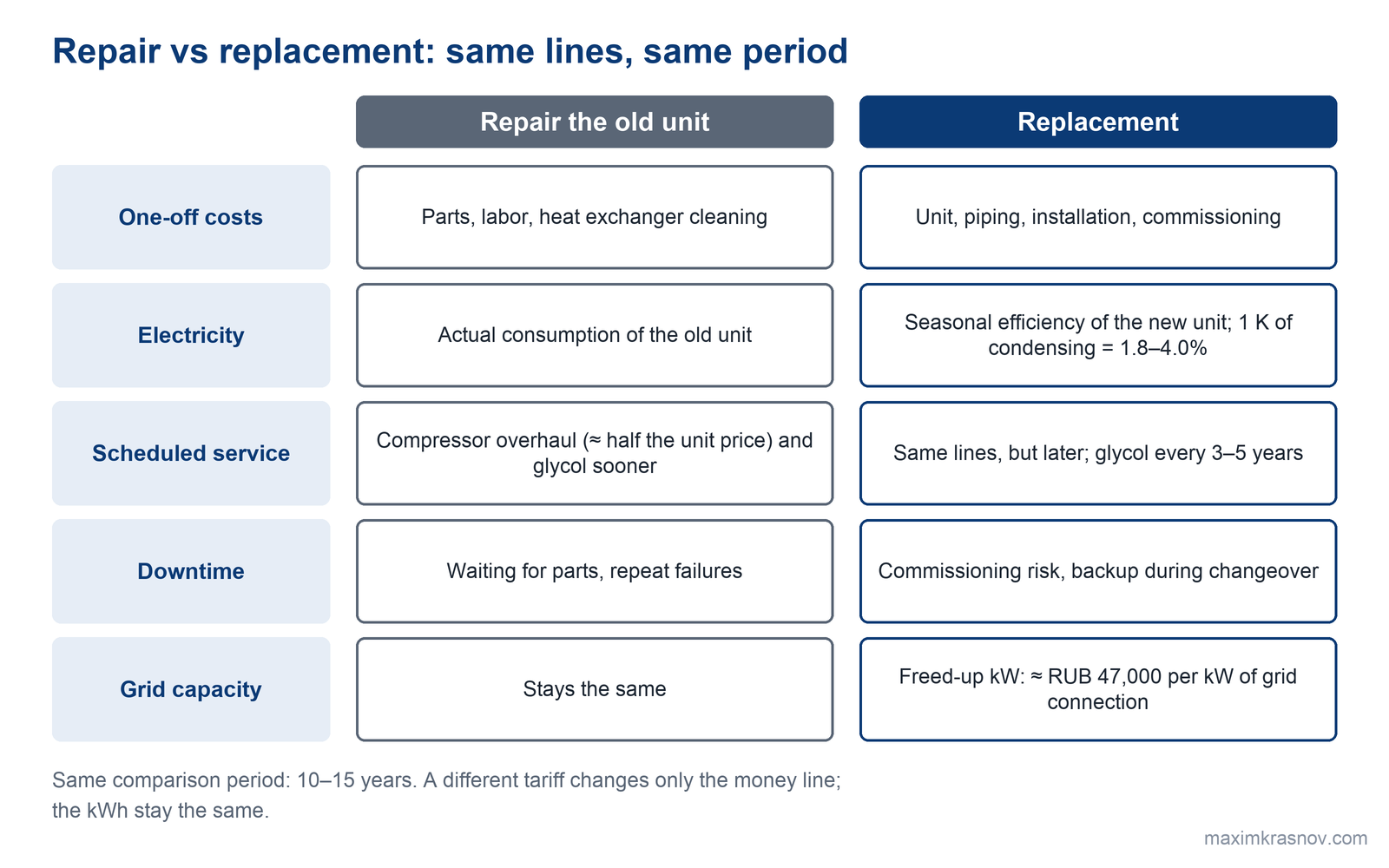
Repair and replacement are compared on the same set of lines and over the same period, usually 10–15 years. The price of a new unit is only the first line: by our calculations it is 5–15% of the money that will go into cooling over 15 years.
| Line | Repair the old unit | Replacement |
|---|---|---|
| One-off costs | Parts, labor, heat exchanger cleaning | Unit, piping, installation, commissioning |
| Electricity | Actual consumption of the old unit | Seasonal efficiency of the new unit |
| Scheduled service | Compressor overhaul and glycol change come sooner | The same lines, but later |
| Downtime | Waiting for parts, repeat failures | Commissioning risk, backup during the changeover |
| Grid capacity | Stays the same | If the new unit draws less, kilowatts are freed up |
The last line is often forgotten. The grid connection fee is about RUB 47,000 per kilowatt, and if the new unit takes 166 kW off the intake, that is about RUB 7.8 million of capacity you can give to production.
How much does a chiller overhaul cost?
A compressor overhaul in year 10 costs about half the price of the unit. The ballpark price of a megawatt-class chiller I gave in my webinar on chiller selection is RUB 25–30 million, so a compressor overhaul on such a unit is about RUB 12.5–15 million. Only a teardown inspection of the specific unit gives the exact figure.
The second scheduled line is glycol: it is replaced every 3–5 years. Both lines go into the total cost of ownership from day one, so an overhaul in itself is not a reason to replace the unit. It is an expected stage.
Heat exchanger cleaning is also a repair, and it restores capacity. If the plant room has no clearance for pulling the tubes, they can only be cleaned chemically, and the deposits eat capacity. One millimeter of scale on a heat exchanger means 30% less capacity.
How much electricity does an old chiller use?
A chiller with 1,000 kW of cooling capacity and a 300 kW power draw, running around the clock for a year, uses 2.63 million kWh, or RUB 26.3 million at RUB 10 per kWh. At full load the unit burns through electricity worth close to its own price in a year, so the efficiency gap quickly outgrows the price gap.
How much your unit actually uses is shown by the meter on its feed, not by the nameplate. An old unit loses efficiency for well-known reasons: deposits in the heat exchangers, weak glycol, rising condensing temperature. According to manufacturers, each extra degree of condensing temperature adds 1.8–4.0% to compressor consumption.
The main lever is the heat rejection scheme. At +30 °C outdoors, an air-cooled packaged unit condenses at 46 °C, and a water-cooled unit on a cooling tower at about 35 °C. For 1,000 kW of cooling, the compressors of an air-cooled unit with a coefficient of performance (COP: kilowatts of cooling per kilowatt of electricity) of 3 draw 333 kW, a water-cooled unit with COP 5 draws 200 kW, and a centrifugal unit on a cooling tower with COP 6 draws 167 kW.
How do you put a price on chiller downtime?
The cost of downtime is what the site loses without cooling for the whole time the old unit is under repair or waiting for a part. It has to be calculated before the decision; otherwise any saving on reliability looks like a good deal.
At an edible oil plant in the Lipetsk region, the loop water was 10 degrees warmer than required, and in summer the plant cut its oil output. With output down 20–30% for half a year, an additional chiller would have paid for itself in one to two months. When I worked at Trane, we did the cooling for MEGA shopping malls: a day of downtime on a weekend was valued there at about a million dollars, and the client bought the most expensive unit.
At a large plant, a single day of downtime costs more than the entire chiller plant. If production stops without cooling and there is no backup, the cost of the days spent waiting for a part goes into the repair calculation. N+1 redundancy removes this risk only together with backup power: redundant units without redundant power do not work.
Example: repair or replace a megawatt-class chiller
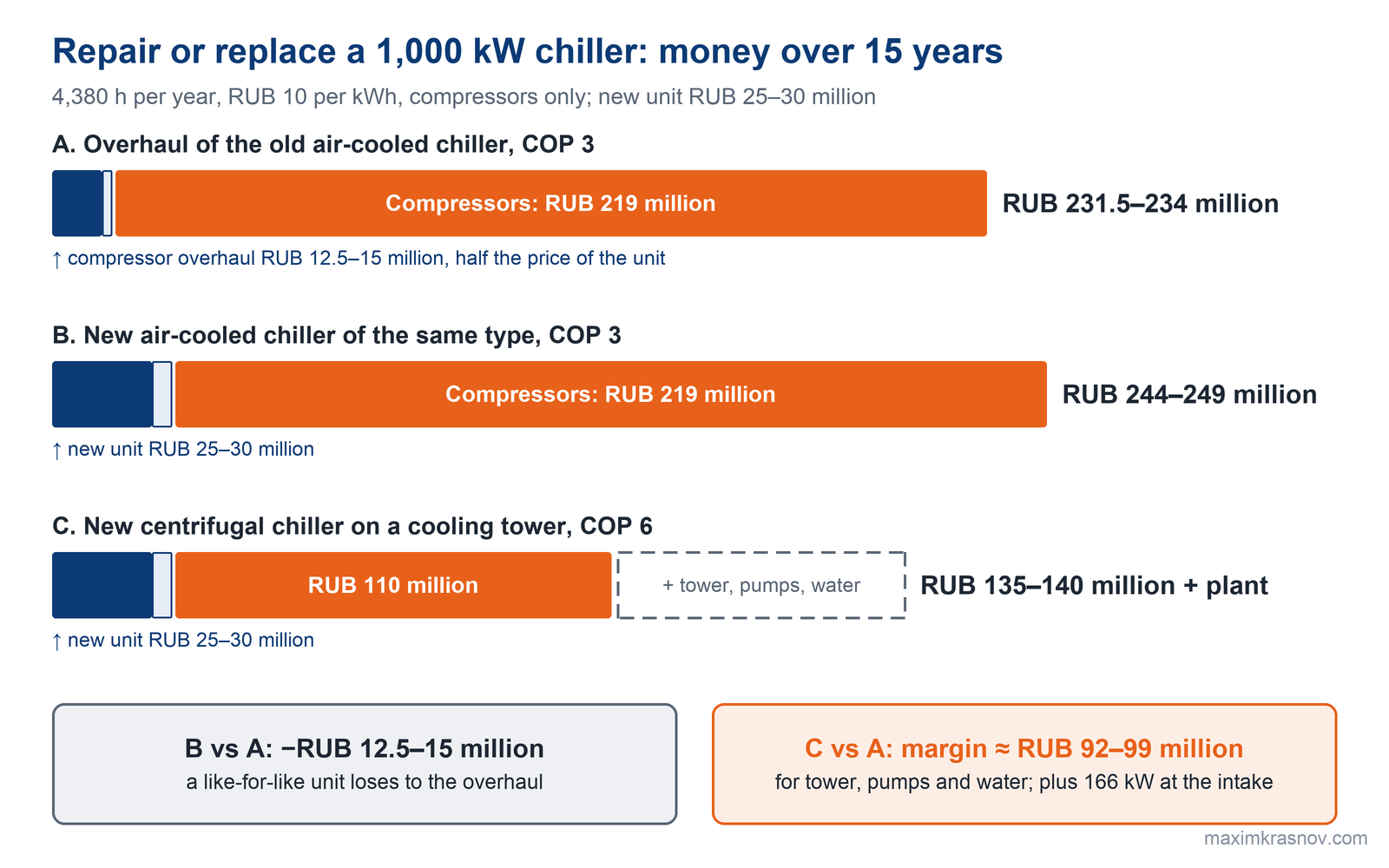
Take an old 1,000 kW air-cooled chiller, 4,380 operating hours a year, a tariff of RUB 10 per kWh and a 15-year comparison period. A new unit costs RUB 25–30 million; a compressor overhaul costs half that. The table covers compressors only: pumps, fans, water and downtime come on top.
| Option | One-off costs, RUB million | Compressors, RUB million per year | Compressors over 15 years, RUB million | Total over 15 years, RUB million |
|---|---|---|---|---|
| A. Overhaul of the old air-cooled chiller, COP 3 | 12.5–15 | 14.6 | 219 | 231.5–234 |
| B. New air-cooled chiller of the same type, COP 3 | 25–30 | 14.6 | 219 | 244–249 |
| C. New centrifugal chiller on a cooling tower, COP 6 | 25–30 + cooling tower, pumps, water treatment | 7.3 | 110 | 135–140 + cooling tower and water |
Like-for-like replacement (B vs A) loses to the repair by RUB 12.5–15 million over 15 years. A new unit of the same type can win at part load: in an example from our engineering guide, the difference between two 1,000 kW units is 39,683 kWh a year, about RUB 6 million over 15 years. That does not close the gap, so such a replacement is justified by reliability and the cost of downtime, not by electricity.
Replacement with a change of scheme (C vs A) comes out about RUB 92–99 million ahead over 15 years before the cost of the cooling tower, pumps, water and water treatment. As long as those cost less than this amount, replacement beats repair. On top of that, 166 kW at the intake are freed up for production.
If your tariff is different, only the money line changes: the kilowatt-hours stay the same. Compare at least three options, not two prices for the one scheme you are used to. "I'm not saying replace everything right now. I'm saying let's do the numbers," is what I said at Russian Data Center Week in March 2026, and it applies just as much to old chillers.
When is repair the better deal, and when is it time to replace the chiller?
Repair pays off when the unit uses the same scheme as the possible replacement, parts are available, and downtime does not threaten to stop production. Replacement pays off when the scheme changes, the load runs long hours, or every day of waiting for a part costs more than a new unit.
1. Repair: a water-cooled chiller on a cooling tower, the site's operating mode is unchanged, and capacity has dropped because of deposits or weak glycol.
2. Repair and upgrade the plant: cooling is needed in winter, but there is no free cooling. For 1,000 kW in Moscow with a 12/18 °C water schedule, free cooling saves about 1.78 million kWh a year; more in How to cut industrial cooling costs.
3. Replace: an air-cooled unit on a long-running load, with water and space for a cooling tower available on site.
4. Replace or add a backup: parts take months to arrive, there is no backup unit, and a day of downtime costs more than the repair.
5. Change the principle: the site has steam or hot water from 80 °C. At the Polief plant of SIBUR, a Thermax absorption chiller running on waste steam replaced a 1,000 kW compressor chiller that constantly drew 300 kW, and paid for itself in a few months.
Before any of these decisions, rule out water, glycol and a selection error: in our experience, nine times out of ten capacity drops because of the water, and a new unit in the same water will go the way of the old one.
Key takeaways
1. Chiller repair and replacement are compared over the same period, 10–15 years, on five lines: one-off costs, electricity, scheduled service, downtime and grid capacity.
2. A compressor overhaul in year 10 costs about half the price of the unit; for a megawatt-class chiller that is about RUB 12.5–15 million.
3. Replacing a unit with one of the same scheme barely pays back through electricity: in our example it loses to an overhaul by RUB 12.5–15 million over 15 years.
4. Switching from an air-cooled chiller with COP 3 to a centrifugal chiller on a cooling tower with COP 6 saves RUB 7.3 million a year per 1,000 kW at 4,380 hours, about RUB 110 million over 15 years.
5. The cost of downtime is calculated before the decision: at a large plant, a single day without cooling costs more than the entire chiller plant.
FAQ
How much does it cost to repair an industrial chiller?
A compressor overhaul costs about half the price of the unit; for a megawatt-class chiller that is about RUB 12.5–15 million. Only a teardown inspection of the specific unit gives the exact figure.
How often does a chiller need maintenance?
On the manufacturer's schedule, which depends on the compressor. For an oil-lubricated centrifugal compressor, the NCT catalog calls for an oil change every three years, oil filters every year, a quarterly oil pump check and weekly oil monitoring; with gas bearings these operations are not required. Glycol is replaced every 3–5 years.
After how many years should a chiller be replaced?
Age alone is not a reason. Chiller cost of ownership is calculated over 10–15 years, and the replacement decision is made on the numbers: the repair cost plus the electricity and downtime of the old unit against the price of a new one and its electricity.
Will replacing an old chiller with an energy-efficient one pay off?
It depends on the scheme and the operating hours. A new unit of the same type saves little: in an example from our engineering guide, about RUB 0.4 million a year per 1,000 kW. Switching from an air-cooled unit to a centrifugal one on a cooling tower at the same capacity and 4,380 hours a year saves RUB 7.3 million a year on the compressors.
What if chiller parts take months to arrive?
Calculate how much the site will lose over that time and compare it with the price of a backup or a new unit. For sites that cannot afford to lose cooling, N+1 redundancy with backup power is installed: if any one unit fails, the remaining ones cover the critical load.
Sources
-
ANSI/AHRI Standard 550/590 "Performance Rating of Water-Chilling and Heat Pump Water-Heating Packages Using the Vapor Compression Cycle": IPLV part-load metric.
-
NCT chiller catalogs 2026: COP by series, maintenance comparison of oil-lubricated and gas-bearing centrifugal compressors.
-
Maxim Krasnov, Telegram channel: post on water quality in cooling equipment, 1 July 2026; post on the absorption chiller at the Polief plant, 2 September 2026.
-
Cold Energy (NCT) experience and calculations: engineering guide "NCT Chillers: a Guide for Engineers", webinar "13 Critical Mistakes in Choosing a Chiller" (February 2026), tariff of RUB 10 per kWh.
Need a cooling solution for your site? Get a consultation