
Chiller with a Remote Condenser: When It Beats a Packaged Unit

founder and CEO of Cold Energy (NCT)
A remote condenser is the air-cooled condenser of a chiller moved out to the roof or a pad, while the compressors and evaporator stay indoors. The layout pays off when the machine cannot stand outside and there is no water for a cooling tower. Its price is the refrigerant piping: up to 15 m it is run to the size of the unit's connections, anything longer only by calculation, and every extra kelvin lost in the pipe costs about 3% of compressor power.
This article is for plant directors and chief engineers choosing between a packaged air-cooled unit, a remote condenser and a water-cooled chiller with a cooling tower or dry cooler. The main risks of the split layout are not at the factory but in the piping between the unit and the condenser: it is designed and brazed by someone other than the chiller manufacturer. How the chiller itself works and what types exist is covered in what is a chiller and how it works.
What is a chiller with a remote condenser?
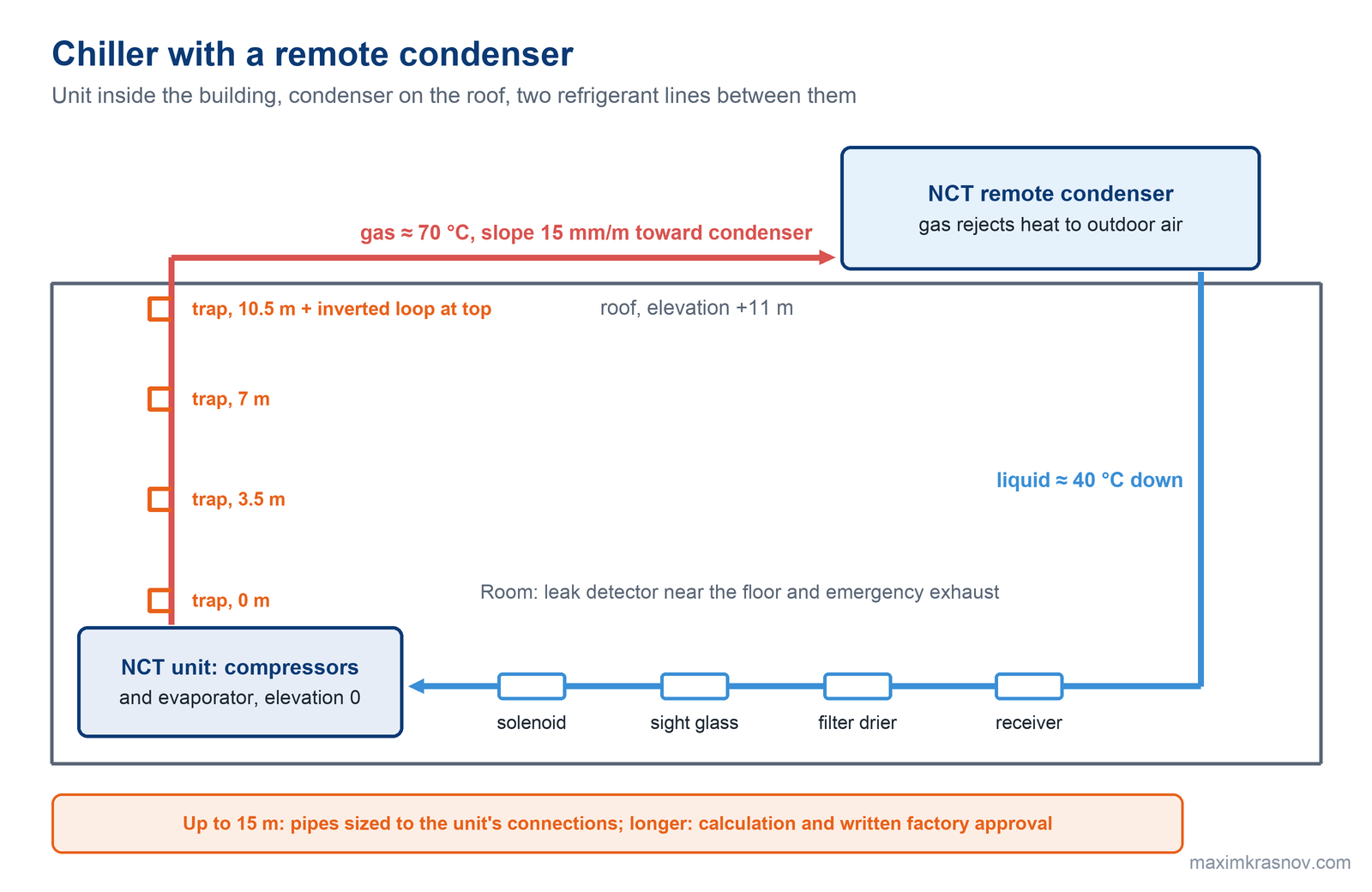
A chiller with a remote condenser (condenserless chiller) is a machine cut in two. The compressor and evaporator unit stands inside the building, the air-cooled condenser with its fans stands outside, and two copper lines connect them:
-
discharge line: hot refrigerant gas at about 70 °C goes from the compressor up to the condenser;
-
liquid line: liquid refrigerant at about 40 °C comes back down through a receiver, filter drier, sight glass and solenoid valve.
The suction line stays factory-made, because the evaporator sits inside the unit. In the NCT range these are the NCSA series with scroll compressors and NCRA with screw compressors. NCSA covers 11 models from 69 to 621 kW of cooling, refrigerant R410A, two to six compressors, and an oversized liquid receiver as standard. On glycol solutions the machine delivers fluid from −15 to +20 °C, and free cooling is available. NCRA is selected for each duty; it has no standard capacity table.
When is a remote condenser better than a packaged air-cooled chiller?
A remote condenser wins when the machine has to stand indoors and the process water must not be exposed to frost. Only refrigerant goes outside, and it does not freeze, so there is no need for a glycol loop through the wall or heat tracing on outdoor pipes. The NCSA catalog lists one more advantage, reliability: the hot parts of the machine are separated from the condenser.
A packaged air-cooled unit is not put into a workshop without powerful ventilation. Along with cooling, the machine rejects condensing heat: for a 1,000 kW chiller with a COP of 3 that is about 1,333 kW, and all of it stays in the room. In summer the machine trips on high pressure, in winter it starts to ice up. We had a case where there was no room for a cooling tower and the workshop was hot. We selected a chiller with a built-in pump and a remote condenser.
If the machine can stand outdoors, a packaged unit is simpler. It installs faster, usually costs less than a split system, is tested as a whole at the factory and is serviced in one place. A split layout is chosen not because it is better, but because the site left no other option.
| Criterion | Air-cooled packaged unit | Remote condenser | Water-cooled chiller + cooling tower or dry cooler |
|---|---|---|---|
| Where the machine stands | Outdoors, on a pad or roof | Unit in the building, condenser outside | Plant room, outdoor heat rejection unit outside |
| Water on site | Not needed | Not needed | An open cooling tower needs make-up and water treatment, a dry cooler does not |
| What goes outdoors | The whole machine and the process loop | Refrigerant only | Water or glycol |
| Summer condensing | 10–15 K above air | As a packaged unit plus piping losses | About 35 °C on a cooling tower |
| Refrigerant indoors | No | Yes, GOST EN 378-2014 requirements apply | Yes |
| Main risk | Winter without a low-ambient kit, heat waves | Pipe length, oil return, brazing | Water quality, glycol dilution |
NCT series: packaged NASA and NARA, remote condenser NCSA and NCRA, water-cooled NWSA, NWRA and NWCV.
How much power does air-cooled condensing lose compared with water-cooled?
About a third of compressor power in summer. An air-cooled condenser condenses refrigerant 10–15 K above air temperature: at +30 °C outdoors that is about 46 °C. A water-cooled machine on a cooling tower condenses at about 35 °C on the same day. A gap of 11 K, with compressor power rising 1.8–4.0% per kelvin (manufacturer data; the calculation uses 3%), gives roughly 33%.
On a 1,000 kW machine running 3,000 hours a year, that means compressors drawing about 266 kW instead of 200 kW, or about 198,000 kWh a year. At RUB 10 per kWh that is about RUB 2 million a year, minus the water, water treatment, pumps and fans of the cooling tower. A remote condenser lives on the same air side, so in summer efficiency it is no better than a packaged unit, and piping losses come on top.
On megawatts and long running hours a water-cooled machine with a cooling tower or dry cooler is almost always cheaper to run. The split layout makes sense at tens and hundreds of kilowatts, where a water loop and a plant room do not pay back. Water versus electricity for outdoor heat rejection units is compared in cooling tower vs dry cooler.
How long can the refrigerant piping run be?
Up to 15 m without calculation: under the NCT operating manual the pipes match the diameter of the unit's connections. Longer runs need a calculation and written approval from the factory. In practice refrigerant runs rarely go beyond 30–50 m, while water runs can be hundreds of meters.
| Run length | Approach |
|---|---|
| Up to 15 m | Pipes sized to the unit's connections |
| 15–50 m | Calculation of pressure drop, oil and charge plus factory approval |
| Over 50 m | Compare with a water-cooled chiller and a glycol dry cooler: a water run can be an order of magnitude longer |
Every extra meter means pressure drop, extra charge and the risk that oil will not return to the compressor. At the design stage 50% is added to the actual length for bends and valves; at the detailed design stage fittings are counted one by one from the fittings catalog.
What does an undersized pipe cost?
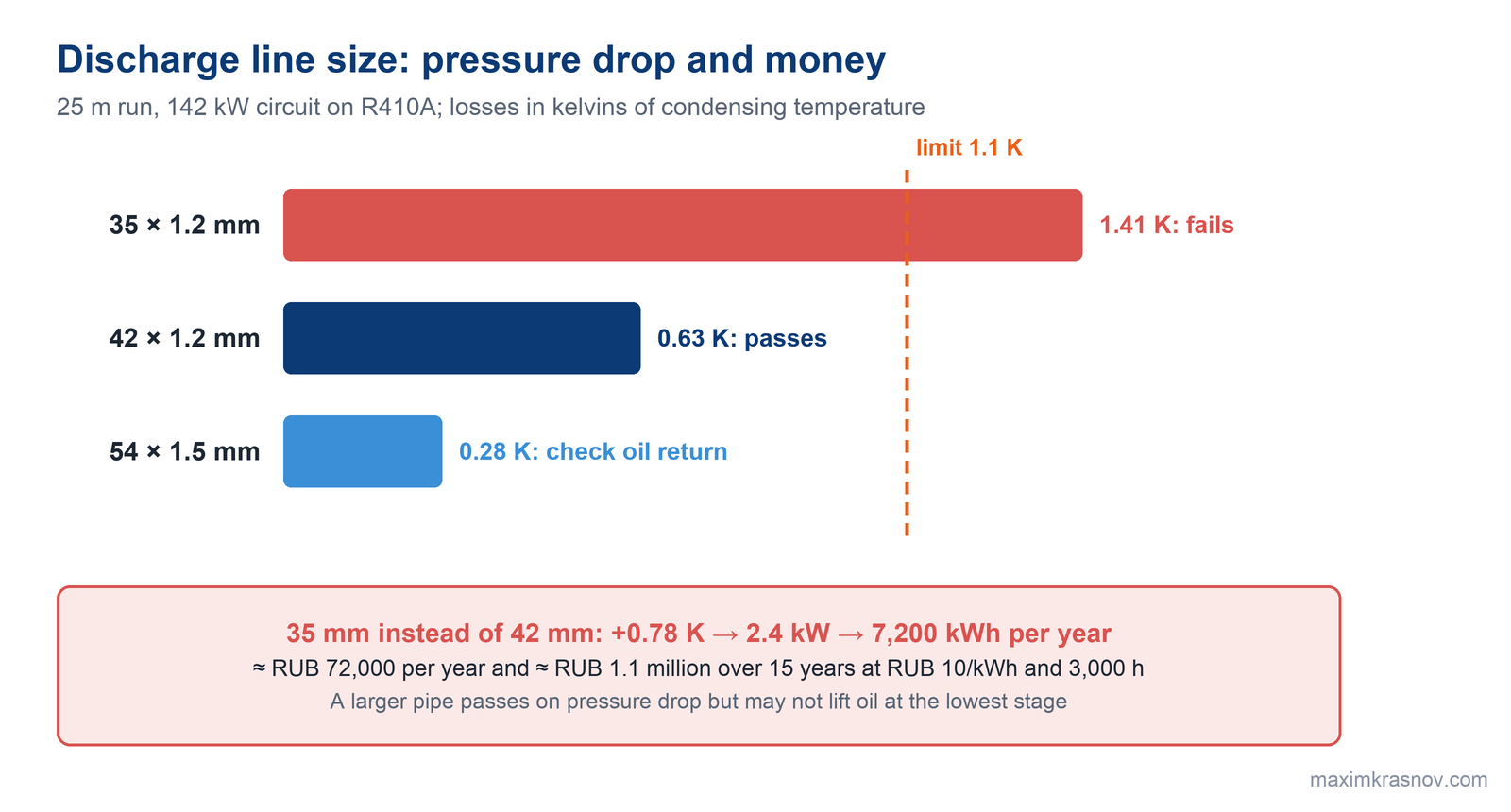
On a 284 kW machine, a pipe one size too small costs about 7,200 kWh a year. Pressure drop in the discharge line is counted in kelvins of condensing temperature. The criterion from international practice and manufacturer data is no more than 1.1 K for the discharge line and for the liquid line; on the liquid side it is better to stay within 0.5 K.
An example from our engineering guide: an NCSA circuit of 142 kW (a 284 kW machine with two circuits), R410A, condensing at 50 °C. The run is 25 m: 8 m horizontal at the unit, an 11 m riser and 6 m across the roof. With the allowance for bends that is 37.5 m equivalent length, and the gas column in the riser adds another 0.15 K.
| Discharge pipe, mm | Gas velocity, m/s | Loss, K | Verdict |
|---|---|---|---|
| 35 × 1.2 | 11.7 | 1.41 | Fails |
| 42 × 1.2 | 7.9 | 0.63 | Passes |
| 54 × 1.5 | 4.8 | 0.28 | Passes on pressure drop, check oil |
Each kelvin of condensing here is about 3.2% of compressor power. A 35 mm pipe instead of 42 mm adds 0.78 K, which is 2.4 kW per machine and 7,200 kWh over 3,000 operating hours a year. At RUB 10 per kWh that is about RUB 72,000 a year, or about RUB 1.1 million over 15 years, from the diameter of one pipe alone.
Why does oil not return to the compressor?
Because the gas in the riser moves slower than it must to carry oil upward. A compressor always throws some oil out with the gas. On horizontal runs it drains along the slope, but on a rise it is lifted only by the gas flow. That is why the riser is checked not at full load but at the lowest capacity step of the circuit.
Continuing the example: a 42 mm riser. At full load the gas moves at 7.9 m/s. At half load, with one compressor of two running, it is 4.0 m/s, which passes. At the 25% step it is 2.0 m/s against a minimum of 2.6 m/s for this diameter, and the oil will not rise. Oversizing the pipe to cut pressure drop makes the problem worse, and traps do not cure it.
What the NCT manual requires for the piping:
1. Oil traps at the base of the riser and then every 3–3.5 m of rise, with an inverted loop at the top. For an 11 m riser that is four traps at 0, 3.5, 7 and 10.5 m.
2. Horizontal discharge runs slope at least 15 mm/m toward the condenser.
3. Traps are bent with a radius over 3.5 pipe diameters, not assembled from elbows. Each 42 mm trap needs an extra 160 ml of oil, four traps need 640 ml.
4. Riser clamps every 1–1.5 m. The piping is not fixed to other services, and brazed joints are not buried in wall chases.
If the lowest step fails on velocity, the factory decides: a double riser or an oil separator on the discharge. A mistake in a double riser is worse than having none.
Condenser above or below the unit: what changes?
A condenser above the unit is the usual and calmer option: the liquid drains down by itself. A condenser below the unit is riskier: the liquid has to be lifted, and every meter of lift eats into subcooling, that is, how much colder the liquid is than its boiling point at its pressure. For R410A that is 0.13 K per meter.
At least 2.8 K of subcooling must remain at the expansion valve, otherwise vapor bubbles form in the liquid and the machine loses capacity. Example: condenser 8 m below the unit, 4 K subcooling at the outlet, 37.5 m liquid line. A 28 mm pipe leaves 2.51 K, below the requirement. A 35 mm pipe leaves 2.83 K, right on the edge with no margin for sun or a clogged filter. Such a layout needs extra subcooling or a different arrangement, and the factory has to decide.
The liquid line on the roof is insulated and shaded from the sun: a kelvin of heat gain is a kelvin of subcooling lost.
How much refrigerant does the piping add, and what does that mean for the room?
A 25 m run adds about 15.5 kg of R410A per circuit to the nameplate charge: 12.5 kg in the 28 mm liquid line and 3 kg in the 42 mm discharge line. NCSA and NCRA machines leave the factory under nitrogen, and refrigerant is charged on site after the piping is installed, so these kilograms must be bought before start-up and listed in the specification.
The extra charge also affects the room. Under GOST EN 378-2014 (Russian adoption of EN 378) and GOST 12.2.233-2012 (Russian safety standard for refrigerating systems), the charge of the largest circuit is divided by the room volume and compared with the limit for the refrigerant. Example: 30 kg nameplate plus 15.5 kg for the piping gives 45.5 kg.
In a 6 × 8 × 4 m room that is 0.24 kg/m³. The same unit in a 3 × 4 × 3 m ventilation room reaches 1.26 kg/m³. For R410A the 2008 edition of EN 378 gives a limit of 0.44 kg/m³: the large room fits, the ventilation room exceeds it almost threefold. Check the limit against the current edition.
The piping raised the charge by half and can turn an ordinary room into a machinery room with leak detectors near the floor, emergency exhaust and relief valves vented outdoors.
What does a remote condenser need to run in winter?
A low-ambient kit and a receiver sized for the full charge. The standard version in the NCT catalog runs from +10 °C outdoor air. In winter the condensing pressure drops too low, the expansion valve loses its pressure difference and oil returns worse. According to condenser manufacturers, control is needed below roughly 15.6 °C outdoors; in our climate that is half the year.
| Version | Outdoor air |
|---|---|
| Standard | +10 to +35 °C |
| Control panel heating and fan speed controller | −5 to +35 °C |
| Plus condensing pressure and receiver pressure regulators, receiver | −30 to +35 °C |
NCT catalog, NASA packaged units and NCSA chillers.
If winter pressure is held by flooding the condenser, part of its tubes fills with liquid, and the winter charge can be about twice the summer charge. In summer that liquid has to go into the receiver, so the receiver is sized for the full system charge. "Year-round operation" in the specification must turn into line items: low-ambient kit, panel heating, receiver of the right volume. No line items means the machine runs outside its range in winter.
What should be checked in the design before installation?
The most expensive mistake in a split layout is brazing without a nitrogen purge. In our practice there were machines that could not be commissioned because of scale inside the refrigerant circuit. The piping is not made "on site by eye": diameters, traps, oil and refrigerant additions are calculated before installation.
Owner's checklist before installation:
1. Run longer than 15 m or condenser below the unit: written factory approval is on file.
2. The specification lists as separate items the extra refrigerant for the piping in kilograms and the extra oil for the traps in milliliters.
3. Discharge pressure drop at full load is no more than 1.1 K, and riser velocity at the lowest step is not below the minimum.
4. Refrigerant concentration in the room is checked against the current standard, and relief valves vent outdoors.
5. For year-round operation there is a low-ambient kit and a receiver for the full charge.
For NCT chillers we calculate the piping at the factory: diameters and charge based on length, height difference and the locations of the unit and condenser. We select the machine to the specification, without spare kilowatts.
Our chillers have a bolted, dismountable frame: the unit is easier to bring into the room, and installation goes faster. We make the dimensions fit the space, whether a cramped room or the footprint of an old imported machine.
We have installed this layout, for example, as part of a chiller plant for a foundry in Tver, together with an open cooling tower, a pump group and water treatment, and at many other sites. More on choosing a machine is in the chillers section and in how to calculate chiller capacity.
Key takeaways
1. A remote condenser is chosen when the machine must stand inside the building, there is no water for a cooling tower and the process loop cannot be exposed to frost; if the machine can stand outdoors, a packaged unit is simpler and usually cheaper.
2. In summer efficiency a split layout is no better than a packaged unit: on a 1,000 kW machine, air-cooled condensing versus water-cooled costs about 198,000 kWh a year.
3. Refrigerant piping up to 15 m is sized to the unit's connections; longer runs need calculation and written factory approval; beyond 50 m a water-cooled layout pays off.
4. A discharge pipe one size too small on a 25 m run costs about 7,200 kWh a year, and an oversized one will not carry oil at the lowest step.
5. A 25 m run adds about 15.5 kg of refrigerant per circuit, which can turn the unit's room into a machinery room; winter operation needs a receiver for the full charge.
FAQ
I need 4.5 °C water and the machine has a remote condenser. Can the loop stay on plain water?
No. The NCT catalog allows operation below +6 °C only on ethylene or propylene glycol solution: at 4.5 °C on plain water the risk of freezing the evaporator is high. The concentration is chosen for the lowest temperature the loop will see: 30% ethylene glycol freezes at −16 °C, 40% at −23 °C. Only inhibited solution will do, not automotive antifreeze, and the freeze protection and low-pressure setpoints are readjusted.
What share of the equipment price goes to installation and design?
Not even an approximate percentage can be given. It depends on the plant, the length of the piping, tie-in to the existing system and whether steel structures are needed under the condenser. An honest figure appears only once the elevations, pipe route and crane location are known.
Who is responsible if the machine does not deliver its rated capacity?
The manufacturer is responsible for the performance stated in the technical documentation. The guaranteed capacity and the conditions for reaching it go into the contract: design air temperature, water or glycol temperatures, piping length. The scope boundary is also written into the contract: at which flange and connection the factory's responsibility ends.
Sources
-
GOST EN 378-2014 "Refrigerating systems and heat pumps. Safety and environmental requirements" (Russian adoption of EN 378).
-
GOST 12.2.233-2012 "Refrigerating systems with cooling capacity above 3.0 kW. Safety requirements".
-
SP 131.13330 (Russian building climatology code).
-
ASHRAE Handbook — Refrigeration: refrigerant piping design, oil return, pressure drop.
-
Cold Energy experience and calculations: engineering guide "NCT Chillers" (October 2026), NCT chiller catalog 2026, operating manual for NASA and NCSA chillers.
Need a cooling solution for your site? Get a consultation