
What Is a Cooling Tower? How It Works, Explained Simply
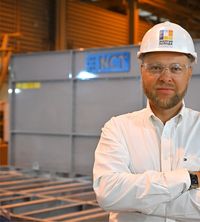
founder and CEO of Cold Energy (NCT)
A cooling tower is a water cooler that rejects heat from plant equipment to outdoor air through evaporation: for every 7 °C of cooling, about 1% of the water leaves as vapor. There is no compressor in a cooling tower; only a pump and a fan do the work. It cannot cool water below the wet-bulb temperature, so in a Moscow summer it delivers around 25–26 °C.
This article is for plant directors and chief engineers who have met a cooling tower in a project for the first time. At our cooling-tower sessions, webinars and tours of the plant, I take the design apart on slides and next to a real unit in the shop; here I have collected the essentials. How to choose the type and model for your plant is a separate article: how to choose an industrial cooling tower.
What is a cooling tower in simple terms?
A cooling tower works like a wet cloth in the wind. A thermometer wrapped in wet cloth reads lower than the air around it when the wind blows: water evaporates and cools it. A cooling tower does the same with hot water from equipment: it spreads the water over a large surface, blows outdoor air through it, and part of the water leaves as vapor, taking heat with it.
For a director, the picture is this: a machine tool, a furnace or a chiller heats the water, the water goes to the cooling tower, cools down and returns in a loop. You pay for a pump and a fan, not a compressor, so electricity use is several times lower than with a chiller. In exchange, the tower spends water on evaporation and needs water treatment.
The scale in numbers: a 1,000 m³/h loop cooled from 35 to 28 °C rejects 8,141 kW of heat and evaporates 12.6 m³ of water per hour to do it, about 1.3% of the flow.
Why does a plant need a cooling tower?
A cooling tower dumps into the atmosphere the heat that the process or the chiller has nowhere else to put. The NCT reference list has more than 360 sites with cooling towers, and the duties repeat: furnaces, test benches, compressors, chiller condensers, absorption machines, autoclaves and quench tanks. At Severstal in Cherepovets our cooling tower serves an induction furnace; at the Tatprof plant it serves a quenching line for aluminum profiles.
The line between a cooling tower and a chiller is simple. A cooling tower fits if the water can be the wet-bulb temperature plus 4 °C. If you need 7–15 °C water for air conditioning, food or pharmaceutical lines, that is a chiller's job, and the cooling tower removes heat from its condenser. At most plants the right answer is "both".
The difference in money is large. For a talk in Cherepovets I calculated one 1,000 kW cooling duty with five different systems for the local climate: the electricity bill of a conventional chiller and of a wet cooling tower with no refrigeration machine differs tenfold.
How is a cooling tower built?
An open fan-assisted cooling tower has seven main components. They are listed below in the order the water meets them, using NCT modular towers as the example.
1. Water distribution with spray nozzles sprays hot water over the fill. NCT nozzles are polypropylene, self-draining, and do not crack in frost.
2. Fill (packing) is a pack of corrugated PVC sheets where water runs down as a film and droplets against the air. The fill can be removed and washed.
3. The fan pushes outdoor air through the fill. A centrifugal fan sits at the bottom or side and blows air in (forced draft); an axial fan sits on top and pulls it through (induced draft).
4. Air inlets with louvers let air in. If access to them is poor, the tower starts to draw in its own warm exhaust.
5. The drift eliminator above the fill catches droplets: the airflow changes direction three times inside it. NCT drift loss is 0.0005–0.002% of the water flow.
6. The basin collects the cooled water, and the pump takes it from there. Make-up with a float valve or level sensor adds water to replace what has evaporated.
7. The casing is painted hot-dip galvanized steel, stainless on request. Per the NCT catalog: a 10-year warranty against perforation corrosion and a service life of up to 25 years.
A closed-circuit cooling tower adds two items: a coil that carries the process fluid, and a spray pump that wets the coil with water from the basin.
In a counterflow tower, air moves bottom-up against the falling water; in a crossflow tower, it moves across the water. A crossflow tower is lower but its air inlet starts to ice up already at −5 °C. A modular tower arrives from the factory as finished blocks and is installed in 1–2 days; a field-erected tower is built on site for flows from 500 m³/h.
How does a cooling tower work?
A cooling tower works by evaporative cooling: part of the water evaporates, and that takes heat from the rest. The cycle of an open tower:
1. The pump sends heated water from the equipment to the nozzles.
2. Water runs down the fill while outdoor air moves against it or across it.
3. A small share of the water evaporates and carries off heat; the rest cools down.
4. Cooled water collects in the basin and goes back to the equipment.
5. Make-up replaces evaporation, and blowdown, draining part of the water, keeps salts from building up.
Two numbers describe a cooling tower. The range is how many degrees it cools the water: from 35 to 28 °C is 7 °C. The approach is how much warmer the leaving water is than the wet bulb; the smaller it is, the bigger the unit, and below 2.8 °C CTI (Cooling Technology Institute, the US cooling tower institute) will not certify it.
The wet-bulb temperature is the limit below which an evaporative tower cannot cool water. On a hot day in central Russia the wet bulb can be 7–10 °C below the dry bulb; the drier the air, the bigger the gap. For Moscow the design reference is a 22 °C wet bulb at a 30 °C dry bulb, and in practice the tower delivers the wet bulb plus 3–4 °C.
A reader of my channel asked: the tower was designed for +27 °C, but in summer it gives +30 °C, is it defective? Almost always no: someone used an "average summer" wet bulb, and on hot humid hours +27 °C is out of reach. The design wet bulb should be taken for your own city from SP 131.13330.2025 (Russian building climatology code).
Evaporation takes about 1% of the flow for every 7 °C of range (ASHRAE Handbook, chapter 40). How to calculate and reduce make-up water is covered in how much water a cooling tower uses.
What types of cooling towers are there?
Cooling towers fall into four types by two questions: does the cooled water touch the air, and is there evaporation.
An open cooling tower is an evaporative cooler in which water runs over the fill in direct contact with air. A closed-circuit cooling tower is a unit in which the fluid flows inside a coil while the outside of the coil is sprayed with separate water; the two circuits never mix. A hybrid cooling tower is a closed tower that runs wet in summer and cools with air alone in cold weather: at NCT these are the e-series with a finned coil, which per the catalog run without spray water from 0 °C. A dry cooling tower, or dry cooler, is a finned heat exchanger with fans that works without water.
| Criterion | Open | Closed-circuit | Hybrid (e-series) | Dry (dry cooler) |
|---|---|---|---|---|
| How it rejects heat | Water touches air and partly evaporates | Fluid in a coil, spray water evaporates outside | Like a closed tower in summer, air only in the cold | Only by heating the air |
| Cooling limit | Wet bulb + approach | Wet bulb, larger approach | Same as closed tower in summer | Dry bulb + 5.6–11 °C |
| Leaving water at +30 °C outdoors | 26–28 °C | Close to open, depends on selection | Same as closed tower | 36–41 °C |
| Loop cleanliness | Contact with air, filtration needed | Clean | Clean | Clean |
| Glycol | Not possible | Possible | Possible | Glycol almost always |
| Make-up water | Evaporation + blowdown | Spray water only | Spray water in summer, none from 0 °C | Not needed |
| Typical site | Metals, machine building, food plants | Pharma, electronics, glass, chillers | Same + water shortage | Sites without water, data centers |
A conventional closed tower with a plain coil can also run dry, but only at −15 to −25 °C. A comparison of cooling towers and dry coolers on water, electricity and climate is in cooling tower vs dry cooler.
What does a cooling tower system layout look like?
The simplest open cooling tower layout is a closed ring: basin → pump → equipment → nozzles → fill → basin, plus make-up, blowdown and overflow lines. All other layouts are variations, chosen by the elevations of the tower, the consumer and the pump, and by winter conditions.
| Layout | How it works | When it is used |
|---|---|---|
| Pump from the basin | The pump takes water straight from the basin | Consumer below or level with the basin |
| Tank in a heated room | Water drains by gravity into a tank, the pump takes it from the tank | Year-round, when water cannot be kept outdoors |
| Isolating heat exchanger | A separate clean consumer loop beyond the heat exchanger | Consumer 10–15 m higher, high pressure, clean process |
| Several towers in parallel | Common headers and equalizer lines between basins | Load exceeds one tower, or redundancy is needed |
A closed cooling tower has two independent circuits: the outer one sprays the coil with water from the basin, the inner one carries the process fluid under pressure with its own expansion tank.
A layout error shows up at the first pump stop: water from pipes above the basin drains back into the tower. In our calculation for a typical 1,000 m³/h loop routed over a pipe rack, this drain-back ranges from 7.1 to 51.7 m³ depending on routing and valves. If the basin cannot hold it, treated water with chemicals goes to overflow at every stop.
A layout can also deliver free cooling. At a powder metallurgy plant we installed a Thermax absorption chiller and three NCT cooling towers for 4.6 MW of cooling with +7/+12 °C water. In summer the towers cool the machine's water from +32 to +25 °C; in the cold season the machine is off, and two towers cool water from +12 to +7 °C through heat exchangers directly for production.
Why does a cooling tower stop cooling?
Most often a cooling tower loses capacity because of water, not hardware: when equipment does not deliver its capacity, nine times out of ten water quality is to blame. Salts from make-up water build up, so part of the water is drained (blowdown) and corrosion and biofouling inhibitors are dosed. Without water treatment, scale, biology and corrosion kill even a good tower within a couple of years.
An open tower paired with an absorption chiller needs especially strict control: dirt from outside clogs the condenser, and the machine loses capacity sharply. For such machines I advise installing a closed-circuit tower from the start.
In winter a tower stops because of icing. In series with a centrifugal fan at the bottom, the wheel and motor sit in a dry compartment: NCT VR-series towers run in winter in Murmansk, Vorkuta and Ulan-Ude.
Key takeaways
1. A cooling tower is a water cooler with no compressor: heat leaves into the air through evaporation, about 1% of the flow for every 7 °C of cooling.
2. A cooling tower cannot cool water below the wet bulb: in a Moscow summer that is around 25–26 °C. For 7–15 °C water you need a chiller, and the tower rejects its heat.
3. The main parts of an open tower are nozzles, fill, fan, drift eliminator and basin; a closed tower adds a coil and a spray pump.
4. An open tower gives the coldest water, a closed tower keeps the loop clean, a hybrid tower saves water in cold weather, and a dry cooler needs no water but gives the warmest water in summer.
5. Nine times out of ten a tower loses capacity because of water, so every evaporative cooling tower needs water treatment.
FAQ
What is the difference between a cooling tower and a chiller?
A cooling tower cools water by evaporation and cannot go below the wet bulb, which in summer means 25–28 °C. A chiller is a refrigeration machine with a compressor: it delivers 7–15 °C in any weather but uses several times more electricity. They often work together: the tower rejects heat from the chiller's condenser, and in winter it supplies cold water on its own.
Can a cooling tower run in winter?
Yes, if it was selected for that. It needs fan control, a winter bypass, basin heating or a tank in a heated room. Closed towers can run dry in winter, without water.
Is a cooling tower dangerous for people nearby?
SanPiN 3.3686-21 (Russian sanitary rules on infectious disease prevention) classifies industrial cooling towers as potentially hazardous for Legionnaires' disease and requires periodic water testing. A drift eliminator cuts drift to thousandths of a percent, but nobody gets it to zero. So you need water treatment and a monitoring plan, and next to housing a closed tower or a dry cooler is considered.
How long does a cooling tower last?
Per the NCT catalog, up to 25 years, with a 10-year warranty against perforation corrosion. The real service life depends on water: without treatment a tower fails within a couple of years.
Sources
-
ASHRAE Handbook — HVAC Systems and Equipment, 2024, chapter 40 "Cooling Towers": evaporation of about 1% of flow per 7 °C of range.
-
Cooling Technology Institute, STD-201RS: approach of at least 2.8 °C for certification.
-
SP 131.13330.2025 (Russian building climatology code).
-
SanPiN 3.3686-21, chapter XLII "Prevention of Legionnaires' disease".
-
Cooling Best Practices, "Evaluating Process Cooling Supply Temperatures": dry cooler leaving water temperature.
-
NCT cooling tower catalogs and reference list, 2026; experience and calculations of Cold Energy.
More on cooling towers in the Cooling towers section.
Need a cooling solution for your site? Get a consultation