
Multi-Agent AI System in an Industrial Company: How I Built One

founder and CEO of Cold Energy (NCT)
A multi-agent AI system is a set of AI agents, each with its own job, connected to a shared knowledge base and working under one senior bot. I built one on Claude Code and Telegram. By my own estimate, I now prepare documents, procedures and brochures 3 to 5 times faster than before.
I am not an IT person. I am the CEO of Cold Energy (NCT): 200 people, our own design office, production of NCT chillers and cooling towers, installation and service. I am writing for business owners and plant directors who have tried asking a chatbot something and still do not see where the money is for their business.
This is where I see the main asymmetric opportunity for an entrepreneur today. An asymmetric opportunity is one where you put in little money and effort and get back a disproportionate return. Ten years ago it was crypto, five years ago it was online marketplaces, and today it is artificial intelligence assembled into a system.
How is a multi-agent AI system different from a chatbot?
A chatbot is a single conversation partner that knows about your business only what you typed into the prompt. A multi-agent system is a team of agents: each has its own area and its own rules, all are connected to your knowledge base, and they work together.
The difference is roughly that between a one-off consultation and a co-pilot. You can ask a chatbot for a pancake recipe, but that has nothing to do with running a business. A co-pilot knows everything about you and your company and gives advice as you go, not only when you remember to ask.
| Feature | Chatbot | Multi-agent system |
|---|---|---|
| Who does the work | one conversation partner for everything | several agents, each with its own topic |
| What it knows about the business | only what you put in the prompt | connected to the company knowledge base |
| Working rules | you explain them again every time | each bot has written rules: what it does and how |
| How you set a task | you query and merge the answers yourself | one task to the orchestrator, one combined answer |
| Recurring tasks | done only when you remind it | the bot sees on the board that a task is due |
| Typical task | a pancake recipe, a social media post | a review of a product's weak points by three bots at once |
When I hire, I write the same distinction into the job ad. I need people who work with AI like grown-ups: they build agents and skills for their tasks instead of just asking a chatbot to write a post.
How do the orchestrator and topic bots work?
The orchestrator is a senior bot that takes a task from the manager, decides which bots to bring in, and returns one combined answer. I talk to one bot, and it calls on all the others.
My foundation is Claude Code. It is effectively a constant companion: almost everything I do, I do together with it. I connected it to Telegram and created several bots: one for sales, one for product, one for hiring, one for health, one for personal matters. Each big topic has its own bot, and each bot has written rules: what it does and how it works.
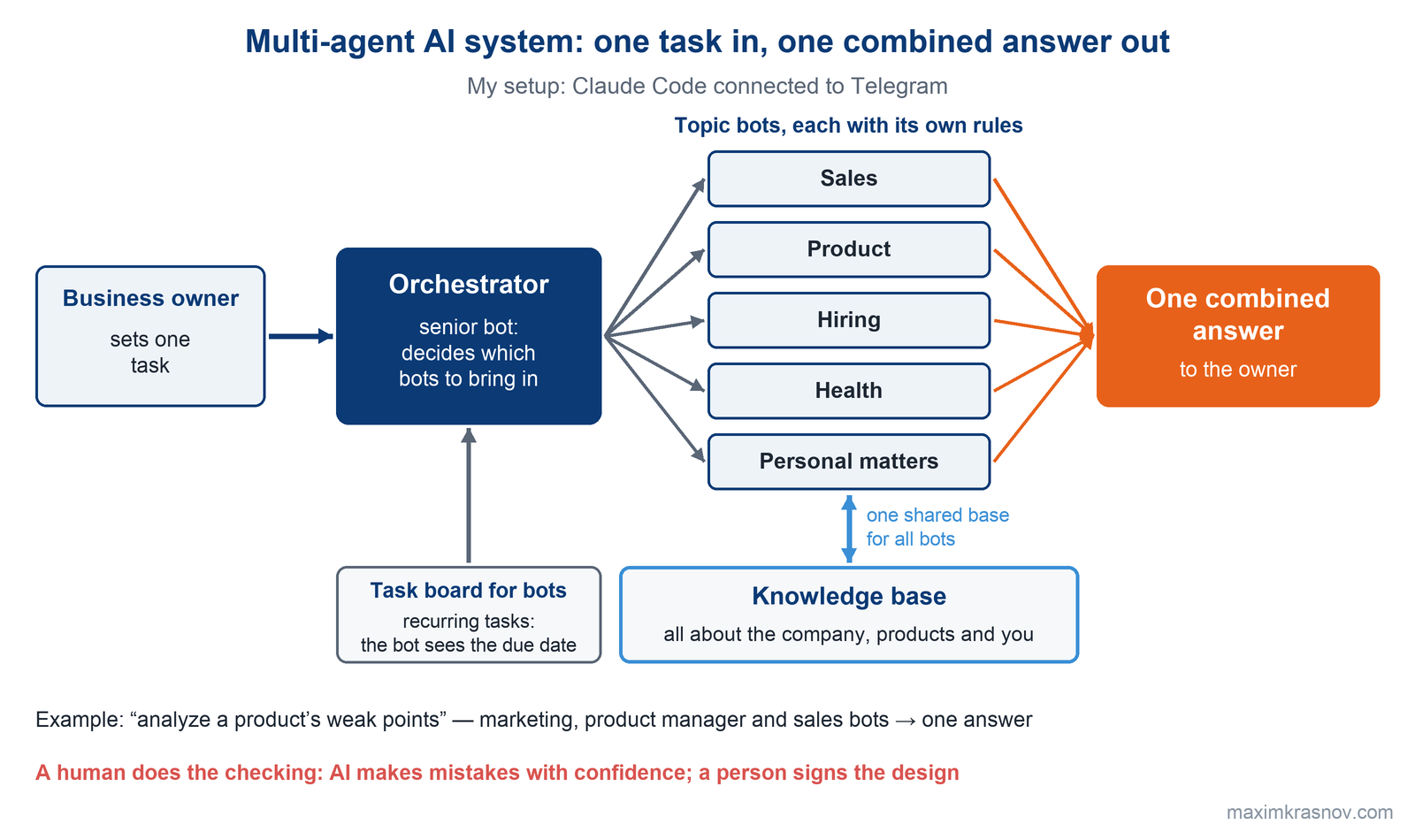
Here is how it looks in practice. I set a task: analyze the weak points of one of our products. The orchestrator brings in the marketing bot, the product manager bot and the sales bot. The three of them do the work, and I receive one combined answer instead of three separate ones.
Why do AI bots need their own task board?
A task board for bots is our own CRM (a system for tracking tasks and clients) in the form of a kanban board with cards for recurring tasks. Every day the bot checks the board, sees that a task is due, and does it on its own, without reminders.
One example is a monthly review of new legislation. In the past someone had to remember this work and assign it. Now the card sits on the board, and the review appears on time.
This is a particular case of what I call a capitalizable action: you do something once and keep getting the benefit. Set up the card once, and the task gets done every month.
What does AI already do in an industrial company?
At our company, AI already builds 3D models of chiller plants from a schematic, checks a client's request before the first call, analyzes the site climate hour by hour, and powers our calculators and atlas of schemes. I showed all of this at our educational session on October 2, 2026.
A 3D model of a chiller plant from a schematic. AI shows water flow through the circuits, temperatures and the equipment layout. This is how we built a model of a 2,500 kW energy center for an office complex in St. Petersburg straight from the technical specification.
Checking a client's request before the call. A real case: the client writes that they need 300 kW of cooling. AI recalculates from the client's own data: a flow of 23 m³/h at water temperatures of 25/19 °C gives about 160 kW (23 m³/h × 1.163 kWh per m³ per degree × 6 °C). That is almost half the stated figure, and the first question for the client is ready before the call.
Hour-by-hour site climate analysis. AI calculates how many hours a year free cooling works in the client's particular city. This decides whether chiller free cooling pays off at a given site.
Calculators and an atlas of schemes. Our cooling cost calculator for chiller plants with absorption chillers or conventional chillers runs in a browser. An atlas of 31 cooling system schemes is available free on my channel.
Outside engineering, AI handles management routine:
-
Procedures from conversations. You explain to an employee how things should be done, and a week later they have forgotten. Transcribe that conversation with AI and add it to a procedure, and the rule works permanently; a new employee gets it without you explaining again.
-
Finding errors in processes. You describe to AI how a process works, and it highlights: there is an error here, here and here. You go back to the shop floor and fix it.
-
Finance. AI is connected to our dashboards, and I get conclusions on the reports at the level of a Big Four auditor.
-
Sales. We teach sales trainees to work with AI: chatbots for deals, preparing presentations, reviewing negotiations.
For the cooling industry this is not news either. In 2016 Google and DeepMind put a neural network in charge of cooling their data centers, and cooling energy use dropped by up to 40%. Why AI computing itself runs into cooling limits, I explain in AI hits the cooling wall.
Where is the line: what should you not trust AI with?
You should not give AI the final word: a person signs the design. AI makes mistakes with confidence, so checking remains our job.
Today AI is an engineer's second brain for us. Tomorrow it will be a reliable partner. The 300 kW request shows its role well: AI does not replace the engineer, it asks the right first question. The decision on the scheme and responsibility for it stay with people.
When AI will design on its own is an open question. We have an ongoing debate about it with one of our engineers, and I put the question to the audience at our educational session on October 2, 2026. Until there is an answer, the rule is simple: everything that goes to a client is checked by a specialist.
How much does it cost and how much time does it save?
My foundation is a Claude Code subscription at 200 dollars a month. By my own estimate, I now work 3 to 5 times faster on preparing documents, procedures and brochures than before.
To be honest: "3 to 5 times" is my own estimate, not a stopwatch measurement. The baseline is how I prepared the same documents myself before I built the system. It applies specifically to documents, procedures and brochures, where there is a lot of text following clear rules.
The second part of the savings does not show up in hours. A conversation turned into a procedure and a task put on the board once keep working without me. That is a capitalizable action: invest once, then collect the interest.
Where should a business owner start with AI?
Start not by choosing a neural network but with one big topic where you have the most repetitive document work. Then grow the system step by step.
1. Choose a main tool and work in it every day, not now and then. Mine is Claude Code: almost everything I do, I do together with it.
2. Build a knowledge base: procedures, product descriptions, company rules. Without it, an agent knows about your business only what you put in the prompt.
3. Set up your first bot for one topic and write its rules: what it does and how it works. Then add bots for other topics.
4. Once you have several bots, put an orchestrator above them so that you talk to one bot and get one combined answer.
5. Move recurring tasks to a board with cards so the bot sees the due date itself.
6. Decide from the start who checks the result. AI makes mistakes with confidence, and a person signs the document.
A separate point about people. I bet on employees who build agents for their own tasks, not on those who ask a chatbot to write a text. We teach this to newcomers in sales as well.
Key takeaways
1. A multi-agent AI system is a team of agents with a shared knowledge base and an orchestrator, not a chat with a chatbot.
2. I built mine on Claude Code and Telegram: topic bots, a senior orchestrator bot and a board with recurring tasks.
3. By my own estimate, I prepare documents, procedures and brochures 3 to 5 times faster than before.
4. In an industrial company AI already builds 3D models of chiller plants, checks requests before the call and analyzes site climate hour by hour.
5. There is one line: AI makes mistakes with confidence, so a person keeps the checking and the signature on the design.
More on how the company is run is in the Manufacturing and business section.
FAQ
What is an orchestrator in a multi-agent AI system?
An orchestrator is a senior bot that takes a task, decides which topic bots to bring in, and assembles their work into one answer. The manager talks to one bot instead of five.
What tool do I use for my multi-agent system?
I work in Claude Code on a 200-dollar-a-month subscription and connected it to Telegram. In Telegram I have a separate bot for each big topic.
Can you trust AI with an engineering calculation?
AI can calculate, but it cannot sign. It is good at rechecking a request and finding discrepancies, as in the case where the flow gave about 160 kW instead of the stated 300. But AI makes mistakes with confidence, so checking and signing the design stay with the engineer.
Why is a bot with a knowledge base better than a regular chatbot?
A bot with a knowledge base answers with your company in mind: products, rules, past decisions. A regular chatbot knows only what you wrote in the prompt and starts from scratch every time.
How much time does AI save on documents?
By my estimate, I now prepare documents, procedures and brochures 3 to 5 times faster than before I built the system. This is a personal estimate, not a time study.
Sources
-
Telegram post "How I work with artificial intelligence", July 17, 2026 (in Russian): t.me/krasnov_energy/308.
-
Telegram post "Asymmetric opportunities", August 27, 2026 (in Russian): t.me/krasnov_energy/333.
-
Telegram post on capitalizable actions, July 31, 2026 (in Russian): t.me/krasnov_energy/319.
-
Telegram post on processes and the gemba, July 24, 2026 (in Russian): t.me/krasnov_energy/311.
-
Telegram post on finance and AI-connected dashboards, April 6, 2026 (in Russian): t.me/krasnov_energy/242.
-
Google DeepMind, July 20, 2016: DeepMind AI reduces Google data centre cooling bill by 40%.
-
Talk "Engineer plus artificial intelligence" at the 3rd Cold Energy educational session, October 2, 2026.
Want to discuss AI in your company? Get a consultation