Russian Data Center Week 2026: do data centers still need chillers?

founder and CEO of Cold Energy (NCT)
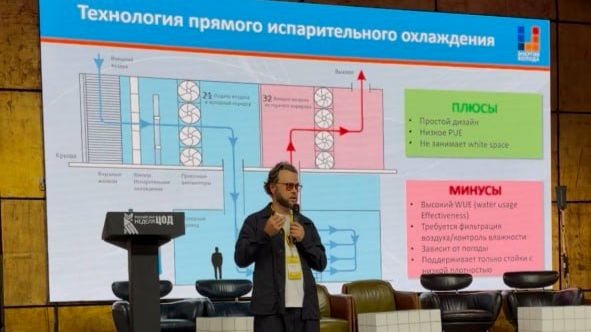
Russian Data Center Week, one of the main events for the data-center infrastructure market in Russia, took place in Moscow.
At one of its sessions in late March 2026, Maxim Krasnov, CEO of Cold Energy, opened his talk with a provocative statement:
«Data centers no longer need chillers.»
That sounds unexpected, especially from a company that makes chillers itself. But the statement is based on a calculation, not an opinion.
Russian Data Center Week: context and trends
Russian Data Center Week is a key venue for the infrastructure market: equipment manufacturers, cloud providers and data-center operators all meet there.
The main insight of the business program: the market is moving away from «hardware for the sake of hardware» toward complete solutions. What matters to the business today is not equipment as such but the result:
-
high operational efficiency
-
less dependence on human error
-
lower operating costs
Case: a 10 MW data center in Astrakhan
To keep it concrete, here is a specific example.
Inputs:
-
data-center capacity: 10,000 kW
-
location: Astrakhan (southern Russia)
-
outdoor air temperature: up to +39 °C
-
one of the most difficult climates for cooling in Russia
Option 1: conventional chiller-based system. The industry standard, a proven and well-understood approach:
-
electricity consumption: 8,000,000 kWh per year
-
equipment footprint: 183 m²
-
highly predictable operation
Option 2: NCT hybrid cooling tower. An alternative approach based on liquid cooling:
-
85% lower energy consumption
-
0 hours per year outside the temperature tolerance
-
3–4 times cheaper than a chiller of the same capacity
-
water consumption: 16.5 t per year
Even at a water price of RUB 30 per m³, operating costs stay minimal.
Why it works
The key reason is the physics of the process. Water carries heat 3,500 times more effectively than air. When server equipment moves to liquid cooling:
-
the heat load on the air goes down
-
energy-hungry refrigeration machines are no longer needed
-
the system becomes simpler
As a result, in a number of scenarios a cooling tower can fully replace a chiller.
The technology shift: from chillers to hybrid systems
The data-center market today is on the verge of a paradigm shift:
-
growing power density calls for new solutions
-
energy efficiency is becoming a critical factor
-
total cost of ownership is moving to the forefront
Hybrid cooling towers, dry coolers with adiabatic cooling and liquid cooling systems are becoming the new design standard rather than an alternative.
At the same time, there is no universal solution: everything depends on the region, the load and the data-center architecture.
The Cold Energy approach
The company offers a complete approach to design and upgrades:
-
hybrid cooling towers
-
dry coolers with adiabatic cooling
-
chillers with free cooling
-
water cooling systems
In addition:
-
data-center audits
-
ROI calculations
-
engineering consulting
-
the full cycle, from design to service
Conclusion
The statement «chillers are no longer needed» is not a universal truth but a reason to rethink habitual solutions.
As Maxim Krasnov put it: «I'm not saying change everything right now. I'm saying let's run the numbers.»
Today it is calculation, not habit, that determines how efficient data-center infrastructure is.